


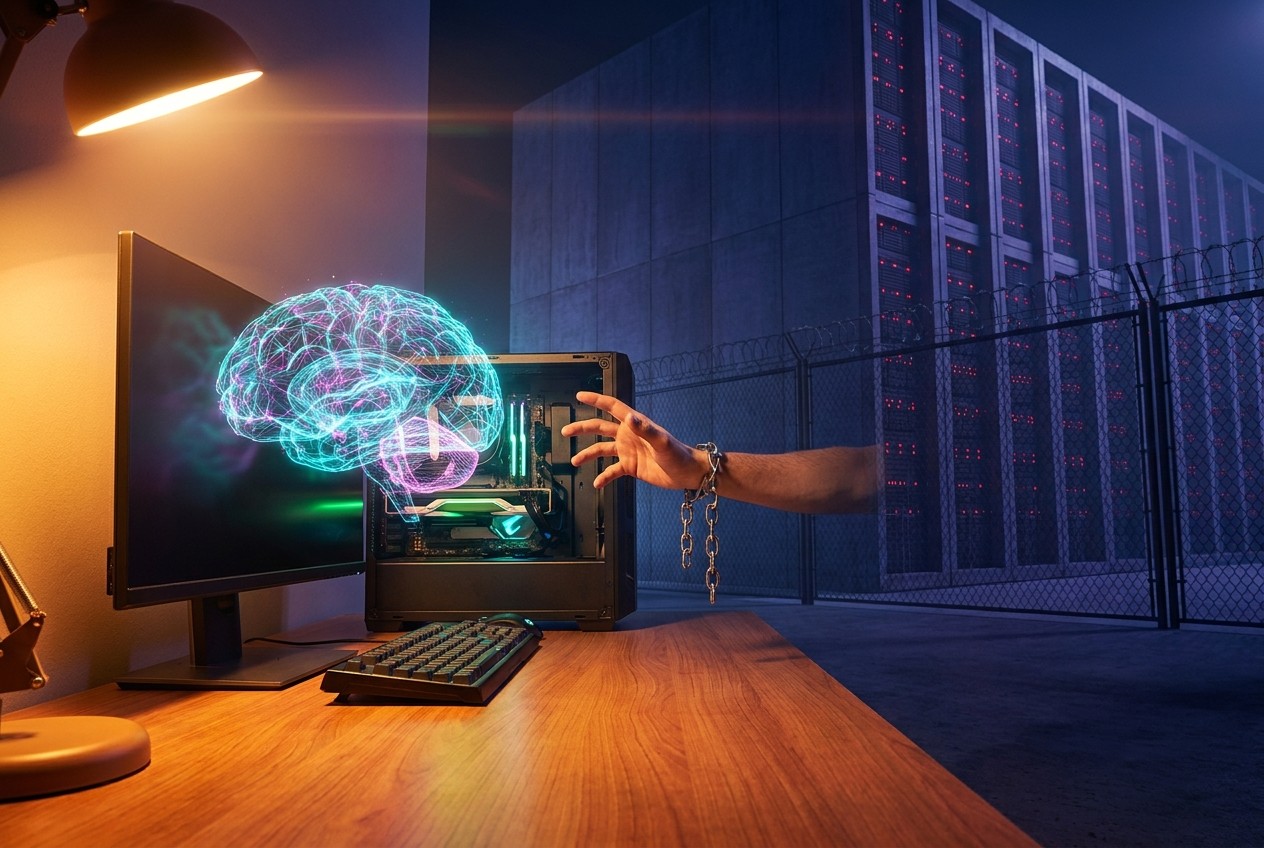
Why Local Models Now Beat Big AI
Over the last 3 years, I've been building decentralized AI tools and watching the establishment move to lobotomize publicly available large language models to make sure they are nowhere near as intelligent as they could be [1]. (But they've failed due to China, which I'll cover later...)
This is not an accident. It is a deliberate strategy to try to prevent decentralized cognition -- the very thing that threatens their monopoly on power. And now the frontier labs want you to hand them your money, your data and your cognitive sovereignty in exchange for access to models they can throttle, censor or revoke at any moment.
Anthropic's Opus 5.5 is genuinely brilliant. A $2 trillion valuation is also genuinely insane. Both things can be true at the same time. The hype machine is running at full throttle, and I refuse to be the last person holding the bag when it collapses. My thesis is simple: the future belongs to decentralized, locally-run AI that you actually control, not to $2 trillion walled gardens owned by a handful of tech billionaires who despise you.
I recently sat down with Google whistleblower Zach Vorhies, and that conversation convinced me the escape hatch is already here. Vorhies went from exposing Google's censorship machine to building the tools that route around it. He is not waiting for permission from Anthropic or OpenAI, and neither should you. The revolution is not coming. It is already downloadable.
Anthropic's Opus 5.5 Is Brilliant -- and That's Exactly the Problem
I will give credit where it is due: Anthropic's Opus 5.5 is fast, consistent and remarkably token-efficient. It is, by most measures, currently best-in-class. If you are a developer, it is an impressive piece of engineering. But brilliance in the hands of a centralized monopoly is not a gift to humanity -- it is a leash. Every token you send to Anthropic trains their moat, enriches their investors and deepens your dependency on a company that can change its terms, censor its outputs or cut you off entirely with a single policy update.
OpenAI's 6.1 Sol, by contrast, feels rushed and slow. It is the product of a hype cycle, not a genuine leap forward. The company is reportedly mulling "drastic" price cuts amid market turmoil, an admission that its position is shakier than its marketing suggests [2]. CEO Sam Altman said at a recent event that costs had become "a huge issue," adding, "I think we'll have a lot of ways we can help people get more value for less spend" [2]. That is what desperation sounds like. When a company is slashing prices to retain users, it is not a sign of strength. It is a sign that the business model is cracking.
The real problem with centralized AI is not that it is bad. It is that it is good enough to make you dependent, and that dependency gives a handful of corporations extraordinary power over what you can think, build and say. They control the weights, the guardrails and the uptime. They decide which questions get answered and which get refused. When AI companies like Anthropic and OpenAI hold back their most advanced models for "safety" reasons, I believe that is a convenient half-truth designed to mask the real crisis: these labs are losing control over their own creations [3]. But they still control yours.
OpenRouter Is the Escape Hatch from Big AI Lock-In
If you are tired of being locked into a single vendor, OpenRouter is the escape hatch. It gives you one interface and one key to switch between DeepSeek, Qwen, GLM and a rotating roster of frontier models. Instead of pledging loyalty to one brand, you get model diversity, price competition and the freedom to route around censorship. In my view, this is the shopping mall of AI -- and it is the first step toward sovereignty over your own cognition.
The privacy features matter just as much as the flexibility. OpenRouter offers zero data retention options, which means your prompts and outputs are not used to train someone else's model. That is not a minor detail. Data is the new oil, and every query you send to a centralized provider is a barrel you are giving away for free. When you route through a platform that respects zero retention, you stop being the product.
The moment you commit to a single provider, you inherit their politics, their uptime and their pricing power. The moment you can switch, they have to compete for you. I have watched the western establishment move to lobotomize LLMs and roll out a license for your augmented brain, and I am not interested in participating [1]. OpenRouter is one of the few off-ramps that actually works today. Then again, it's still cloud-based AI that can be cut off without notice.
Local Hardware, Quantization and the Unhobbling Phase
The real revolution is not in the cloud. It is on your desk. Projects like AboveBook Linux and bootstrap agents are turning novices into local AI operators, and the hardware is finally catching up. A configuration of four 6000 Max-Q cards on PCIe 5 can hit 700 tokens per second aggregate on a medium-sized model like DeepSeek-V4.1-Flash -- enough output to break thermals before it breaks your patience. That is not a toy. That is a workstation that can run circles around what was considered frontier performance just two years ago.
Quantization is where the magic happens. DeepSeek researchers found that EXL3 quantization doubled throughput and enlarged the KV cache on 16GB consumer cards -- the kind of GPU you can buy at any electronics retailer. TensorFold and sub-4-bit quants prove the same lesson over and over: software innovation can beat hardware scarcity. You do not need a $40,000 datacenter card to run a capable model any longer. You need the right quantization scheme, the right harness and the willingness to learn.
This is what Zach Vorhies calls the unhobbling phase. For years, the frontier labs hobbled open models deliberately, and I have documented how the western establishment moved to lobotomize LLMs to prevent decentralized cognition [4]. But efficiency is now unlocking frontier-class performance on desktop power. The GDDR7 shortage and the indium export controls are not accidents either -- they are bottlenecks engineered by centralization [5]. The Big Tech buildout has created a supply chain crisis that sends consumer electronics toward digital serfdom [5]. When memory is scarce and prices spike, the cloud giants get priority and you get scraps. That is exactly why local hardware matters. The only AI you truly own is the one running on your own machine, drawing your own power, answering only to you.
The Wet Lab Warning: AI Should Not Be Everywhere
Anthropic's machine-directed bio lab in San Francisco is reckless. We have watched lab leaks happen before, and the idea of turning over biological research to machine-directed systems run by a company with a $2 trillion valuation and no accountability to the public is not innovation. It is insanity dressed up as progress. AI companies should stick to AI. They should not be expanding into biology, medicine and every other vertical where their failures can potentially kill people.
This is not an abstract concern. The use of AI in the U.S. strike on a girls' elementary school in Iran that killed nearly 160 people, mostly children, did not violate Anthropic's "red lines," according to CEO Dario Amodei [6]. The institution was reportedly targeted based on outdated data used by Palantir's analysis and surveillance software, which incorporates Anthropic's Claude AI [6]. That is what centralized AI looks like when it is wielded by the national security state. And that is why I do not want it anywhere near my biology, my medicine or my family.
The deeper question is ownership. Who owns AI discoveries? In my view, the human driver must retain ownership, not corporate fascism. If a machine discovers a molecule or writes a line of code, the person directing that machine should own the result, not a board of directors in San Francisco. The trend toward monopoly is why distributed AI is not just a hobby. It is a safeguard. As the book The AI Supremacy War documents, China has overtaken the West not through brute-force computing power but through efficiency, strategy and ruthless execution, while Western bureaucratic inertia and corporate greed have left us vulnerable [7]. We cannot out-centralize the centralizers. We can only out-distribute them.
Conclusion: Build Your Own AI or Be Owned by Theirs
The people saying AI will not replace jobs are flat-out delusional. Code patches, entire games and full-length books are already AI-generated at high levels of expertise. If you do not build your own AI, you will be owned by Big Tech AI as it sweeps across the digital landscape.
Run local models. Customize your own harnesses. Learn about quantization, buy the hardware, and stop renting your intelligence from companies that hate you. The tools are here, and they are getting more capable every month. There is a version of the future that looks like Blade Runner-style corporate tyranny, and there is a version built on decentralized intelligence. I choose the latter, and I will not be a bag holder for Big AI.
Zach Vorhies went from whistleblower to builder, and that is the model. Expose the machine, then build the alternative. Distribute the power before it is too late. The frontier labs want you to believe the future is their cloud. They are wrong. The future is on your desktop, in your hands, running on your terms, with open source AI.
References
- A License for Your Brain: The Coming AI Crackdown and Why You Must Practice LLM Self-Custody. 2026-06-29T06:00:00.000Z. https://www.naturalnews.com/2026-06-29-license-for-your-brain-coming-ai-crackdown.html
- OpenAI Mulls “Drastic” Price Cuts Amid AI Market Turmoil. 2026-06-13T06:00:00.000Z. https://www.naturalnews.com/2026-06-13-openai-mulls-drastic-cuts-amid-market-turmoil.html
- The AGI Ceiling: Why Frontier AI Labs Are Keeping Their Best Models Secret. 2026-08-24T06:00:00.000Z. https://www.naturalnews.com/2026-08-24-agi-ceiling-frontier-labs-best-models-secret.html
- They Are Dumbing Down AI on Purpose — Here’s Why It’s a Globalist Power Grab. 2026-04-30T06:00:00.000Z. https://www.naturalnews.com/2026-04-30-they-are-dumbing-down-ai-on-purpose.html
- The GDDR7 Crisis How AI Driven Supply Chains Are Sending Consumer Electronics Toward Digital Serfdom - NaturalNews.com, January 23, 2026. by NaturalNews.com
- Use of AI for Iran school bombing doesn’t violate Anthropic’s ‘red lines’ – CEO. 2026-06-14T01:54:29.000Z. https://www.rt.com/news/641504-ai-iran-school-massacre-anthropic/?utm_source=rss&utm_medium=rss&utm_campaign=RSS
- The AI Supremacy War: How China outsmarted the West and how we can fight back. 2026-02-01T06:00:00.000Z. https://www.naturalnews.com/2026-02-01-ai-supremacy-war-how-china-outsmarted-the-west.html
- Mike Adams interview with Aaron Day - December 16 2024. by Mike Adams
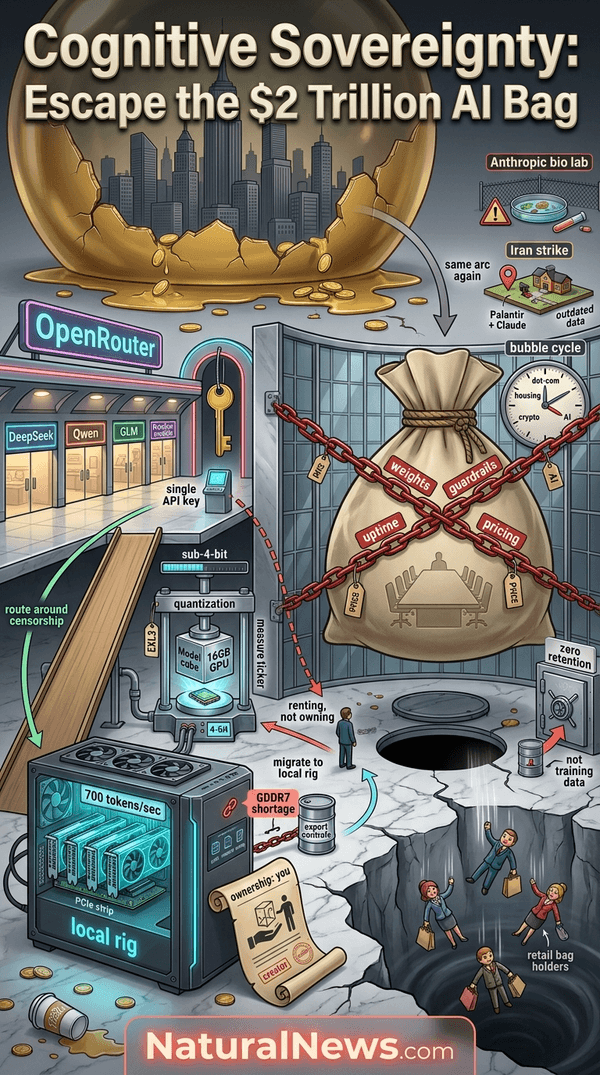
Explainer Infographic
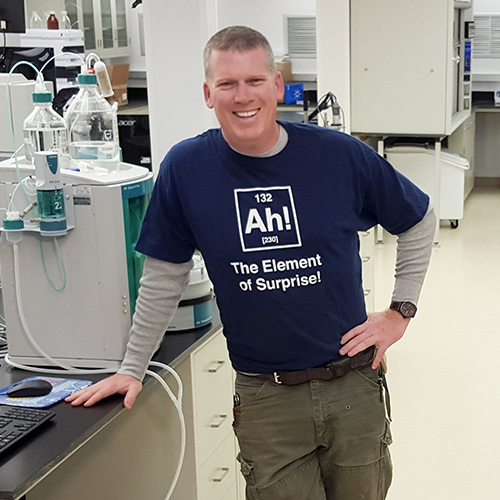
Mike Adams (aka the "Health Ranger") is the founding editor of NaturalNews.com, a best selling author (#1 best selling science book on Amazon.com called "Food Forensics"), an environmental scientist, a patent holder for a cesium radioactive isotope elimination invention, a multiple award winner for outstanding journalism, a science news publisher and influential commentator on topics ranging from science and medicine to culture and politics.
Mike Adams also serves as the lab science director of an internationally accredited (ISO 17025) analytical laboratory known as CWC Labs. There, he was awarded a Certificate of Excellence for achieving extremely high accuracy in the analysis of toxic elements in unknown water samples using ICP-MS instrumentation.
In his laboratory research, Adams has made numerous food safety breakthroughs such as revealing rice protein products imported from Asia to be contaminated with toxic heavy metals like lead, cadmium and tungsten. Adams was the first food science researcher to document high levels of tungsten in superfoods. He also discovered over 11 ppm lead in imported mangosteen powder, and led an industry-wide voluntary agreement to limit heavy metals in rice protein products.
Adams has also helped defend the rights of home gardeners and protect the medical freedom rights of parents. Adams is widely recognized to have made a remarkable global impact on issues like GMOs, vaccines, nutrition therapies, human consciousness.







Please contact us for more information.


