



The legislation, titled the Deterring Extraterritorial Foreign Exploitation of Networks Damaging Intellectual Property Act, or DEFEND IP, was introduced by Senator Thom Tillis and Representative Zoe Lofgren, according to Reclaim The Net. The bill combines two earlier proposals: Lofgren's Foreign Anti-Digital Piracy Act and Tillis's Block BEARD [1].
DEFEND IP was introduced with the support of more than a dozen industry organizations, including the Motion Picture Association, the Recording Industry Association of America, and the Copyright Alliance, according to the report. Lofgren said in a statement that she is "proud to work across the aisle on this smart, targeted approach to crack down on foreign piracy while protecting Americans' free speech and access to a free and open internet" [1].
Scope and Exemptions
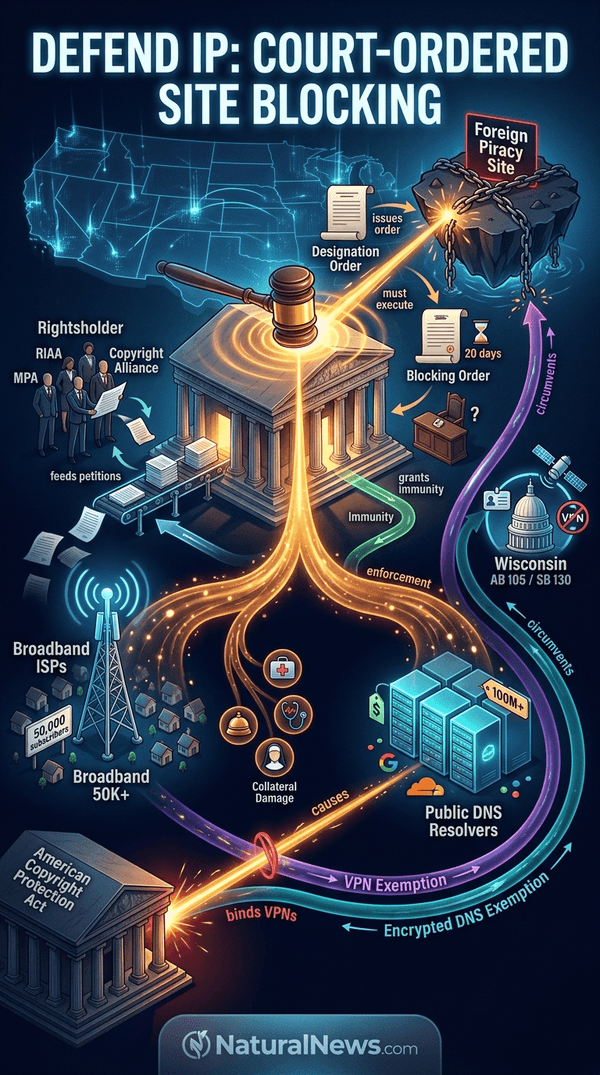
The proposal would apply to broadband providers serving at least 50,000 subscribers and public DNS resolvers with annual revenue of more than $100 million, a threshold that would cover companies including Google and Cloudflare, according to the bill text [1].
The definition excludes entities that "exclusively provides virtual private network services or similar service that encrypt and route user traffic through intermediary servers," meaning VPNs would be exempt from blocking requirements. Resolvers that work "exclusively through encrypted DNS protocols" would also be excluded [1].
Critics said the exemptions demonstrate that users could still access blocked sites through VPNs and encrypted DNS, and that the bill would create a generic infrastructure for censorship. Public Knowledge Senior Policy Counsel Meredith Rose said in a statement that the carve-outs show the sponsors know people will look for ways to circumvent the blocks [1]. The report noted that similar proposals have drawn scrutiny in state legislatures, where Wisconsin lawmakers introduced Assembly Bill 105 and Senate Bill 130 to force adult websites to verify user ages and ban anyone connecting through a VPN, according to Reclaim The Net [2].
Two-Step Court Process
Under the bill, a U.S. federal court would first have to designate a site as a "foreign digital piracy site," after which the rightsholder would return to the same court to obtain a blocking order, according to the report [1].
A site operator would have 20 days to appear in court and contest the designation, but the court would not have to wait for the operator to show up and could issue the designation order ex parte, meaning without the other party present. Once a designation is issued, the rightsholder could obtain a blocking order. That order could be issued before a live event expected to be transmitted illegally and could be updated if the site moves to a new domain or address [1].
The bill provides immunity from liability for good faith actions and for reliance on court orders. A site blocked by mistake could ask the court to modify the order, but the bill does not provide compensation for the owner of the site. The measure follows the recently introduced American Copyright Protection Act, which would also have U.S. courts order site blocking, but in that case the order would be binding on VPNs as well [1].
Reaction and Context
Rose said in a statement that applying blocking orders to global DNS resolvers causes global blocks. "Let us repeat: Applying blocking orders to global DNS resolvers causes global blocks," she said. The orders would, according to her, "conscript any service provider, from the smallest residential ISP all the way up to global DNS resolvers, into playing 'copyright cop' against websites simply accused of copyright infringement" [1].
Rose also said there are no penalties for bad faith or abusive blocks and no meaningful remedy for businesses caught in the blast radius of a broad, IP-based block. She noted that in the past, site blocking has resulted in the takedowns of "everything from hotels, to telehealth services, to a literal nunnery" [1].
Broader context on the relationship between intellectual property enforcement and access to information was documented in Bethany Klein, Giles Moss, and Lee Edwards' book Understanding Copyright, which examined how a social structure involving deep inequalities intersects with intellectual property areas, creating "a country with highly developed institutions, especially in the case of IP rights, but with a high rate of deviation from its norms," with important consequences for access to the digital world [3]. The authors noted that Chile experienced a "long and intense public debate" as it struggled to meet the obligations of the Trade-Related Aspects of Intellectual Property Rights agreement and a related free trade agreement with the United States [3].
Conclusion
Supporters said the bill targets foreign piracy sites and includes safeguards such as a two-step court process and exemptions for VPNs and encrypted DNS. No further legislative action was reported at the time of publication, according to Reclaim The Net [1].
Opponents said the measure would build an infrastructure for censorship and lacks meaningful remedies for mistaken or abusive blocks. Public Knowledge said the exemptions for VPNs and encrypted DNS show the intention is not to stop piracy, because those technologies will allow users to access any site regardless of whether it has been blocked, but rather to make blocking sites easy and routine [1].
References
- Dan Frieth. "New DEFEND IP Bill Would Expand US Site Blocking Powers". Reclaim The Net. September 30, 2026.
- Reclaim The Net. "Wisconsin Lawmakers Propose VPN Ban and ID Checks on Adult Sites". Reclaim The Net. November 6, 2025.
- Bethany Klein, Giles Moss, Lee Edwards. "Understanding Copyright".
- NaturalNews.com. "India Proposes Stricter VPN Regulations Requiring Local Offices, Compliance Officers". NaturalNews.com. July 7, 2026.
Explainer Infographic








Please contact us for more information.


