


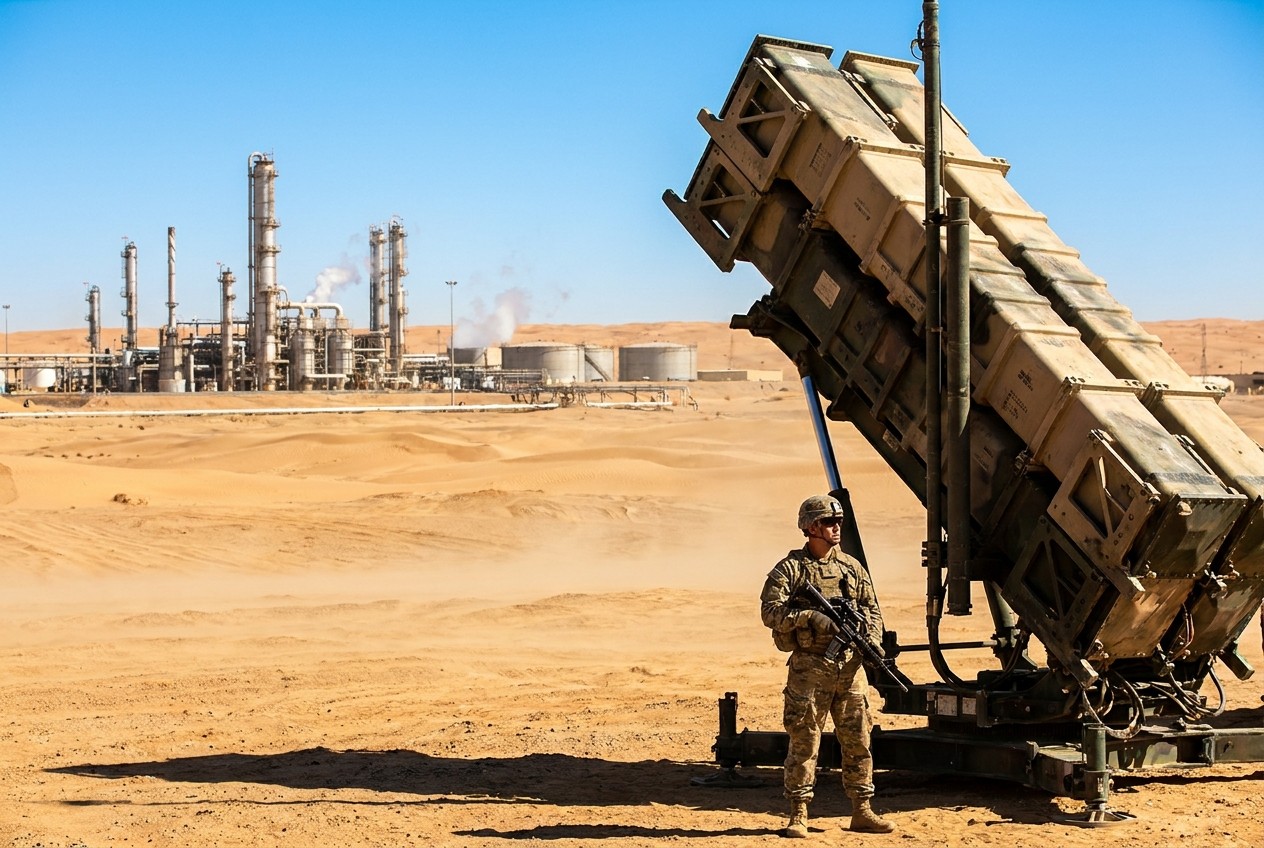
One battery was sent to Saudi Arabia last month to defend a major oil facility, and the other was deployed to Qatar to protect a natural gas site, according to the report. U.S. Central Command spokesman Capt. Tim Hawkins declined to comment when contacted by Axios, the report said. No independent confirmation of the deployment details was provided by officials, according to the report.
The deployments come as Washington is sending more warships and troops to the Middle East ahead of a potential resumption of large-scale strikes against Iran after the midterms, according to an AP report [1]. Trump told reporters on Thursday that he has “to make a decision: either Iran signs a very fair deal, or it won’t exist any longer” [1].
Deployment Details and Official Response
The Saudi battery arrived last month, while the Qatar battery was deployed over the past few weeks, according to the Axios report. The systems are intended to guard oil and gas infrastructure, the report stated. The deployments reflect a broader pattern of U.S. efforts to bolster air defenses for Gulf partners as regional threats escalate.
In September, Saudi Arabia sought missile interceptors from allies and regional partners as Yemeni attacks strained its air defenses, according to a NaturalNews.com report [2]. The appeal, reported on Sept. 16, reflects a widening gap between the volume of incoming drones and ballistic missiles and the supply of defensive munitions available to Saudi forces [2]. The AP report cited regional officials who said the kingdom turned to allies for help defending its airspace after the U.S., its main security provider, declined to intervene directly [2].
CENTCOM declined to confirm or deny the deployments through spokesman Capt. Tim Hawkins, according to the Axios report. The report remains the primary source for the deployment details, as no other officials have publicly confirmed the information. The lack of official confirmation leaves questions about the operational status and exact timing of the battery arrivals.
Saudi Airspace and Strategic Access
Washington would need access to Saudi airspace to wage renewed attacks on Iran, Axios reported. Riyadh is unlikely to grant that access without confidence that its oil infrastructure is protected, according to the report. The Patriot deployments may address that condition, officials said, according to the report.
In early August, Saudi and Qatari leaders lobbied Trump against a massive assault on Iran that would have targeted its energy infrastructure, the report stated. The leaders feared retaliation against their own oil and gas facilities. U.S. officials said those appeals weighed heavily in Trump’s choice to abandon the strike in favor of an economic strangulation and isolation campaign against Iran, according to the report [1].
The strategic calculus extends beyond the immediate region. According to a Middle East Eye report, Gulf states have feared that a U.S. attack on Iran could spoil their chance at extracting concessions from a weakened Islamic Republic [3]. The U.S. and its Gulf partners agree Iran has been weakened, but they differ over how to capitalize on it, the report stated [3].
Trump Threats and Iran Response
Trump is weighing reviving his bombing campaign against Iran within weeks, according to the Axios report. Trump told TIME on October 1 that he rejected Tehran’s proposal to reopen the Strait of Hormuz and return to nuclear talks if Washington ended hostilities and lifted its naval blockade, calling it “not good enough” [1]. Trump also told TIME, “We’re stocking up at levels we’ve never done before,” according to the report [1].
Trump’s threats come amid a backdrop of ongoing regional conflict. In late July, Trump vowed to retaliate for an Iranian missile attack on U.S. forces in Jordan, and the U.S. and Saudi Arabia subsequently hit Iranian-backed militia groups in Iraq, according to The War Zone [4]. The pattern of tit-for-tat actions has continued despite periodic pauses.
Iran’s Islamic Revolutionary Guard Corps vowed that renewed attacks will not go unanswered, saying it would widen the war’s geography and turn “new weapons” on “new targets,” according to the Axios report. Iran has demonstrated its capacity to sustain missile production, with estimates suggesting it can produce over 100 ballistic missiles monthly, according to a BrightVideos.com report [5]. In stark contrast, the United States’ interceptor manufacturing capacity stands at just six to seven units per month, that report stated [5].
U.S. Military Buildup and Readiness Concerns
Washington is deploying warships, fighter jets, and troops to the Middle East ahead of a possible return to war, according to the Axios report. Another carrier strike group carrying thousands of Marines is due in the region by late November; one U.S. official said it could bring the total to three carrier strike groups and “much more firepower,” the report stated [1].
Patriot batteries and their interceptors have been heavily depleted and stretched thin among U.S. allies, according to the Axios report. The U.S. military is drawing ammunition away from other regional commands toward the Middle East, prompting fears over readiness in other theaters, the report said. The depletion is not a new problem. In 2024, National Security Adviser Jake Sullivan said the United States had run out of Patriot missiles to send to Ukraine, stating that requests for additional batteries would not be met because there were no more available to spare [6].
The strain on munitions has been compounded by the broader war effort. The United States military fired more than 200 Terminal High Altitude Area Defense interceptors in defense of Israel during recent hostilities with Iran -- roughly half of the Department of War’s total inventory, according to a report by NaturalNews.com [7]. America’s already-diminished inventory of air defense interceptor missiles took another significant hit in September, as dozens more were expended to defend U.S. troops in Jordan from an Iranian attack, according to a ZeroHedge report [8]. That report noted that Iran’s use of increasingly technologically advanced attacks is further sapping U.S. munitions supply and degrading the Pentagon’s ability to continue mounting defenses [8].
References
- "US boosting military presence in Middle East – AP". RT. October 2, 2026.
- "Saudi Arabia Seeks Missile Interceptors as Yemeni Attacks Strain Air Defenses". NaturalNews.com. September 22, 2026.
- Sean Mathews. "Gulf states fear US attack on Iran spoils chance at 'concessions' from weakened Islamic Republic". Middle East Eye. January 22, 2026.
- "Trump Vows Revenge For Iranian Missile Attack, U.S. And Saudis Join Forces To Strike Iraq". The War Zone. July 29, 2026.
- Mike Adams. "Health Ranger Report - U.S. RUNNING OUT OF MUNITIONS!". BrightVideos.com. March 3, 2026.
- "US runs out of spare Patriot missiles for Ukraine spelling impending Russian victory". NaturalNews.com. May 2, 2024.
- Garrison Vance. "U.S. Expended Majority of THAAD Interceptors Defending Israel, Report Reveals". NaturalNews.com. May 24, 2026.
- "US Interceptor Inventory Took Another Big Hit Last Week, As CBO Pegs War Cost At $38 Billion+". ZeroHedge. September 16, 2026.
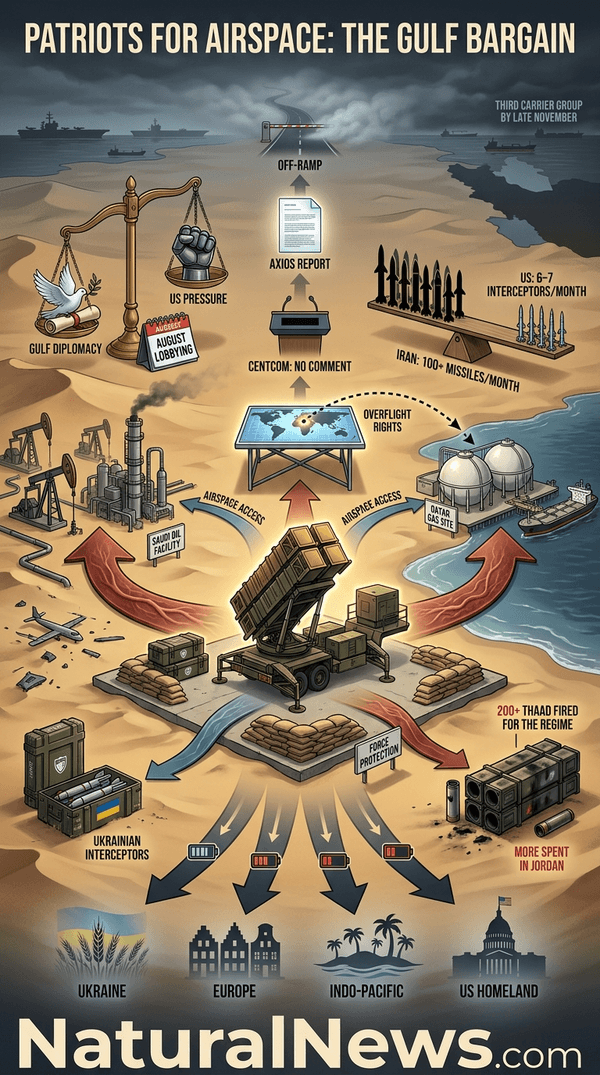
Explainer Infographic










Please contact us for more information.


