


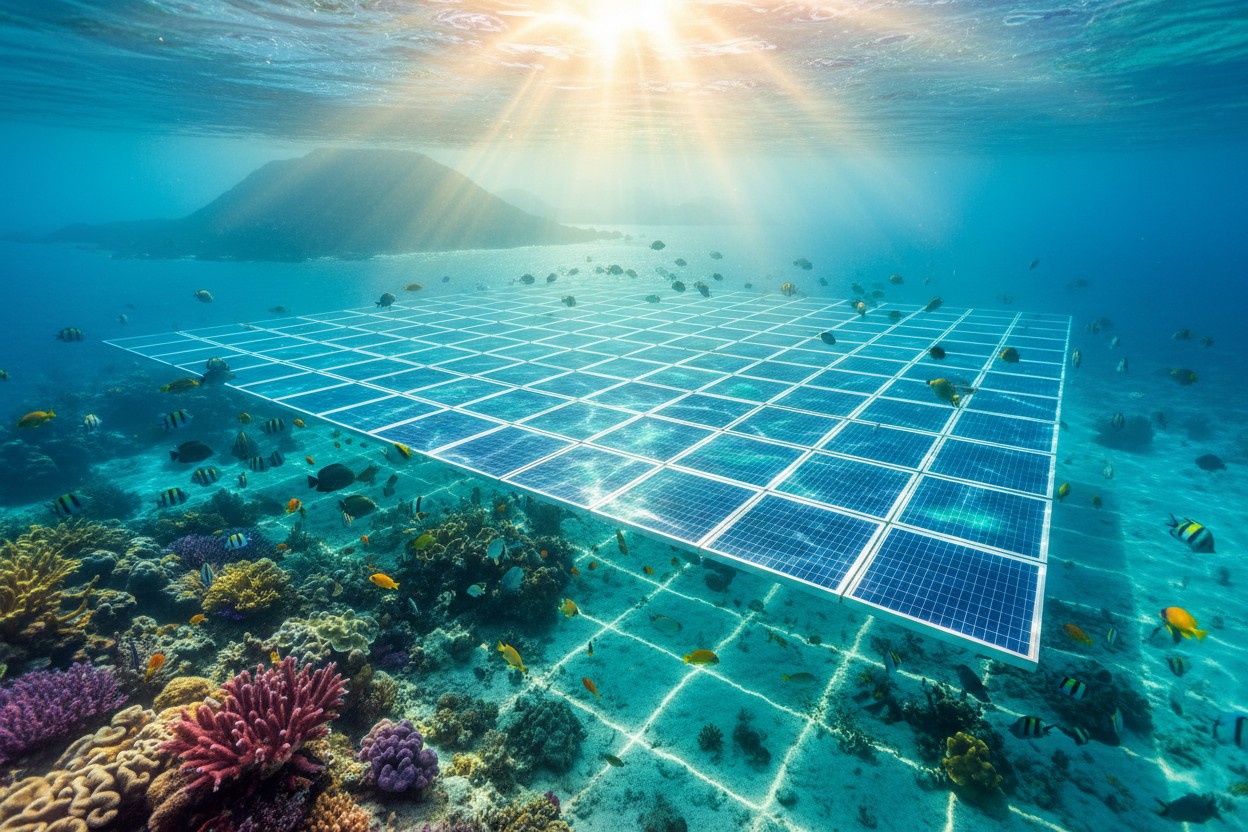
The researchers described the test as a new record for photovoltaic research. They employed perovskite-based solar cells rather than conventional silicon and adjusted them to capture the blue and green wavelengths of sunlight that penetrate the ocean surface.
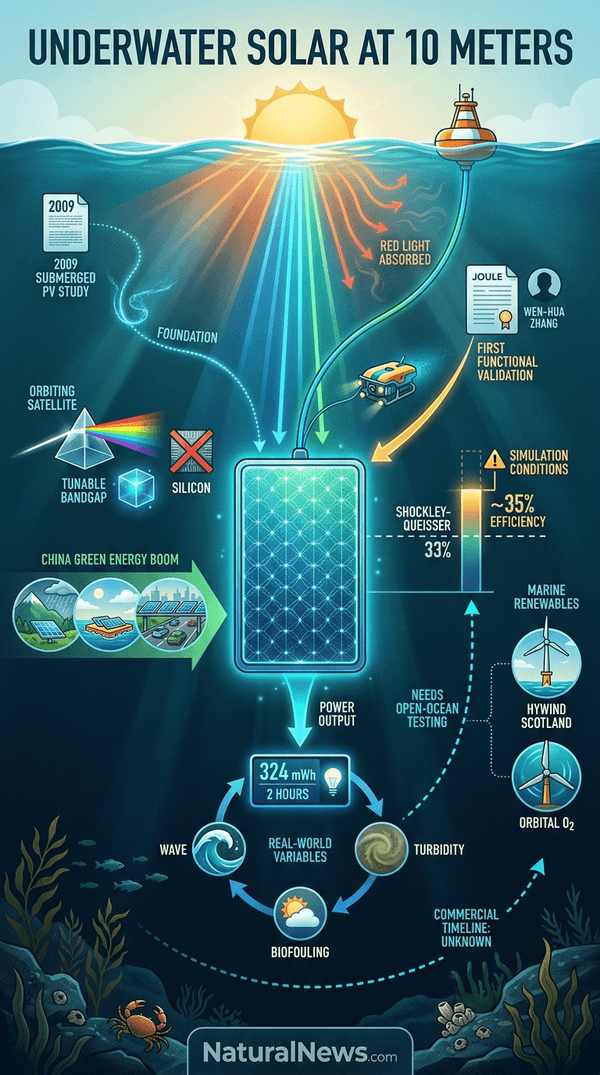
According to the published paper, the submerged cells generated power for two hours and produced 324 milliwatt-hours of electricity. The authors described the outcome as the first functional validation of submerged solar cells operating at a water depth of up to about 10 meters, a result they said broadens the potential application scope for photovoltaics. EuroNews reported that the electricity output far surpassed the researchers' expectations.
The test site near Weizhou Island places the experiment within a broader push by China into renewable energy deployment. China's green energy boom has seen solar panels installed on rainy mountains, on floating coastal platforms, and above bustling highways, according to EuroNews. The underwater trial adds a new dimension to that pattern of deployment.
Study Results and Efficiency
The paper reported that peak power conversion efficiency – a measure of how much sunlight striking a panel is converted into usable energy – reached nearly 35% under simulation conditions. That figure sits above the Shockley-Queisser limit, a long-established theoretical cap that has limited photovoltaic efficiency to about 33%, according to the study. If confirmed, such a result would place the submerged cells in line with recent breakthrough research in solar cell efficiency.
The efficiency measurement was obtained under simulation conditions rather than in an open-ocean environment, the paper stated. That distinction matters because simulated conditions may not replicate the variables present in real seawater – including wave action, turbidity, biofouling and variable sunlight. The study's authors acknowledged that more rigorous testing will be needed to confirm whether similar results are possible outside the laboratory setting.
Researcher Comment and Limitations
Study author Wen-Hua Zhang, a professor of material science at Yunnan University, said in the published paper: "This work presents the first functional validation of submerged solar cells practically operating at a water depth of up to about 10 meters, greatly broadening their application scope." The paper stated that the results were obtained under simulation conditions and that more rigorous testing is needed to confirm real-world performance.
Commercial development of the technology is likely a long way off, according to EuroNews. No timeline for commercial deployment was announced by the researchers or their institutions.
Despite the limitations, the study's authors suggested the research could lay the groundwork for solar panels operating in rarely traveled portions of the world's oceans. The concept aligns with prior research into submerged photovoltaic behavior.
A 2009 study published in Solar Energy Materials and Solar Cells examined the behavior of a photovoltaic panel submerged in water, focusing on spectral efficiency and related factors [1]. That earlier work established a foundation for understanding how solar cells respond when placed beneath the surface.
Context of China's Solar Expansion
China's green energy boom has placed solar panels on rainy mountains, on floating coastal platforms, and above highways, according to EuroNews. The underwater test adds to a series of photovoltaic applications reported in the country in recent years. China's expanding role in renewable energy manufacturing and deployment has drawn attention from analysts tracking global energy markets.
The broader context of offshore and marine renewable energy includes projects such as the Hywind floating wind farm off Scotland, which recorded a 65% capacity factor and demonstrated the potential of offshore renewable installations [2]. Other marine energy projects, including the Orbital O2 tidal turbine anchored near Orkney, have shown that underwater generation equipment can deliver power to shore [3].
Outlook
Further testing is required to verify whether similar results are possible in a real-world setting, according to the study. The authors stated that simulation conditions were used for the reported efficiency and output figures, and that these conditions may not fully represent ocean environments.
No timeline for commercial development was provided. EuroNews reported that commercial development on this research is likely a long way off. The research may inform future ocean-based solar applications, according to the study authors, particularly for remote or underutilized marine locations.
The results add to a growing body of work on photovoltaic performance in non-standard environments. A 2010 study in Energy Conversion and Management noted that commercial solar cells reach maximum conversion efficiencies of 20% to 21% under conventional conditions [4], a benchmark that contextualizes the reported underwater figure. Whether the underwater approach can be scaled, and at what cost, remains an open question that only further testing can address.
References
- Wilkins, Joe. "Scientists Unveil Underwater Solar Panels". Futurism.com. September 29, 2026.
- Saueurs, Craig. "Can solar power work underwater? Scientists test solar panels 10 metres beneath the sea". EuroNews.com. September 27, 2026.
- M. Rosa-Clot; P. Rosa-Clot; G.M. Tina; P.F. Scandura. "The behavior of a photovoltaic (PV) panel submerged in water". Solar Energy Materials and Solar Cells. 2009.
- NaturalNews.com. "Floating wind farm in Scotland is beginning to show the positive impact of offshore wind farming". NaturalNews.com. June 06, 2018.
- NaturalNews.com. "Worlds most powerful tidal turbine starts generating electricity". NaturalNews.com. August 02, 2021.
- S. Ould-Amrouche. "Modelling photovoltaic water pumping systems and evaluation of their CO2 emissions mitigation potential". Energy Conversion and Management. 2010.
Explainer Infographic











Please contact us for more information.


