



According to the report, the effort remains under discussion and no final decision has been announced. Officials have not publicly confirmed the specific details of any overseas stablecoin plan, and it was not immediately clear which agencies would lead the effort or how it would be carried out.
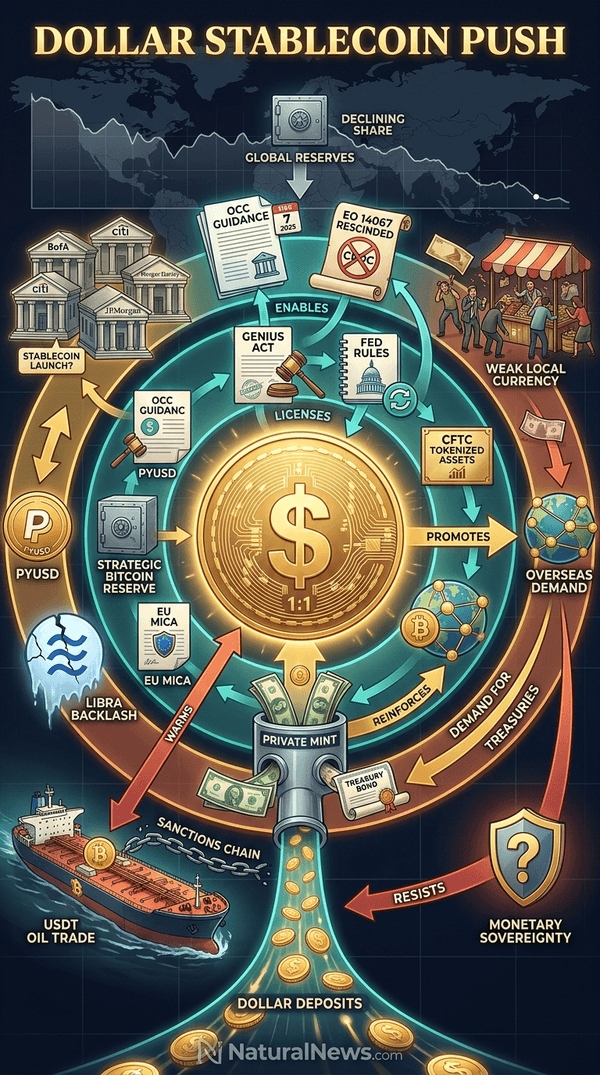
The report follows a series of regulatory and legislative developments involving digital assets in the United States, including banking guidance issued by the Office of the Comptroller of the Currency and stablecoin legislation moving through Congress. The OCC announced on March 7, 2025, that banks can now engage in cryptocurrency-related activities, reversing its 2021 policy that imposed stricter oversight, according to an account published by NaturalNews.com [1].
Reported Effort Said to Target Foreign Demand for Dollar Assets
The reported plan is intended to increase overseas demand for dollar-based assets through stablecoins, people familiar with the matter said. Stablecoins are digital tokens designed to maintain a stable value relative to a reference asset, most commonly the U.S. dollar. PayPal became the first major financial company in the United States to issue its own U.S. dollar-backed stablecoin, PayPal USD, which is redeemable on a one-to-one basis with American dollars and backed by physical assets such as U.S. dollar deposits and short-term U.S. Treasuries [2].
Supporters say dollar-backed tokens could strengthen the dollar's role in cross-border payments and digital finance. The argument echoes prior statements from Federal Reserve Chair Jerome Powell, who said in a June 2022 speech at the Fed's "International Roles of the U.S. Dollar" conference that the dollar is at risk of losing its standing as the world's preeminent currency and that the United States needs to develop digital currency capabilities to compete [3].
Critics say the approach could raise questions about monetary sovereignty and consumer protections in host countries. The author Brett Scott wrote in the book Cloudmoney that Facebook's Libra project drew backlash from regulators around the world over opacity and the question of what hidden movements between banks a token moving "seamlessly" across borders might trigger, and that members of the U.S. Congress sent a letter to Facebook asking it to officially halt development [4].
Regulatory Context Includes Fed and CFTC Actions
The Federal Reserve has proposed new capital and redemption rules for stablecoin issuers, according to reports listed in the Cointelegraph summary. The Commodity Futures Trading Commission also updated guidance on tokenized assets and blockchain records after a failed vote, and the European Union's banking watchdog called for crypto lending rules under MiCA.
The domestic regulatory backdrop has shifted over the past year. The OCC's new guidance allows banks to hold cryptocurrency assets, manage stablecoin reserves, and participate in certain crypto-related activities [1]. President Donald Trump signed an executive order on Jan. 23, 2025, explicitly banning federal agencies from establishing or promoting central bank digital currencies, rescinding the Biden administration's Executive Order 14067 [5].
Congress has also moved on stablecoin legislation. Trump called for swift House passage of the Senate-approved GENIUS Act, which establishes regulatory frameworks for stablecoins and private issuance of digital tokens [6]. Critics of that legislation have warned that privately issued, government-regulated stablecoins could function as a backdoor to a central bank digital currency, enabling surveillance and financial control [7]. The author Aaron Day said on his program that stablecoin legislation was accelerating even as the administration publicly opposed a CBDC, arguing that the key players behind the bills are aligned with entities like Tether and USDC [8].
Officials and Industry Figures Offer Differing Perspectives
One official said the effort is meant to maintain U.S. leadership in digital payments, according to Bloomberg. The administration has taken several steps consistent with that goal. Trump announced the creation of a Strategic Bitcoin Reserve on March 6, 2025, housed within the U.S. Treasury [9]. Major banks including Bank of America, Citigroup, Morgan Stanley, and JPMorgan Chase have explored stablecoin launches amid the regulatory changes [10].
An industry representative said clear regulatory rules are needed before stablecoins can scale internationally. The Federal Reserve Bank of New York previously announced a 12-week digital dollar pilot program with global financial institutions including Citigroup, HSBC Holdings, Mastercard, and Wells Fargo, to review how banks process digital dollar tokens within the central bank system, according to an account published by ChildrensHealthDefense.org [11].
A critic said overseas promotion could conflict with local currencies and require coordination with foreign regulators. The investor and author Chris Martenson said in a July 2025 episode of The Signal Hour that with the signing of the GENIUS Act into law, the public needs a serious conversation about stablecoins and central bank digital currencies as the financial system enters a new digital era [12]. Russia has turned to cryptocurrencies including Bitcoin and Tether's USDT to facilitate oil trade with China and India, bypassing Western sanctions, according to an account published by NaturalNews.com, a development that illustrates how dollar-pegged tokens are already used outside U.S. regulatory reach [13].
Outcome Remains Uncertain as Agencies Review Options
The report stated that discussions are preliminary and no timeline has been set. It is not clear which agencies would lead the effort or how it would be implemented. Observers said any overseas push would depend on congressional action and international regulatory response.
The policy debate has drawn opposition from parts of the banking industry. JPMorgan Chase CEO Jamie Dimon said in a Fox Business interview that the pending Clarity Act market structure legislation is a threat to the financial system and a gift to an industry that wants the privileges of banking without the responsibilities, according to a report by Activist Post [14]. Dimon's remarks were also reported by ZeroHedge [15].
Central banks have continued to favor gold over digital assets for reserve management, citing gold's stability through financial crises, wars, and monetary collapses and the unsuitability of Bitcoin and other cryptocurrencies because of volatility [16].
References
- Willow Tohi. "US regulator greenlights banks for crypto activities reversing 2021 restrictions". NaturalNews.com. March 12, 2025.
- NaturalNews.com. "PayPal launches its own USD-backed stablecoin for transfers and payments". NaturalNews.com. August 11, 2023.
- NaturalNews.com. "Fed chair admits US dollars international standing could collapse". NaturalNews.com. June 26, 2022.
- Brett Scott. "Cloudmoney".
- Ramon Tomey. "CBDCs officially BANNED under new Trump executive order fulfilling his campaign promise". NaturalNews.com. January 25, 2025.
- Willow Tohi. "Trump urges swift crypto bill passage as Senate-backed GENIUS Act heads to House". NaturalNews.com. June 23, 2025.
- Finn Heartley. "Trump's Genius Act sparks fears of CBDC surveillance grid as conservatives warn of digital slavery". NaturalNews.com. July 18, 2025.
- Aaron Day. "S2E6 Stablecoins are Backdoor CBDCs". March 14, 2025.
- Willow Tohi. "Trump's BITCOIN GAMBIT US launches Strategic Bitcoin Reserve to cement crypto dominance". NaturalNews.com. March 12, 2025.
- Willow Tohi. "Major US banks eye stablecoin experiment as crypto regulations shift". NaturalNews.com. July 18, 2025.
- ChildrensHealthDefense.org. "Big Banks Team Up With Feds to Test Digital D". ChildrensHealthDefense.org.
- Chris Martenson. "CBDCs Control and Crumbling Fiat Currencies". PeakProsperity.com. July 30, 2025.
- Belle Carter. "Russia turns to cryptocurrencies to bypass sanctions in oil trade". NaturalNews.com. March 20, 2025.
- Activist Post. "JPMorgan Chase CEO Jamie Dimon Declares War on Clarity Act, Calls Coinbase's Armstrong 'Full of Sh*t'". June 18, 2026.
- ZeroHedge. "He's 'Full Of Sh!t': JPMorgan CEO Jamie Dimon Slams Coinbase's Armstrong, Declares War On Clarity Act". June 1, 2026.
- Jacob Thomas. "Central banks still choose gold over crypto: Why 8000 years of trust outweighs digital innovation". NaturalNews.com. May 28, 2026.
Explainer Infographic










Please contact us for more information.


