


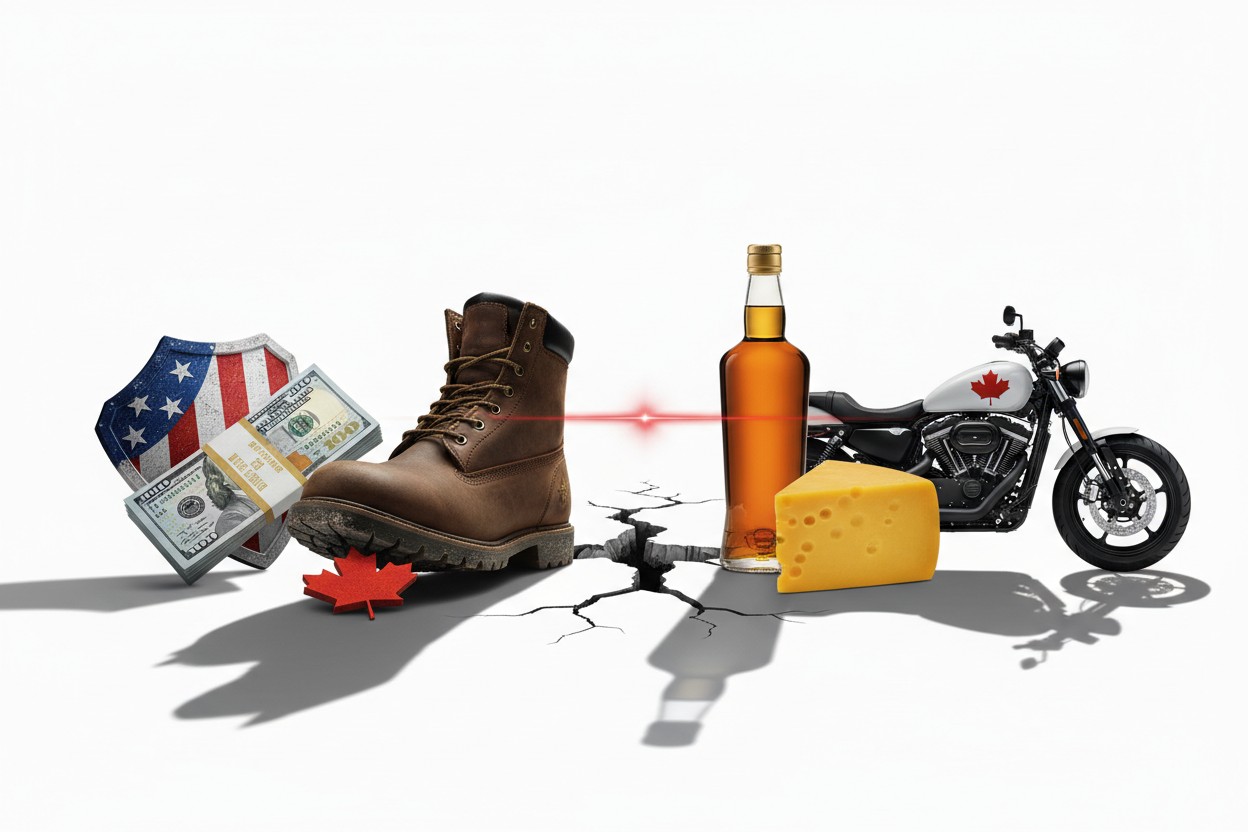
The measure represents the latest action in an escalating trade dispute, coming just days after Canada implemented retaliatory tariffs on roughly $20 billion worth of U.S. goods. The ban also extends to new federal procurement rules, which will exclude Canadian products from large U.S. government contracts – a move the Trump administration cites as a response to a lack of reciprocity in trade relations [1] [2].
The executive action targets specific categories, including Canadian wines and spirits, and follows a period of heightened tension between the two nations. The administration's announcement did not specify a path toward lifting the restrictions, indicating that they will remain in place until a broader trade agreement is reached. This move is the most recent in a series of tariffs and counter-tariffs that have disrupted the flow of goods across the border since talks broke down in late August [1] [2].
Background: Failed Talks and Retaliatory Tariffs
The current escalation traces back to Aug. 21, when bilateral trade negotiations collapsed. Following the breakdown, the U.S. imposed tariffs on a wide swath of Canadian products, which officials said covered about 50% of the roughly 5% of Canadian imports that were subject to the new levies.
The U.S. actions were justified by President Donald Trump's claim that Canada "wants the benefits of being a State, without being one," and accusations that Ottawa has long imposed excessive tariffs on American goods [3] . The dispute marks a sharp deterioration in a relationship that has historically been one of the world's closest economic partnerships [4].
Canada responded by announcing retaliatory tariffs on Tuesday, Sept. 8 targeting nearly $20 billion worth of American products, with rates of 15%, 25% or 50%. The Canadian list includes steel, aluminum, dairy products, appliances and farm equipment, according to the Canadian Department of Finance [1] [5].
These measures took effect on the same day, according to official statements. This tit-for-tat escalation reflects what analysts describe as a fundamental shift away from the framework of the U.S.-Mexico-Canada Agreement (USMCA), with the U.S. invoking Section 338 of the Tariff Act of 1930, a rarely used provision that allows for retaliatory duties [6] [7].
Canadian Leadership Response
Canadian Prime Minister Mark Carney has stated that the country will not capitulate to U.S. demands and will instead accelerate its efforts to diversify trade. "We will reduce our reliance on the United States," Carney said, framing the dispute as an impetus for greater economic independence rather than a reason to concede [8].
He acknowledged that the trade war will cause short-term economic pain for Canadian businesses but asserted that the long-term strategy involves building stronger ties with other global markets. This stance represents a continuation of Carney's earlier promises, where he noted tariffs would remain until Washington. shows "respect" for the trading relationship [9].
Carney's government has also signaled a willingness to adapt to a future where the U.S. market is less accessible. Officials have pointed to rising export numbers to other countries as evidence that the strategy can work, with some projections suggesting exports to non-U.S. markets could double within a decade.
This approach builds on earlier statements from Carney, who declared in March that the era of deep economic cooperation between the U.S. and Canada is "over," a direct response to the tariff actions [10] [11]. The Canadian leader is scheduled to address the European Parliament on Sept. 17, a sign of his focus on securing alternative trade relationships [1].
Details of Bans and Tariff Actions
The newly announced U.S. import ban specifically targets Canadian dairy products, which include whey and other ingredients, as well as most alcoholic beverages such as wines and spirits. Also included are motorcycles and mopeds, a category that directly impacts Canadian manufacturing, alongside molasses and other specific goods.
The exclusion from federal contracts applies to Canadian companies bidding on large-scale U.S. government projects, effectively shutting them out of a significant procurement market [2]. In response to the tightened U.S. market, Canada is exploring deeper economic ties with the European Union. A Canadian official, speaking on condition of anonymity, said the country is investigating possible new treaties or expanded agreements with Brussels to offset the loss of U.S. trade.
While the alcohol ban is a direct hit to Canadian producers, it also reciprocates earlier actions in the dispute. Earlier this year, Carney noted that U.S. liquor could return to Canadian shelves if progress was made on metals and automobile tariffs, indicating that these restrictions remain linked to broader negotiations [12]. U.S. and Canadian trade representatives are reported to remain in contact, but no formal talks have been scheduled since the collapse in August [1].
Wider Consequences and Public Sentiment
The broader consequences of the trade war are substantial, given that over 70% of Canadian exports are still destined for the U.S. market. This heavy reliance underscores the scale of the diversification challenge that Carney's government faces, as alternative markets cannot easily absorb the volume of goods currently shipped southward.
The uncertainty is already impacting business owners on both sides of the border, who report fears that a significant portion of their business will disappear if the tariffs and bans remain in place [13]. The political and public sentiment in Canada has hardened against the U.S. actions.
British Columbia Premier David Eby has announced the installation of border signs rejecting statehood, tapping into a wave of public anger over Trump's repeated suggestions that Canada should become the 51st state. The rhetoric has complicated the trade dispute, making it more difficult for either side to back down without appearing weak, according to former trade official Wendy Cutler.
The long-term outlook remains unclear, but with both sides appearing reluctant to reengage, the prospect of a quick resolution seems unlikely [1]. The historical context of U.S.-Canada trade disputes, such as the 1994 wheat disagreements, shows that these conflicts can be prolonged and damaging when they move beyond technical negotiations into political posturing [14].
References
- BBC News. "Canada braces for prolonged trade war as counter-tariffs on US take effect." September 8, 2026.
- RT.com. "Trump demands Canadian companies relocate to US." August 31, 2026.
- 100PercentFedUp.com. "President Trump Responds After Trade Negotiations With Canada Collapse." August 23, 2026.
- William R. Clement. "Quantum jump: a survival guide for the new renaissance."
- NaturalNews.com. "Canada Imposes Retaliatory Tariffs on U.S. Goods After Trump Trade Action." August 26, 2026.
- WardsAuto.com. "US slaps 50% tariffs on many Canada imports." July 21, 2026.
- RT.com. "Trump slaps 50% tariffs on Canada." July 21, 2026.
- 100PercentFedUp.com. "President Trump’s Transportation Secretary Warns Canada: This Trade War Will Be ‘Devastating’." August 23, 2026.
- Cassie B. "Canada refuses to lift tariffs despite Trump's postponement." NaturalNews.com. March 11, 2025.
- Cassie B. "Canadian prime minister declares US alliance over in defiant rebuke of Trump." NaturalNews.com. March 28, 2025.
- Cassie B. "Canadian Prime Minister Declares U.S.-Canada Alliance "Over" in Defiant Rebuke of Trump." NaturalNews.com. March 28, 2025.
- BBC News. "Canada's US booze boycott could be resolved if Trump addresses tariffs, Carney says." April 24, 2026.
- BBC News. "'Half my business will be gone' - Firms in Canada and US fear trade war." August 24, 2026.
- Ronald A. Babula, Cathy L. Jabara, John Reeder. "US/Canadian Dispute on US Imports of Wheat, Wheat Flour, and Semolina." Journal of Agricultural and Applied Economics.
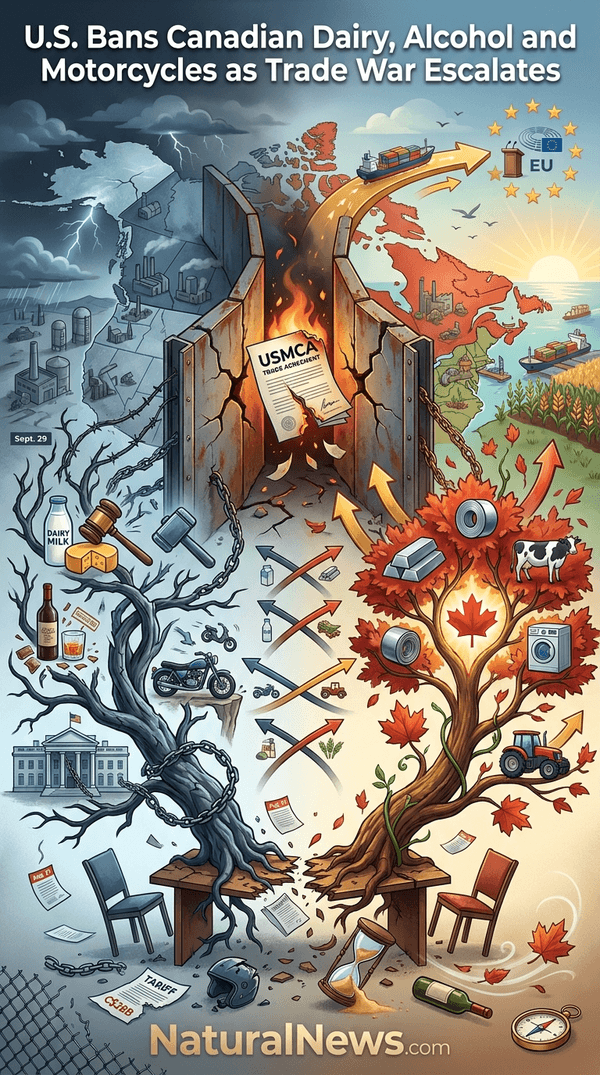
Explainer Infographic











Please contact us for more information.


