


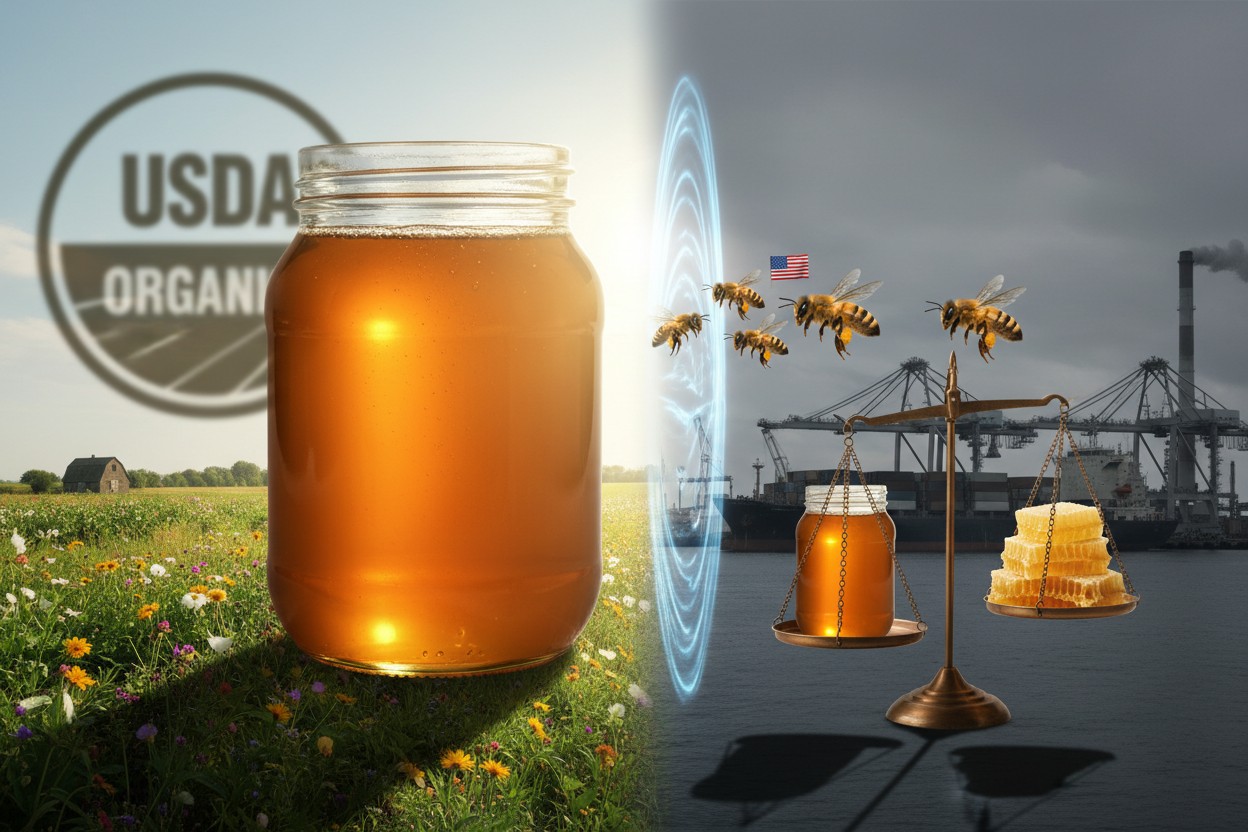
The complaint was filed in the U.S. District Court for the Eastern District of Washington by operations based in Washington, South Dakota, and Texas, according to the plaintiffs [1].
The lawsuit claims the practice misleads consumers, undermines domestic beekeepers, and violates federal organic law by creating a double standard for organic honey certification [1]. The beekeepers are seeking a court order to halt the alleged false labeling rather than monetary damages, according to the complaint [1].
Allegations of Certification Double Standard
The suit alleges that USDA organic standards require bees to forage within a 1.8-mile radius of certified organic land, a rule that makes large-scale organic honey production nearly impossible for most U.S. beekeepers [1]. Consequently, only four certified organic honey operations exist in the United States, all located in Hawaii, according to the plaintiffs [1].
This regulatory burden stands in contrast to the situation abroad, where foreign producers, particularly in Brazil, operate under less stringent rules that allow them to bypass USDA standards, the lawsuit alleges [1].
Experts note that the vast majority of apiary locations within the United States are not able to comply with organic regulations as currently written, and most locations that do conform tend to be in areas where bee forage is extremely limited [2]. As a result, little certified organic honey is currently being produced within the continental U.S., according to those familiar with the industry [2].
Imported Honey Dominates Market
Approximately 80% of honey sold in the U.S. is imported, according to OrganicEye, a nonprofit organization that monitors the organic industry [1]. U.S. beekeepers sold 116 million pounds of honey in 2025, down 14% from the prior year, while organic imports exceeded 78 million pounds during the same period, according to the lawsuit [1].
The complaint further states that roughly 60 million pounds of domestic honey remained unsold, with some producers holding up to three years' worth of inventory [1].
This market imbalance has created significant financial strain for domestic producers, who report difficulty competing with cheaper imported products [1]. The situation mirrors broader trends in the food industry, where imported products can be labeled in ways that obscure their origin and undermine domestic producers [3].
Loopholes in Certification Process
The lawsuit highlights specific loopholes in the certification process that allegedly allow foreign honey to bear the USDA organic seal. One such pathway is group certification, which permits large agricultural organizations to certify multiple producers without individual site visits [1].
This option is used abroad but is not available to U.S. beekeepers, according to the complaint [1].
Additionally, the U.S.-Canada Organic Equivalency Arrangement permits Canadian-certified honey to bear the USDA seal, despite differing standards on pesticide exposure and forage requirements between the two countries [1].
These pathways create a hidden certification route that lets foreign producers label honey as USDA organic without meeting the same standards applied to domestic producers, the lawsuit alleges [1]. The concern over inconsistent certification standards is not new; observers of the organic industry have previously documented cases where the USDA organic label was applied to products that did not meet expected standards [4].
Reactions and Calls for Change
Attorney Bruce Kaser, who represents the beekeepers, stated that consumers who rely on the organic seal are being defrauded and called for public awareness about the issue [1].
Meanwhile, Mark Kastel of OrganicEye said that imported organic products beyond honey face similar problems, and U.S. farmers cannot compete with cheaper imports that do not meet the same standards [1]. Kastel also noted that while the USDA spent $100 million on training new organic farmers, those farmers are set up to fail without a sustainable marketplace that enforces consistent standards [1].
The lawsuit directly challenges the federal agency's oversight of the organic label, which has become increasingly important to consumers seeking cleaner food options [5].
The lawsuit filed by U.S. beekeepers against the USDA centers on the allegation that the agency has created a two-tiered system in which foreign honey can be certified as organic under rules that are less rigorous than those applied to domestic producers [1]. The plaintiffs argue that this discrepancy violates federal organic law and misleads consumers who trust the USDA organic seal [1].
The outcome of this case could have significant implications for the organic food industry, which has seen consistent growth in consumer demand over the past two decades [6].
For domestic beekeepers, the stakes are clear: their economic survival depends on a fair and transparent certification process.
References
- The Defender. "U.S. Beekeepers Sue USDA, Alleging Imported 'Organic' Honey Misleads Consumers and Violates Federal Law." August 4, 2026.
- Conrad Ross. "Natural beekeeping: organic approaches to modern apiculture."
- Mercola.com. "Meat Deception: Imported Beef Masked as 'Product of the USA'." December 1, 2023.
- Mercola.com. "Organic Leaders Take Fight for Authentic Orga." December 14, 2017.
- NaturalNews.com. "Consumers continue to demand clean food as organic market has doubled since 2007." June 11, 2017.
- NaturalNews.com. "Demand for organic food creating new gold rush for producers." February 14, 2017.






Please contact us for more information.


