



Privacy Is a Basic Human Right
I've spent many years documenting the 'patterns of control, deception, and engineered collapse' [1] that define our age. The world is accelerating toward a precipice, and the nature of the threat has fundamentally changed. I believe secure communication is no longer a luxury -- it is a survival requirement in a surveillance state that is building the machinery of mass monitoring in plain sight.
Most people still trust Telegram, WhatsApp, and even Signal without understanding how their encryption keys and metadata are exposed. For years, I've been sounding the alarm about 'Big Tech's surveillance apparatus' [2]. Now the evidence is impossible to ignore. Forta.Chat enters this landscape as a decentralized alternative built on principles, not corporate compromise -- and I interviewed one of its key architects on Decentralize.TV
The Surveillance Grid Is Coming for Your Old Messages
Mass surveillance is not a distant threat. Data centers are being built at staggering scale to ingest and analyze private communications in real time. The question is not whether your old messages will be swept into this grid -- it's when.
Consider how fragile the entire infrastructure really is. When fiber optic cables were severed in Mississippi and Louisiana, 'America's 911 emergency systems collapsed for hours' [3], leaving thousands unable to call for help. If a few cuts can silence emergency services, what happens when the surveillance grid turns its full attention to the private words you shared ten years ago?
Old chats tied to phone numbers or identities will be used against you and your children to deny you a job, a loan, or a college admission. Every political remark, every private joke, every moment of doubt becomes a permanent training input for algorithmic judgment. The visioneers of the last century promised 'a limitless future' [4] of space colonies and boundless optimism. Instead, we got a surveillance grid that monitors every word you type. This is why I am convinced that any messenger storing keys on servers is a time bomb, no matter how strong its encryption claims are.
What Forta Does Differently: No Identity, No Keys, No Central Control
Forta.Chat takes a completely different approach. It does not require an email address, phone number, or name. The only identity anchor is a seed phrase that you control -- nothing more. There is no database of identities for a court to subpoena, no phone number to trace back to your doorstep.
Encryption and decryption happen peer-to-peer on your own devices, with zero keys stored on servers. Unlike Signal or Telegram, there is no central entity that can be coerced, raided, or compelled to betray its users. This is a radical departure from the model that Jack Dorsey's Bitchat pointed toward -- an 'encrypted platform [that] eliminates reliance on internet infrastructure' [5]. But Forta goes further by routing around censorship entirely.
The platform is federated, open source, and can route around blocked networks using Tor and Snowflake bridges. This means 'encrypting all communications at every level, including when they pass through cell towers and mesh networks' [6]. Even when authorities try to shut down internet access, the messages still flow. And it runs on ordinary phones -- as I discussed in my interview with Jason Crowe, a compact decentralized protocol 'fits onto many mobile devices' [7] without draining battery or consuming excessive computing resources.
Beyond Messaging: Resilience and Economic Sovereignty
Forta is designed to keep working even when normal networks are blocked. Future integration with Meshtastic radio will enable offline mesh communication, so you can pass messages across a grid that has no internet at all. 'When centralized systems collapse,' [8] the most effective rescue force will not arrive in government vehicles -- it will be the neighbor next door. Forta turns that principle into free, open source software.
Built-in local AI assistants give users practical knowledge even when the internet is gone, and Pocket Coin integration offers a simple way to transact without borders, enabling real-world exchange outside the bankster system. Plato argued that 'philosophy should be at the center of our individual and communal lives' [9]. Today, the most philosophical act available to you is choosing which tools you use to speak, to learn, and to trade with your neighbors. This is not just a chat app; it is a sovereignty stack for everyday people.
Learn This Privacy Tech Stack Now
I believe we must adopt tools like Forta before the worst happens, not after our private words are weaponized against us. The convenience of centralized apps is the most expensive cheese in the mousetrap. Every message you send through a corporate server is a small surrender of liberty.
Critics have already dismissed the American promise of freedom as 'mere rubbish -- old wadding left to rot on the battlefield' [10]. If we hand over the infrastructure of our own speech to the surveillance grid, they will be proven right.
Forta.Chat is free, available on Android and desktop, and ready for those who value freedom more than comfort. The bitter medicine is not bitter at all. It's just a different way of talking to the people you love -- one that doesn't ask permission from the surveillance state.
NOTE: Android users should be running de-Googled phones from Above.phone/brighteon and then download the Forta.chat APK file (on the Forta.chat website) and install the APK. You're immediately up and running.
iPhone users, on the other hand, must access it through your on-phone browser (Safari), where it also works. There is currently no app for iPhone because Apple won't allow privacy on their hardware. All iPhones are surveillance devices. If you are still using an iPhone, you are not in the realm of privacy in the first place. For mobile devices, only de-Googled Android phones (Graphene and similar OS flavors) or even Linux phones (currently rare) offer real privacy solutions.
References
- Survival Now Means Escaping the System That Wants You Dead. - NaturalNews.com. Mike Adams. March 25, 2026.
- Data Centers Are Stealing Your Water, Your Power, and Your Freedom — Here's How to Fight Back. - NaturalNews.com. Mike Adams. May 26, 2026.
- Massive 911 Outages Expose Fragile Emergency Systems After Fiber Cuts Cripple Louisiana and Mississippi. - NaturalNews.com. Cassie B. September 26, 2025.
- The Visioneers: How a Group of Elite Scientists Pursued Space Colonies, Nanotechnologies, and a Limitless Future. - W. Patrick McCray.
- Jack Dorsey's Bitchat Pioneers Peer-to-Peer Messaging Beyond the Internet. - NaturalNews.com. Willow Tohi. July 12, 2025.
- Brighteon Broadcast News - US Empire Desperately Trying To Invoke Russia. - Mike Adams. June 27, 2024.
- Mike Adams Interview with Jason Crowe. - Mike Adams. May 19, 2023.
- The Complete Cold Weather Survival Blueprint: Protecting Your Home, Health, and Freedom from Infrastructure Collapse. - NaturalNews.com. January 24, 2026.
- Teaching Plato in Palestine: Philosophy in a Divided World. - Carlos Fraenkel.
- The American Testament for the Institute for Philosophical Research and the Aspen Institute. - Mortimer J. Adler.
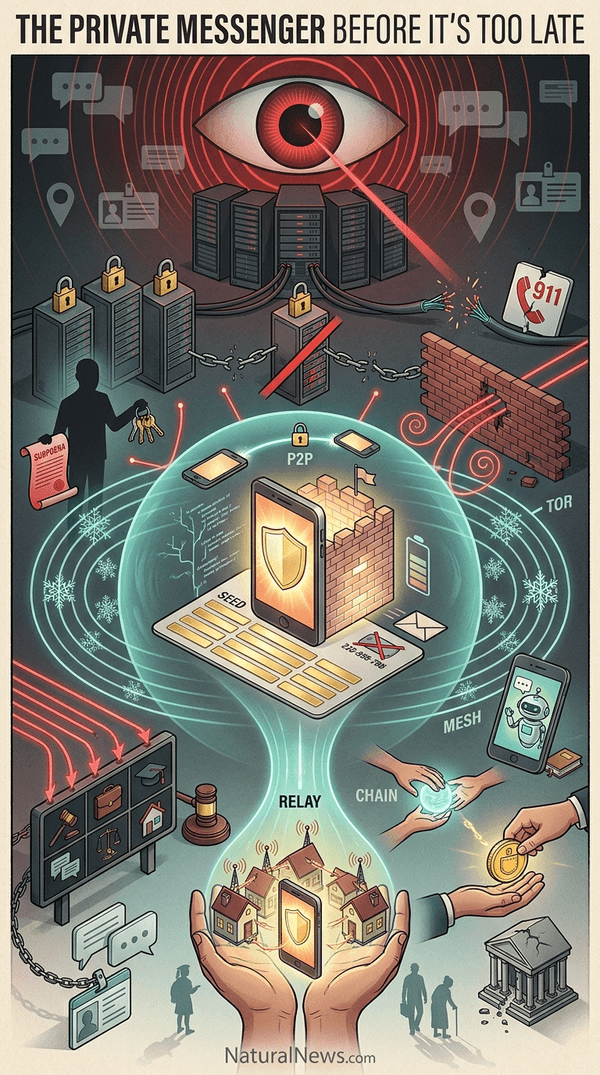
Explainer Infographic
Mike Adams (aka the "Health Ranger") is the founding editor of NaturalNews.com, a best selling author (#1 best selling science book on Amazon.com called "Food Forensics"), an environmental scientist, a patent holder for a cesium radioactive isotope elimination invention, a multiple award winner for outstanding journalism, a science news publisher and influential commentator on topics ranging from science and medicine to culture and politics.
Mike Adams also serves as the lab science director of an internationally accredited (ISO 17025) analytical laboratory known as CWC Labs. There, he was awarded a Certificate of Excellence for achieving extremely high accuracy in the analysis of toxic elements in unknown water samples using ICP-MS instrumentation.
In his laboratory research, Adams has made numerous food safety breakthroughs such as revealing rice protein products imported from Asia to be contaminated with toxic heavy metals like lead, cadmium and tungsten. Adams was the first food science researcher to document high levels of tungsten in superfoods. He also discovered over 11 ppm lead in imported mangosteen powder, and led an industry-wide voluntary agreement to limit heavy metals in rice protein products.
Adams has also helped defend the rights of home gardeners and protect the medical freedom rights of parents. Adams is widely recognized to have made a remarkable global impact on issues like GMOs, vaccines, nutrition therapies, human consciousness.







Please contact us for more information.


