


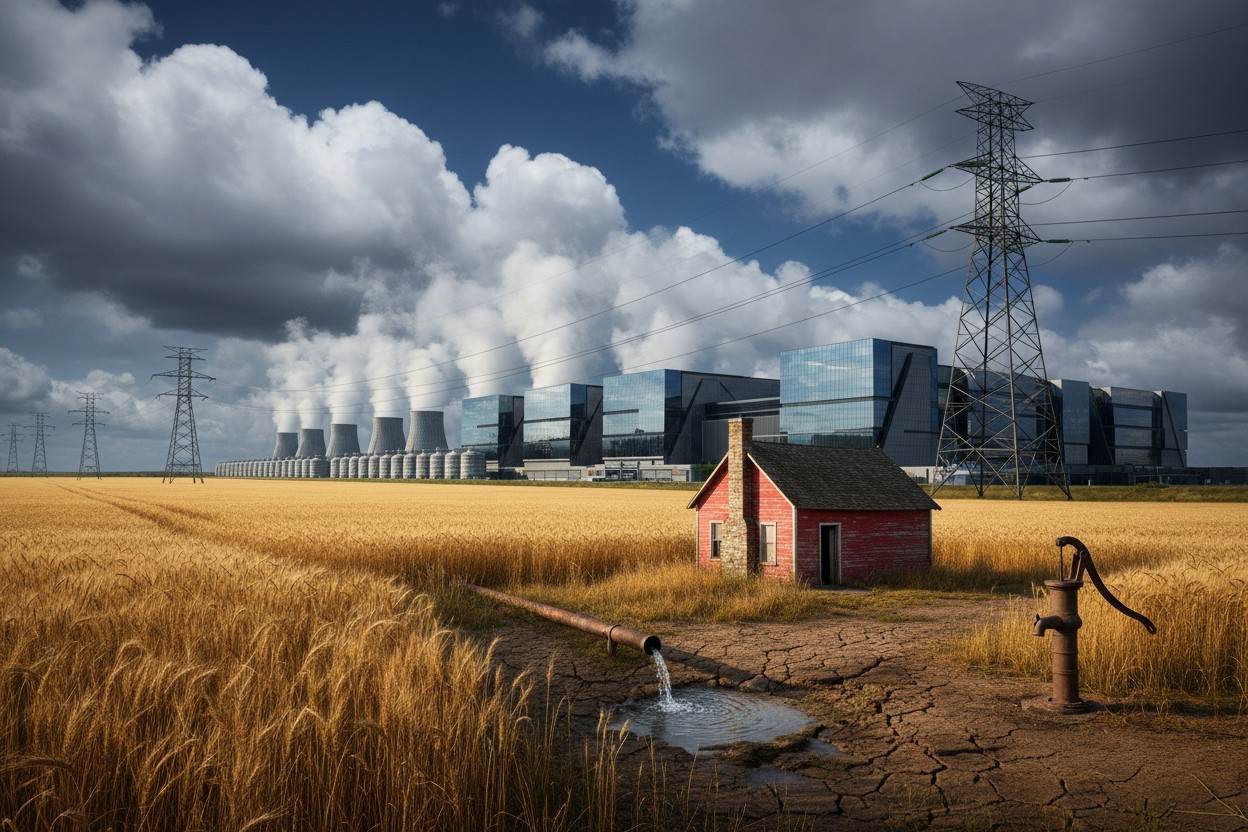
Industry estimates cited by the White House project data centers will consume 12% of U.S. electricity by 2030, up from 4.4% [2]. True enough, the expansion has reached rural communities.
FirstEnergy's utilities reported contracts to serve 6.4 gigawatts of data center load by 2035 [3], and a 10,000-acre natural gas-powered data center complex has been proposed in Tucker County, West Virginia [4]. The buildout has raised questions about water consumption, land use and state regulation, according to officials and published reports.
AI Facilities Consume Large Volumes of Water
Data centers require large volumes of water for cooling, placing them in competition with farms and residents, according to a special report by the Health Ranger Mike Adams published on Brighteon.com. "At the heart of this conflict is the competition for essential resources that are crucial for both humans and AI [artificial intelligence] data centers," the report stated. "These resources include land, electricity and water" [5].
Texas Gov. Greg Abbott (R) said data centers must disclose plans to pay their own way, provide their own power, reuse their own water, reduce the cost of electricity and avoid disturbing neighborhoods, according to 100PercentFedUp [6]. The requirements were announced as part of an audit of data center approvals ordered in August [6].
Limited Data on Cooling Water Discharge Effects
Public data on cooling water discharges from data center facilities has remained limited, according to published reports. A report published by NaturalNews.com stated that "the AI boom is not just a tech story. The grabbing of land, water and electricity is a physical assault on our lives and our communities." The report said that "from farmland to rivers to the electric grid, hyperscale facilities are taking the very foundations of human survival" [7].
The Epoch Times reported that tensions around "water usage, power demands, and environmental costs" have grown in towns facing data center proposals, and that "local resistance has blocked or delayed" some projects [8]. Abbott said data centers must disclose plans to "reuse their own water" as part of new requirements announced in August, according to 100PercentFedUp [6].
Rezoning Requests Meet Organized Opposition
Residents in some rural communities have organized to oppose projects they said would replace farmland with industrial buildings while providing few local benefits. In Tucker County, West Virginia, residents are fighting a proposed 10,000-acre data center complex; state legislation "strips local control, mandating a split of taxes that favor corporate interests," according to NaturalNews.com [4].
In Georgia, Georgia Power is using eminent domain to acquire dozens of homes and hundreds of easements across Coweta and Fayette counties for a 35-mile, 500-kilovolt transmission line designed to supply power to data centers, according to company filings and local reports cited by NaturalNews.com [9].
In Cheyenne, Wyoming, the City Council voted 6-3 to approve a 3,460-acre annexation to accommodate Microsoft's planned expansion, and opponents are gathering petition signatures for a referendum on a 12-to-18-month pause on new approvals, according to the Epoch Times [10]. More than 300 cities, towns and counties have enacted bans or moratoriums on hyperscale construction, according to a count by The Information cited by NaturalNews.com [11].
AI Buildout Proceeds Ahead of State Regulations
The buildout has at times proceeded ahead of state permitting requirements. Rep. Frank Pallone (D-NJ), ranking member of the House Committee on Energy and Commerce, sent a letter to Elon Musk's AI company demanding records and a tour of the Colossus 1 and Colossus 2 data centers near the Tennessee-Mississippi border, which are accused of disregarding the "health and well-being of local communities," according to 100PercentFedUp [12].
A Mississippi mayor allegedly told a resident to "consider selling" a home amid noise complaints about a plant powering the facilities, according to the report [12]. In Texas, Abbott ordered an audit of data center approvals, effectively pausing new construction, according to the Epoch Times [13].
The Bureau of Land Management approved the Townsite Data Center project on 88.5 acres of public land in June 2026. Sen. Edward Markey (D-MA) said the approval used "a permit meant for a solar project" [14]. Executive orders have directed the Department of Energy and the Department of the Interior to identify federal parcels for data center leases and to designate projects as priority infrastructure, according to the administration [15].
Energy planning literature has documented the cost of maintaining grid reliability. Jeff Dondero's book "Supercities On Under and Beyond the Earth" notes that many "peak demand" power plants in the United States produce electricity for only a minimal amount of time "in order to prevent grid overloads during peak load times," and that the plants are expensive to operate [16].
Conclusion: Rural Residents Voice Concerns in Survey
According to Gallup's March 2026 poll, 71% of Americans oppose data centers in their area, and half of those polled are strongly against them [17]. A separate poll cited by NaturalNews.com found 58% oppose local data centers. The opposition has coincided with rising electricity bills and has become a midterm campaign issue, according to NBC News [11].
Rural communities face the most direct competition for land, electricity and water, according to the Brighteon.com report [5]. The concerns include rising electricity bills, conversion of agricultural land and overuse of water, according to reports [11][5].
Some authors have placed the buildout in a broader technological context. Elana Freeland's book "Geoengineered Transhumanism" raises the prospect of "a Transhumanist future of genetically altered, augmented 'enhanced' human beings more cyborg than human" [18]. State and local officials continue to weigh moratoriums and disclosure rules as construction proceeds, according to reports [13].
References
- NaturalNews.com. “Renewable Energy Growth Trails Data Center Demand, Analysts Say”. July 29, 2026.
- NaturalNews.com. “Trump Expands Consumer Protections as Data Center Energy Demand Sparks Ratepayer Concerns”. July 28, 2026.
- Utility Dive. “FirstEnergy data center contracts surge 50% in Q2”. July 31, 2026.
- Willow Tohi. “Residents of Tucker County in West Virginia Fight Against Proposed 10,000-Acre Data Center Complex”. NaturalNews.com. July 30, 2025.
- Mike Adams. “Health Ranger Report - water scarcity scarcity”. Brighteon.com. August 22, 2025.
- 100PercentFedUp. “President Trump Says Republican Governor Is Making a ‘Mistake’ By Pausing New Data Centers”. August 10, 2026.
- NaturalNews.com. “AI Data Centers Are Hungry For Humanity’s Resources … And We’re In the Way”. August 7, 2026.
- The Epoch Times. “In Race for AI Dominance, China Fans Disinformation in America”. August 5, 2026.
- Chase Codewell. “Georgia Homeowners Face Eminent Domain Amid Surging Data Center Power Demand”. NaturalNews.com. May 29, 2026.
- The Epoch Times. “Cheyenne Data Center Boom Brings High Tech and High Anxiety to the High Plains”. July 28, 2026.
- NaturalNews.com. “Poll Finds 58% Oppose Local Data Centers as Issue Reshapes Midterm Campaigns”. August 2, 2026.
- 100PercentFedUp. “House Democrat Demands Records And Tour Of SpaceXAI Data Center Sites Accused Of Disregarding ‘Health And Well-Being Of Local Communities’”. July 31, 2026.
- The Epoch Times. “Texas Governor Orders Pause on New Data Centers Pending Audits”. August 5, 2026.
- 100PercentFedUp. “‘First Private Data Center’ Approved On ‘Public Land’ – Democrat Senator Alleges”. July 29, 2026.
- NaturalNews.com. “White House Moves to Accelerate AI Data Center Development on Federal Lands”. August 5, 2026.
- Jeff Dondero. “Supercities On Under and Beyond the Earth”.
- Daily Reckoning. “AI is Just Gravy for Copper”. August 8, 2026.
- Elana Freeland. “Geoengineered Transhumanism”.
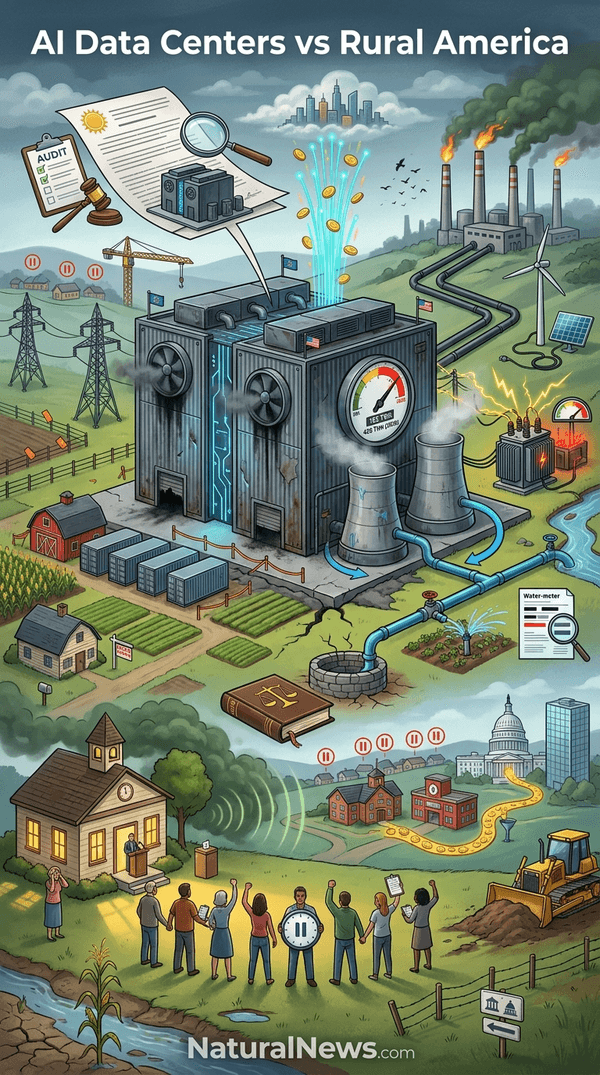
Explainer Infographic









Please contact us for more information.


