



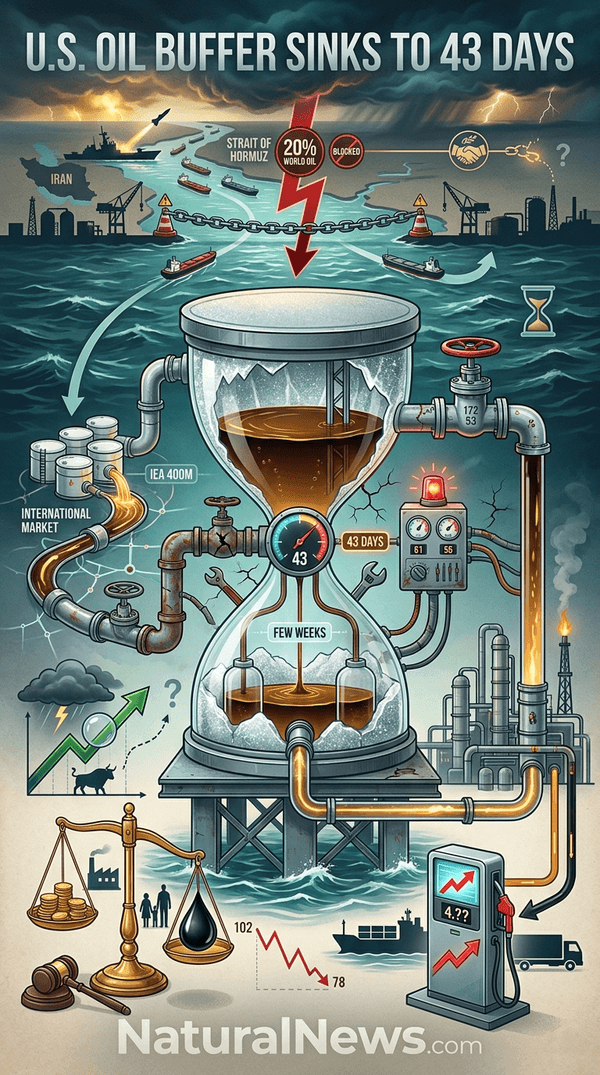
The decline comes as U.S. military strikes against Iran continue, according to the report, and follows Iran's seizure of the Strait of Hormuz, which closed the waterway to through-traffic. Washington has drained nearly 96 million barrels from the SPR since mid-March, according to the New American [1]. President Donald Trump authorized the release of 172 million barrels in March, the largest single drawdown since the reserve's creation in the 1970s, according to NaturalNews.com [2].
Supply Data and Strategic Petroleum Reserve
The SPR is a federal stockpile created by Congress in 1975 after the Arab oil embargo to cushion against severe supply disruptions, according to the Government Accountability Office (GAO) [3]. The 43-day figure includes those reserves, according to Bank of America data. The long-term average of about 65 days reflects periods with larger buffers; the latest figure reflects tighter market conditions, according to the research.
Analysts cited by Bloomberg noted that lower inventories do not necessarily mean an immediate shortage, but the thinner buffer leaves less room for unexpected disruptions. The reserve held 325.7 million barrels as of late June 2026, its lowest level since 1983, according to the GAO [4]. The GAO found that the reserve's effective withdrawal capability had fallen to about 61% of original design capacity, while refill capability stood at 56% [4].
Iran Conflict and Strait of Hormuz
U.S. strikes against Iran began at the end of February, according to reports. Iran subsequently seized control of the Strait of Hormuz, closing it to through-traffic and stymieing the flow of about 20% of the world's oil supply, according to the International Energy Agency (IEA) [5]. The closure is the largest supply disruption in recorded history, the agency stated [5].
The IEA released a record 400 million barrels from emergency reserves in response [5]. The agency's chief later warned that commercial oil inventories have only a few weeks of supply left and that emergency reserves are limited and not endless [6].
Brent crude rose above $90 per barrel in mid-July, while West Texas Intermediate crude stood at about $84.48 per barrel, according to Seeking Alpha data cited in the report. Prices reached $102 a barrel at one point during the conflict, according to the Associated Press (AP).
Stock Market and Corporate Earnings
Stock indexes rose Wednesday morning, Aug. 5, with the S&P 500 climbing 0.4% and the Dow Jones Industrial Average adding 584 points, or 1.1%, according to AP. The Nasdaq composite rose 0.1%. Both the S&P 500 and the Dow set records Tuesday, Aug. 4. [7].
Three-quarters of S&P 500 companies have reported results, and Wall Street expects profit growth of 50%, according to AP. Disney rose 3% after beating profit forecasts; Booking Holdings jumped 6.6%; Nvidia gained 3.7% after SpaceX said it would use its chips; and SpaceX fell 8.8%, the AP reported.
The 10-year Treasury yield remained at 4.63%, according to the AP. Markets in Asia rose, with benchmarks jumping more than 3% in Tokyo and Seoul, and European markets also gained, the AP reported.
Negotiations and Economic Outlook
Trump said a deal to reopen the Strait of Hormuz could come as early as Wednesday, according to AP, though there have been many stops and starts during the five-month-old conflict. Iranian Foreign Ministry spokesman Esmaeil Baghaei said the only negotiations underway are between Iran and Oman, and that the situation in the strait would not change unless the U.S. lifts its blockade of Iranian ports, according to a report from Antiwar.com cited by NaturalNews.com [8].
Brent crude fell 0.6% to $78.81 a barrel, according to the AP. Oil prices have swung from $102 to $78.81 during the conflict, the AP reported, pushing gasoline prices higher and increasing shipping costs.
Federal Reserve officials have held their key benchmark rate steady, according to the AP. Wall Street expects the central bank to raise rates at least once before the end of 2026, the AP reported. The July employment report is due Friday, Aug. 7.
Conclusion
The depletion follows successive drawdowns by two administrations, according to Responsible Statecraft, which noted that the reserve was created in 1975 as a rainy day fund, made ready for the benefit of the American people should a crisis in supply reach us once more [9]. Crude inventories have fallen to "precariously low" levels, with refineries operating at 97% of capacity nationwide, according to the Financial Times [10]. The GAO has warned that the reserve is at growing risk of failing to respond effectively to future energy crises because of aging infrastructure and record-low inventories [3].
In June, after the preliminary ceasefire agreement, Trump highlighted increased oil transit through the strait, writing on Truth Social: "An all time RECORD. Oil prices are tumbling down, and the World is a much safer place!!!" [11].
Former Energy Secretary Bill Richardson previously wrote that a high price for crude "could be inflationary, hurt economic growth and unnerve the financial markets" [12]. Jacek Popiel, author of "Viable Energy Now," has argued that domestic energy production would be far less expensive than ongoing wars [13].
References
- "U.S. Oil Reserve Falls to 43-Year Low as Trump Drawdown Nears Its Limit". The New American. July 10, 2026.
- NaturalNews.com. "Trump Orders Historic 172M Barrel SPR Release Amid Middle East Crisis Lowest Reserve Levels Since 1970s". NaturalNews.com. March 17, 2026.
- "US Strategic Oil Reserve at Risk – Watchdog". RT. July 2, 2026.
- NaturalNews.com. "GAO: U.S. Strategic Petroleum Reserve at Risk Due to Aging Infrastructure, Low Inventories". NaturalNews.com. July 4, 2026.
- Cassie B. "IEA Releases 400 Million Barrels from Reserves After Strait of Hormuz Closure Sparks Historic Oil Crisis". NaturalNews.com. March 12, 2026.
- NaturalNews.com. "IEA Chief Warns Global Oil Reserves Down to Just Weeks of Supply as Hormuz Crisis Deepens". NaturalNews.com. May 21, 2026.
- "Futures Hit New Record High on Strong Earnings Following Historic Call Buying Frenzy". ZeroHedge. August 5, 2026.
- NaturalNews.com. "Trump Says Iran Talks Underway; Tehran Reports Only Oman Negotiations". NaturalNews.com. August 5, 2026.
- "Trump Is Playing Chicken with America's Oil Reserves". Responsible Statecraft. July 28, 2026.
- "Crude Inventories Have Fallen to 'Precariously Low' Levels". ZeroHedge. August 1, 2026.
- "Oil Prices Tumble Following US-Iran Agreement, Sanctions Relief". NTD. June 23, 2026.
- Bill Richardson. "Between Worlds the Making of an American Life".
- Jacek Popiel. "Viable Energy Now When Energy Economics and Politics Converge".
Explainer Infographic










Please contact us for more information.


