


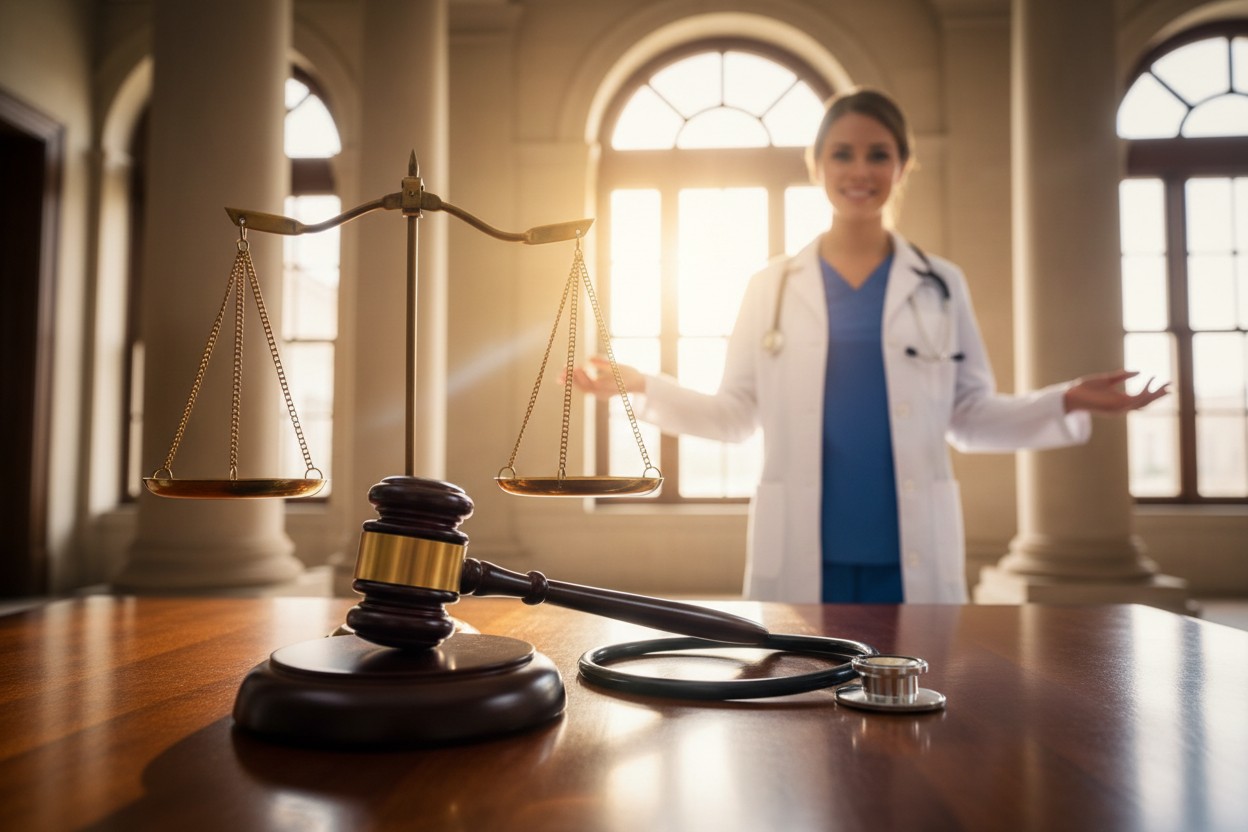
The order names Kory, Dr. Le Trinh Hoang, and Dr. Brian Tyson.
Kory wrote in a Substack post that the ruling prohibits California Attorney General Rob Bonta, the Medical Board of California, and the Osteopathic Medical Board of California from investigating, prosecuting, or threatening the doctors' licenses over professional opinions shared with patients.
Federal Board Restricts California Medical Boards
According to Kory, Shubb granted the renewed motion for a preliminary injunction. The injunction also applies to anyone acting on behalf of the named stated officials.
Kory said his attorney, Rick Jaffe, called him on the evening of Aug. 5 to report that the order had been signed.
Kory, Hoang, and Tyson are the plaintiffs in the case. Kory wrote that the order covers opinions about COVID-19, vaccines, and treatments including ivermectin.
Background: AB 2098 and the Dispute
California enacted Assembly Bill 2098 in 2022. The law made it professional misconduct for physicians to give patients COVID-19 advice that departed from state-endorsed guidance, according to a report published at the time [1].
Governor Gavin Newsom signed the bill on September 30, 2022, and it took effect on January 1, 2023 [1][2].
Children's Health Defense attorneys filed a federal lawsuit in December 2022 against Bonta and the Osteopathic Medical Board on behalf of Hoang and other plaintiffs. The lawsuit challenged the law as a punishment for doctors' speech [3].
In October 2022, two doctors also filed a separate federal lawsuit seeking to stop the law [4].
In January 2023, Shubb granted a preliminary injunction blocking the law, finding that the state provided no evidence that "scientific consensus" has an established technical meaning and that the law did not clearly define "misinformation" [5].
Legal Proceedings and Prior Ruling
Shubb initially denied the plaintiffs' preliminary injunction motion in April 2024, according to Kory's post. He wrote that the judge at that time treated doctor-to-patient speech as conduct that the state could regulate [10].
The plaintiffs appealed, and the U.S. Supreme Court later issued its decision in Chiles v. Salazar, which held that professional speech to a client is protected by the First Amendment. The pandemic that led to these restrictions also produced lockdowns, limits on gatherings, and litigation over emergency orders, as documented in accounts of the period [6].
Kory wrote that the Supreme Court's decision pulled the foundation out from under the earlier ruling against him. The plaintiffs renewed their motion, and Shubb granted it [10]. Kory said the case had continued through a separate challenge to the Medical Board of California's authority to discipline doctors for sharing COVID-19 information [7].
The Preliminary Injunction
The injunction prohibits state officials and anyone acting on their behalf from investigating, prosecuting, or threatening the plaintiffs' licenses over opinions shared with patients, according to Kory's summary of the order [10]. Shubb noted that the order does not prevent discipline for fraud, negligent treatment, prescribing violations, or failure of informed consent, Kory wrote.
Kory also wrote that the court said medical boards may not disguise a viewpoint prosecution as a "standard of care" or "informed consent" case. In his post, Kory described the decision as a recognition that doctors cannot be forced to repeat government-approved statements to keep their licenses.
During the pandemic, one analysis described "the most sweeping peacetime curtailment of civil liberties in modern history," including censorship [8].
Reactions and Next Steps
Kory wrote that Jaffe encouraged him to reapply for a California medical license. Kory said he declined, citing in part the state's $1,500 licensing fee. He thanked Jaffe, Hoang, Tyson, and Children's Health Defense for supporting the litigation [10].
"Free speech prevailed. We do not have to parrot pharma-government nonsense to keep our licenses," Kory wrote. He also wrote that "a government that can tell your doctor what he is allowed to say can basically tell your doctor to lie to you [10]."
Kory noted that the injunction is preliminary and that the fight over the merits continues.
During the pandemic, some medical workers alleged that institutions moved to censor dissent, with one published account stating, "We're being censored here in order to preserve the remaining corruption that is waiting to be uncovered" [9].
References
- NaturalNews.com. "Doctors dispute California law authorizing state medical board to revoke licenses of those challenging COVID-19". October 14, 2022.
- ChildrensHealthDefense.org. "California Quietly Repeals Medical Misinformation Law". September 18, 2023.
- ChildrensHealthDefense.org. "CHD Attorneys File Federal Lawsuit to Stop California Law That Punishes Doctors for COVID 'Misinformation'". December 02, 2022.
- ChildrensHealthDefense.org. "Doctors File First Lawsuit Challenging California Law That Seeks to Punish Physicians for COVID 'Misinformation'". October 06, 2022.
- ChildrensHealthDefense.org. "Breaking Federal Judge Blocks California Law Punishing Doctors for 'COVID Misinformation'".
- Nicholas A Christakis. "Apollo's Arrow".
- ChildrensHealthDefense.org. "CHD Files New Lawsuit Alleging California Med". January 04, 2024.
- Sonia Elijah. "How Dissent Was Silenced". Brownstone Institute. March 26, 2026.
- Erin Marie Olszewski. "Undercover epicenter nurse how fraud, negligence, greed led to unnecessary deaths at Elmhurst Hospital".
- PierreKoryMedicalMusings.com. "As of Last Night, the U.S Government Will Never Get to Tell Doctors What They Can Say Anymore". August 7, 2026.



Please contact us for more information.


