


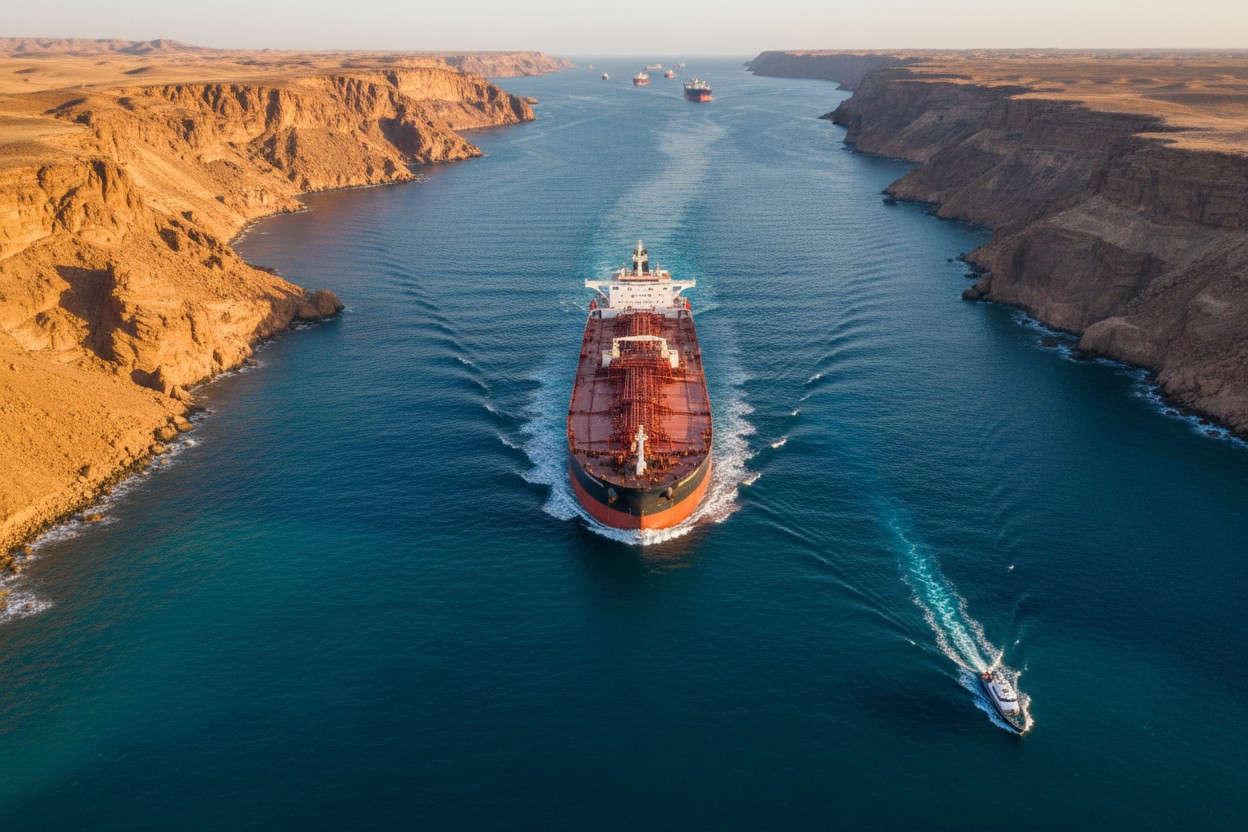
Baghaei said the joint statement between the two countries is in the final review and drafting stage, and that the understanding would not by itself guarantee security in the strategic waterway [1][2]. A source speaking to state broadcaster Islamic Republic of Iran Broadcasting said the possible agreement "has nothing to do with the immediate opening" of the strait [3].
The waterway carries about one-fifth of the world's seaborne oil, and the ongoing closure has already produced what shipping companies describe as a logistical nightmare [4][5]. Analysts said the emerging arrangement would leave Tehran with more leverage over the waterway than it held before the war [6]. The proposed agreement, which would establish a new corridor through the strait, has raised compliance questions for international carriers at a time when the United States is enforcing sanctions and a naval blockade on Iranian maritime trade [7][8].
Sanctions, Insurance Clauses Raise Compliance Risks
Oman presented Iran a proposal for a joint regional mechanism to manage the Strait of Hormuz with voluntary fees, according to a Gulf source cited by Reuters [9]. Under the plan under discussion, Tehran would take full control over inbound shipping while Oman would clear vessels for exit after notifying Iran [10]. Media reports said the emerging deal would give Iran greater control over vessels entering the Persian Gulf, with Muscat overseeing outbound traffic [7].
Shipping companies have described the closure of the strait as a logistical nightmare [5]. U.S. officials have warned foreign purchasers of Iranian oil about sanctions, and the U.S. Navy has imposed a full blockade on Iranian maritime trade [11][8].
Iran and Oman Outline Central Corridor Plan
Iranian Foreign Minister Abbas Araghchi said talks with Muscat over the strait are in their final stages, according to the Islamic Republic News Agency [12]. Baghaei said the talks have been assessed positively at the technical and political levels [13]. A senior Iranian source told Reuters that Tehran is unlikely to accept an arrangement that does not preserve its control over inbound traffic [10].
Oman, described in travel literature as a politically stable country in a volatile region, has served as the interlocutor in the talks [14]. The proposed agreement would establish a new corridor through the strait, with Iran expected to gain greater control over vessels entering the Persian Gulf while Oman would oversee outbound traffic, according to media reports [7].
Iranian Parliament Draft Bill Adds New Restrictions
A report published Aug. 6 said Iran's plan would permanently ban any ships belonging to the U.S., Israel and other "hostile" nations from ever passing through the Strait of Hormuz [15]. A spokesman for Iran's parliamentary National Security Committee said Tehran is close to reaching an agreement with Oman over the strait [16]. Tehran has blamed U.S. and Israeli military operations for destabilizing the waterway [17].
International Legal and Operational Concerns Remain
Former U.S. Navy officials and analysts have suggested that the broader solution to chokepoint closures may be compensating coastal countries for maintaining and managing commercial shipping lanes [18]. An example cited in an Aug. 4 webinar is a voluntary "Aids to Navigation Fund" paid by shipping companies [18].
Historical accounts of U.S. geoeconomic strategy note that American policy in the Persian Gulf has often converted economic dominance into military power [19]. Energy dependence in the region is longstanding; Indian officials forecast years ago that oil demand would double by 2025 [20]. The final effect of the Iran-Oman arrangement will depend on the terms that are completed and on how carriers and regulators respond.
References
- The Epoch Times. "Iran, Oman Near Deal on New Hormuz Shipping Route, but Tehran Says Strait Will Not Reopen Yet". August 6, 2026.
- Zero Hedge. "Iran-Oman Hormuz Route 'Agreed To' As Iran Warns Against US 'Interference'". August 5, 2026.
- Middle East Eye. "Iran says deal with Oman would not immediately reopen Strait of Hormuz". August 5, 2026.
- RT. "Hormuz deal to give Iran greater control over shipping – Axios". August 5, 2026.
- Cassie B. "Global shipping in chaos as Iran shuts Strait of Hormuz vows to target approaching vessels". NaturalNews.com. April 20, 2026.
- Zero Hedge. "Iran Set To Emerge With More Hormuz Leverage Than Before The War Under Draft US-Oman Deal". August 5, 2026.
- RT. "Iran says Hormuz deal 'nearing completion'". August 6, 2026.
- Cassie B. "U.S. Navy Halts All Iranian Sea Trade in Strait of Hormuz Blockade". NaturalNews.com. April 15, 2026.
- Middle East Eye. "Oman proposes to Iran joint regional measure to manage Hormuz Strait". July 28, 2026.
- Middle East Eye. "Iran and Oman discussing plan to split control of Hormuz shipping routes". August 4, 2026.
- Garrison Vance. "U.S. Officials Express Optimism for Deal, Warn Oil Buyers of Sanctions". NaturalNews.com. April 19, 2026.
- Middle East Eye. "Iran says Hormuz talks with Oman in final stages". August 2, 2026.
- Middle East Eye. "Talks with Oman over Hormuz proceeding 'positively', Iran's foreign ministry says". August 4, 2026.
- Diana Darke. "Oman: the Bradt travel guide".
- End of the American Dream. "They Want To Fully Humiliate Trump: Iran Just Released Their 'Plan' For The Strait Of Hormuz, And It Guarantees More War". August 6, 2026.
- Middle East Eye. "Iranian official says they are close to reaching Hormuz deal with Oman". August 3, 2026.
- Middle East Eye. "Iran blames US for Hormuz closure as Oman talks continue". July 30, 2026.
- The Epoch Times. "Iran's Hormuz Shutdown Could Lead to Coastal Countries Gaining More Control of Chokepoints". August 6, 2026.
- Glenn Diesen. "Russia's geoeconomic strategy for a Greater Eurasia".
- Jagdish N. Sheth. "Chindia rising: how China and India will benefit your business".
Explainer Infographic












Please contact us for more information.


