



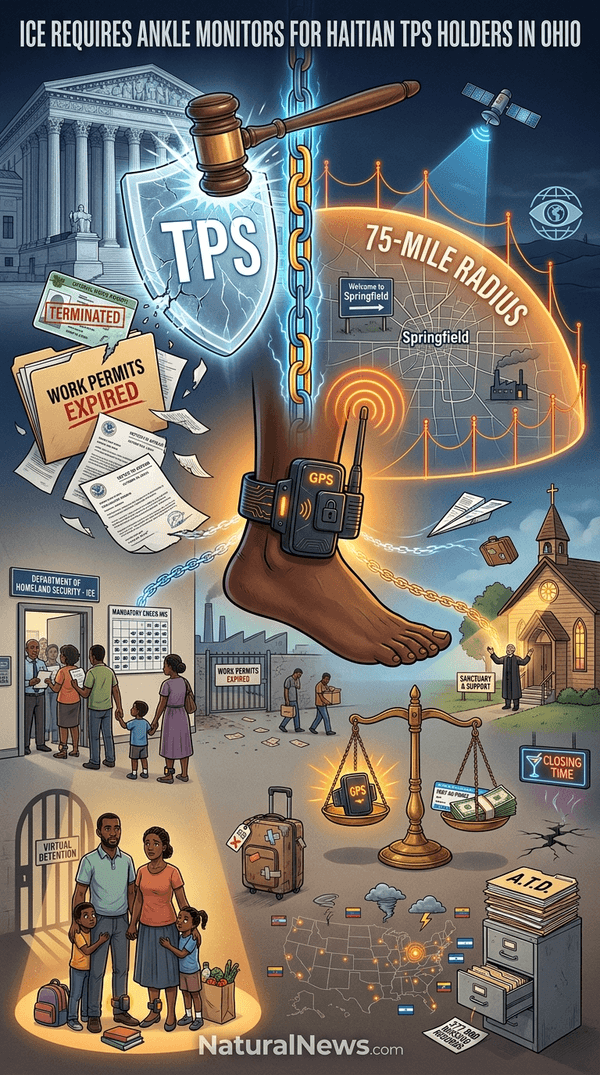
Dozens of immigrants were called into ICE offices in recent days and outfitted with monitoring devices that block travel outside a 75-mile radius from their homes, the groups said. Roughly 15,000 Haitian immigrants live in the Springfield area, many of whom were protected by TPS until a Supreme Court decision on June 25 permitted the administration to move forward with ending the designation for Haiti [1].
Viles Dorsainvil, executive director of Springfield's Haitian Community Help and Support Center, told reporters that the monitoring has created fear. "It is so humiliating to see parents, fathers and mothers, who have not been committing any crime now with some type of ankle bracelets on their feet," Dorsainvil said. "That has created so much fear."
Appointments and Monitoring Procedures
Philbert Viaud, a Haitian resident of Columbus who has lived in the U.S. for five years, was seen wearing an ankle monitor after leaving an ICE office in suburban Cincinnati on Sunday, Aug. 2, and was told to return for an appointment in two weeks, according to the Cincinnati Inquirer. Viaud said he has been applying for asylum for the past four years.
Sony Prenice, another Haitian resident, told reporters she was given a choice between wearing an ankle monitor or being deported with $2,600. Carl Ruby, senior pastor of Central Christian Church in Springfield, said he supported a congregation member called in for an appointment. "I want the ICE agents to look out and see me praying," Ruby told The Enquirer.
The use of ankle monitors in immigration enforcement is not new. ICE's Family Expedited Removal Management program, launched in May 2023, sought to put GPS ankle monitors on immigrant families as an alternative to detention [2].
Immigrant-rights advocates have long criticized such monitoring. ICE's Intensive Supervision Appearance Program, once presented as an alternative to family detention, has been challenged by organizers with direct experience of the program [3]. In 2022, ICE acknowledged it had no records for 377,980 people enrolled in its Alternatives to Detention program [4].
ICE Letters and DHS Response
Letters to TPS holders from ICE officials instruct recipients to bring "any and all immigration documents" to offices within 30 days. "It is important that you keep this appointment and bring this letter with you," one letter reads. "If you are unable to do so, state your reason, sign below and return this letter to this office at once."
A Department of Homeland Security (DHS) spokesperson declined to discuss ongoing operations. "Temporary Protected Status is exactly that – temporary," the spokesperson said, adding that previous administrations used TPS as a "de facto amnesty program despite Congress never intending it to be permanent."
"What we would say now is it's closing time which means you don't have to go home, but you can't stay here," the spokesperson added. "The good news is it's not too late to get a $2,600 check and a free flight home."
Legal Rulings and Termination of TPS
Congress created TPS in 1990 to provide temporary immigration protections for people fleeing war, natural disasters and “extraordinary and temporary” conditions. Haiti received the designation after a 2010 earthquake that killed more than 200,000 people, and the status was extended several times.
Federal courts last year blocked termination after judges determined the government acted with "racial animus" and an anti-immigrant agenda. The Supreme Court reversed, with Justice Samuel Alito writing that "none of the cited statements by either the President or the Secretary was overtly racial, and in substance all expressed policy views that could rest on race-neutral justifications." Author David K. Shipler, in "Rights at Risk: The Limits of Liberty in Modern America," describes a noncitizen who "cannot look to any due process in such a case" [5].
Last week, DHS announced TPS for Haiti is officially terminated and alerted employers that work permissions have ended, triggering mass layoffs and legal uncertainty. The Trump administration has argued the designation "contradicts U.S. national interests" [6]. The Supreme Court's decision could fuel efforts to strip TPS designations protecting roughly 1.3 million immigrants from a dozen other countries.
Reactions and Broader Impact
Reactions from elected officials followed party lines. "This is wrong, it’s punitive and excessive, and it tells you everything Trump's ICE agents think about Haitians who came here legally," Rep. Shontel Brown (D-OH) said Monday, Aug. 3. "We will fight this."
The Republican-controlled House passed a bill to extend TPS for Haiti earlier this year; ten Republicans joined every Democrat in a 224-204 vote [6]. The measure was not brought to a vote in the Senate, according to reports.
Sen. Chris Murphy (D-CT) said TPS holders have no safe place to return. "There is no safe place to return for TPS holders from places like Haiti and Yemen and Venezuela and Syria," he told reporters. "In fact, in those places I just mentioned, the situation is not stabilizing, getting better. It is getting worse."
Faith communities have also mobilized. More than 5,000 churches across the United States have formally declared themselves ICE-free zones in what legal experts called the largest coordinated religious resistance to federal immigration enforcement in American history [7].
Springfield, which became a national focus after Trump said during the 2024 campaign that Haitian residents were eating pets, is bracing for the end of protections [1]. Employers in the area now face confusion over legally authorized workers, while families fear removal to a country that advocates describe as unsafe.
References
- The Epoch Times. "Springfield Residents, Haitian Nationals Brace for End of Temporary Protected Status". July 16, 2026.
- NaturalNews.com. "REPORT Biden Harris deportation program lets nearly 90 of illegal immigrant families STAY in the US". August 16, 2024.
- "Beyond Walls and Cages Prisons Borders and Global".
- NaturalNews.com. "VANISHED_ ICE admits it has no records of almost 400K illegals that were enrolled in ATD program". December 31, 2022.
- David K. Shipler. "Rights at Risk: The Limits of Liberty in Modern America".
- 100percentfedup.com. "10 House Republicans Just Helped Democrats Pass a Bill Shielding 330,000 Haitians From Deportation". April 18, 2026.
- NaturalNews.com. "Over 5,000 churches declare themselves ICE-free zones as faith leaders challenge Trump enforcement policies". May 16, 2026.
Explainer Infographic








Please contact us for more information.


