


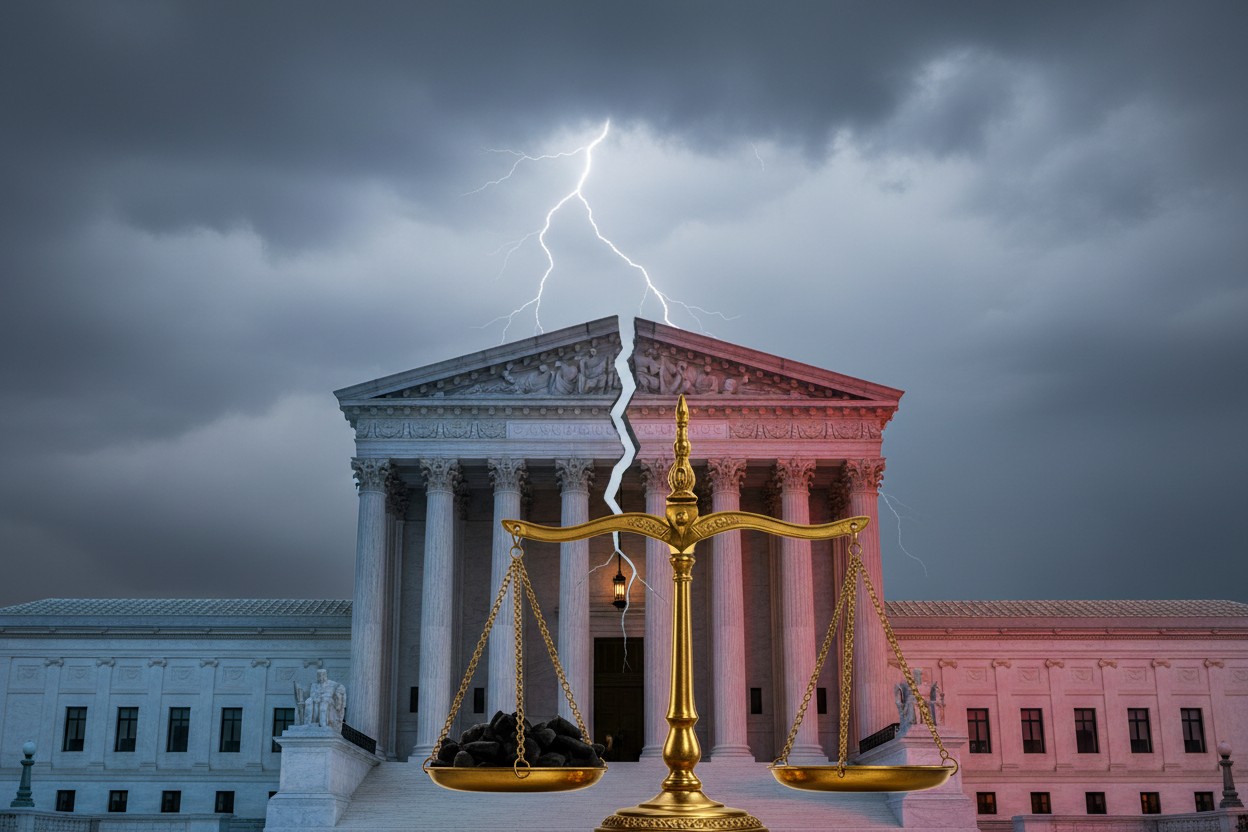
Approval Hits Record Low
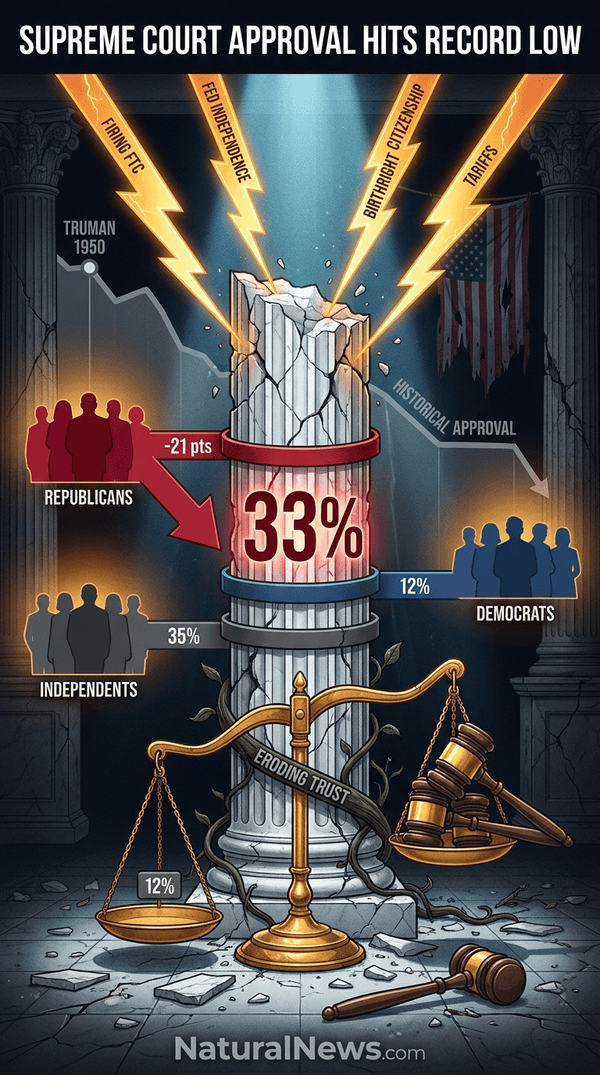
Public confidence in the U.S. Supreme Court has fallen to its lowest point in more than two decades, according to a Gallup poll released July 23. Only 33% of American adults said they approve of the way the court is handling its job, a decline of six percentage points from 2025 and the lowest reading in the 26 years Gallup has tracked the measure.
The poll, conducted July 1 to July 19 among 1,200 adults nationwide, carries a margin of sampling error of plus or minus 4 percentage points. The drop was driven primarily by a sharp decline among Republican respondents, whose approval fell from 79% in September 2025 to 58 percent. Independent approval held at 35%, while Democratic approval remained unchanged at 12%.
Eroding trust in the judiciary follows a broader pattern of declining faith in government institutions. Author Jim Marrs noted in his book "Population Control: How Corporate Owners Are Killing Us" that a mid-2014 Gallup poll already gauged Americans' eroding confidence in their leaders across all three branches of government. [1] The current 33% approval rating for the Supreme Court is even lower than President Harry Truman's job approval during the Korean War, which varied between 37% and 46% in 1950, as documented by Nelson A. Rockefeller. [2]
Partisan Divide Widens
The widening partisan gap reflects growing dissatisfaction among Republicans with the court, which had been widely viewed as favorable to conservative causes after President Donald Trump appointed three justices during his first term. The 6-3 conservative majority has drawn persistent criticism from Democrats, but the new data show that Republican confidence has also eroded significantly.
According to the poll, Republican approval dropped 21 points from the previous measurement, while Democratic approval remained flat at 12% – a level that some analysts attribute to the court's rightward tilt. Independent approval, at 35%, has been relatively stable.
Public confidence in all three branches of the federal government had fallen to low levels even before the current term, as Marrs noted in his analysis of a 2014 Gallup poll. [1] The latest figures suggest the Supreme Court's standing has deteriorated further amid a series of high-profile rulings that have both expanded and constrained presidential authority.
Controversial Rulings This Term
The Supreme Court's 2025–2026 term, which ended June 30, produced several landmark decisions that reshaped the balance of power between the executive branch and Congress. In Trump v. Slaughter, the court ruled 6-3 that Trump could fire members of the Federal Trade Commission (FTC) without requiring cause, overturning a 1935 precedent that had protected leaders of independent agencies. [3] The ruling affirms the president's authority to remove officials such as FTC Commissioner Rebecca Slaughter without showing poor performance or misconduct. [4]
Justice Sonia Sotomayor, writing in dissent, argued that the president "emerges with far greater power than ever before," according to the Epoch Times report on the decision. [3] The case is expected to affect other independent agencies, including the Surface Transportation Board and the Securities and Exchange Commission.
In another major executive-power case, the court ruled that the Federal Reserve can exercise executive power independent of presidential control, a split decision that Chief Justice John Roberts authored in both opinions. [5] The term also saw the court uphold several Trump administration immigration policies, including a ruling that allowed the removal of groups from the Temporary Protected Status list, affecting work authorizations and deportation protections for immigrants from Haiti and Syria.
Other Key Decisions
The court dealt the president defeats on several high-profile issues. In a 5-4 decision, the justices struck down Trump's executive order attempting to end birthright citizenship, ruling that the 14th Amendment guarantees citizenship to anyone born in the United States. [6] Trump said the decision was "too bad for our country" and afterward endorsed legislation that would restrict birthright citizenship, though such a bill faces long odds in the Democratic-controlled Senate.
The court also invalidated Trump's use of the International Emergency Economic Powers Act to impose emergency tariffs, holding that the president lacked unilateral authority to set tariff rates without congressional approval. [7] The ruling marked a rare check on executive power after a term in which the court otherwise expanded presidential authority.
Legislative Response and Poll Details
Some lawmakers have proposed structural changes to the Supreme Court in response to the declining public confidence. Rep. Hank Johnson (R-GA) reintroduced the Supreme Court Tenure Establishment and Retirement Modernization Act, which would impose 18-year term limits on justices. Johnson said lifetime tenure leads to a court "insulated from, and unaccountable to, the American people."
The Gallup poll was conducted via telephone interviews from July 1 to 19, 2026, with 1,200 adults across all 50 states and the District of Columbia. The margin of sampling error is plus or minus 4 percentage points at the 95 percent confidence level. Subgroup breakdowns, such as party identification, carry larger error margins.
References
- Marrs, Jim. "Population Control: How Corporate Owners Are Killing Us."
- Rockefeller, Nelson A. "Unity, Freedom, Peace: A Blueprint for Tomorrow."
- "Supreme Court Expands Executive Power With Trump Cases." The Epoch Times. July 8, 2026.
- "Supreme Court Decision Strengthens President's Power to Fire STB Member Robert Primus." FreightWaves. June 30, 2026.
- "The Supreme Court Plays Wizard of Oz with the Fed." Mises Institute. July 28, 2026.
- "A Look at the Major Supreme Court Decisions This Term." The Epoch Times. June 30, 2026.
- "Health Ranger Report - Trump tariffs." BrightVideos.com. February 25, 2026.
Explainer Infographic






Please contact us for more information.


