


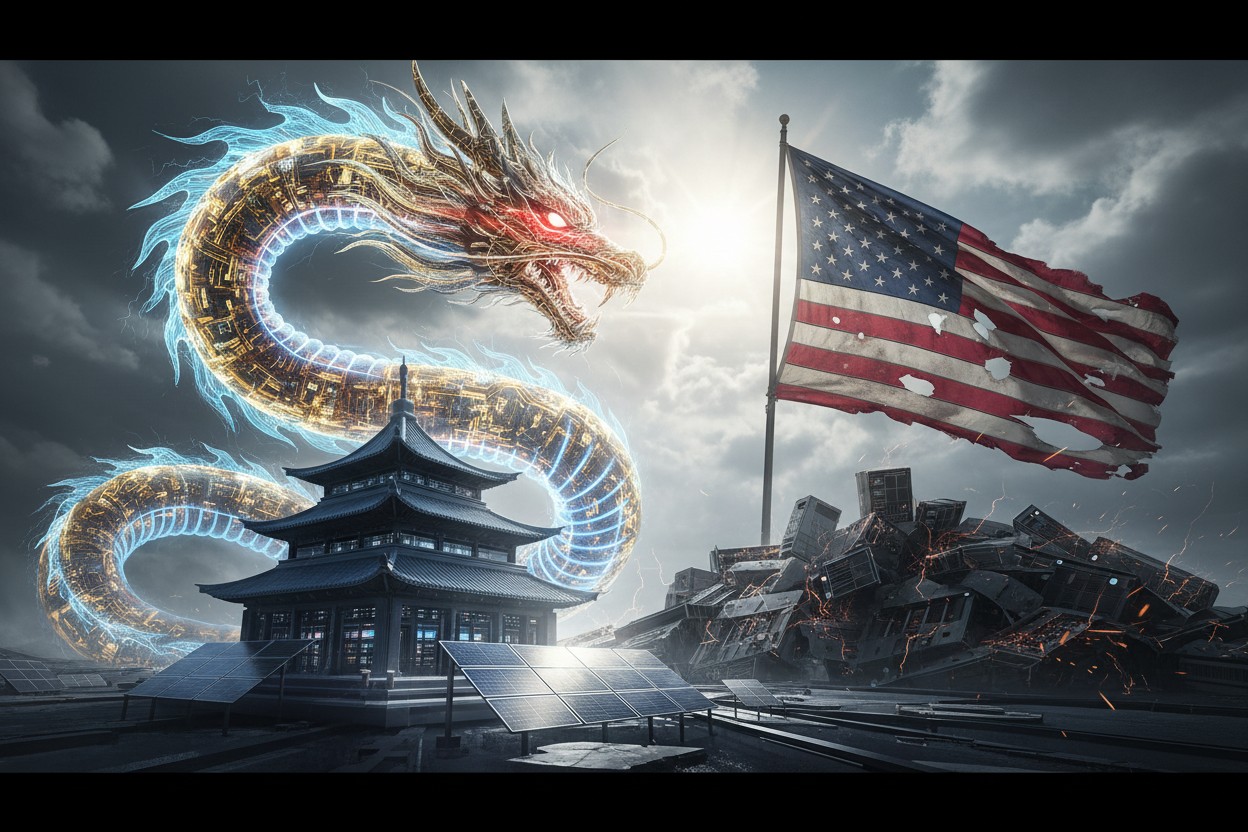
The Kimi K3 Moment: A Personal Test
I‘ve been testing AI models for years, and I’ve never seen anything like Kimi K3. This open source model from China’s Moonshot AI utterly demolishes every frontier model from the United States on benchmarks like Terminal Bench and front-end design. I connected to it with an API key and asked it to fix a critical bug in my code -- a bug that Anthropic's Claude had failed to resolve. Kimi K3 patched it expertly and found several other bugs I wasn't even looking for.
This is not just incremental progress; it is a leap that renders the US labs' secrecy and revenue models obsolete. The so-called ‘DeepSeek moment’ people talked about earlier last year was just a warm-up. Kimi K3 is the real knockout.
I believe this marks the definitive moment when China stopped being six months behind and pulled neck-and-neck -- or ahead. The model is uncensored, affordable, and available for anyone to download. Meanwhile, US companies like Anthropic are panicking, smearing Chinese competitors with desperate accusations of ‘industrial espionage’ [1]. This is not about safety; it is about protecting a crumbling monopoly. The U.S. government just handed China the AI race by overreacting to a trivial jailbreak and banning Anthropic’s own model, proving that American AI policy is a self-destructive mess [2].
Why China’s Open Source Culture Beats US Secrecy
The secret to China‘s success is not just money or talent; it is a culture of open collaboration that puts the West’s walled gardens to shame. Chinese AI companies routinely publish their research papers and share innovations like DeepSeek’s sparse attention mechanism and Moonshot’s KV cache improvements. As one report notes, “a horde of Chinese start-ups are blitzing the country’s AI market,” with at least 262 young companies competing to create China’s flagship platform [3]. They are sharing knowledge at a pace that US labs, with their paywalls and guardrails, can't even begin to touch.
In contrast, US companies hoard their technology behind intellectual property protectionism and censorship layers. Anthropic’s desperate smear campaign against Chinese ‘distillation’ is the whining of a giant that realizes it can no longer compete on merit [1]. The AI Arms Race, as detailed in independent analyses, is fundamentally a battle between open-source freedom and centralized control [4]. By locking down their models, US firms are alienating the very developers who could help improve them. China’s collaborative approach accelerates the entire field, and that is why their models keep getting cheaper, faster, and more powerful while US labs stagnate.
The Real Reason China Leads: Engineering Culture vs. Woke Academia
I lived in Taiwan for years, and I saw firsthand the relentless academic rigor that Asian education systems demand. China graduates 400% more STEM students annually than the United States, and their merit-based system rewards excellence rather than victimhood or DEI quotas.
Even as a top math student in the US (I aced the math sections of college entrance exams), I could not keep up with my Asian peers -- they simply worked harder and were also quite bright to begin with. America‘s universities, sadly, have become indoctrination centers that prioritize intersectionality over calculus, and the result is a catastrophic talent gap.
US companies are forced to hire Chinese engineers to build their best AI models because American graduates lack the foundational skills. The broader culture of woke censorship and anti-intellectualism has crippled our ability to innovate. Meanwhile, China’s engineers are focused on solving real problems. As one analysis put it, Trump’s recent humility in Beijing reveals just how weak America has become -- we have no leverage because we have no manufacturing base and no energy surplus [5]. The cognitive elite in America are largely conservative skeptics who dismiss AI as hype, while China is racing ahead in every measurable way [6].
Energy Infrastructure: The Hidden Advantage
AI runs on electricity, and China has an insurmountable lead in power generation. Over the last several decades, China built diverse infrastructure -- nuclear, coal, solar, hydro -- keeping industrial electricity costs around 8 cents per kWh. The US grid is maxed out, by comparison, with no spare capacity on the eastern grid, and climate-obsessed regulations make it nearly impossible to build new power plants. The Environmental Protection Agency’s recent reversal of the endangerment finding on carbon dioxide is a step in the right direction, but it comes far too late to undo two decades of deliberate energy sabotage by climate loons [7].
China’s power grid advantage is not just about quantity; it is about reliability. Interview after interview with experts like Cyrus Janssen highlight how China can add massive data center capacity within months, while the US struggles with NIMBY lawsuits and green tape [8]. Cheap, abundant energy makes AI inference affordable in China, undercutting US labs on cost. The US economy is already cratering under the weight of energy collapse and AI job displacement, and we are nowhere close to solving the energy supply problem [9].
The Inevitable Collapse of the US AI Bubble
No sustainable revenue model exists for US AI labs outside of government contracts. Consumer and corporate users will sooner or later flee to cheaper, more capable Chinese models. The US AI bubble, inflated by trillions in speculative investment, is about to pop. We are already seeing layoffs at major tech firms -- Cloudflare cut 20% of its workforce, Oracle slashed 30,000 jobs [10][11]. Nvidia briefly hit $5 trillion in market cap, but with PE ratios near 40, this looks like the dot-com bubble all over again [12].
When the bubble bursts, server hardware like GPUs will become available for pennies on the dollar. The US financial system is heading for a catastrophic reset, and I predict that only those holding physical metals will survive with most of their assets intact [13].
The AI race is already over. China has won it through innovation and merit. The United States has fallen flat due to climate alarmism, academic wokeism and rank retardation at every level of government policymaking.
References
- Anthropic's Desperate Smear Campaign: A Pathetic Attempt to Hide China's AI Dominance - NaturalNews.com. February 26, 2026.
- The U.S. Government Just Handed China the AI Race – Here's Why - NaturalNews.com. June 23, 2026.
- Trends-Journal-2024-05-19.
- The AI Arms Race: The battle between open-source freedom and centralized control - NaturalNews.com. February 3, 2026.
- Why Trump's China Humility Reveals America's Weakness: China Holds All the Cards - NaturalNews.com. May 15, 2026.
- The Conservative AI Illiteracy Crisis: Unpacking the Blind Spots - NaturalNews.com. February 15, 2026.
- Health Ranger Report - EPA Endangerment - Mike Adams - BrightVideos.com. February 11, 2026.
- China's Power Grid Advantage and Infrastructure Prowess, an interview with Cyrus Janssen - Brighteon.com. May 21, 2026.
- The Twin Economic Superstorms: Why Your Financial Future Is at Risk from Energy Collapse and AI Job Replacement - NaturalNews.com. Mike Adams. May 1, 2026.
- Cloudflare Cuts 20% of Workforce in AI-Driven Restructuring - NaturalNews.com. May 11, 2026.
- Oracle's ruthless AI gamble: Mass layoffs amid data breaches and mounting debt - NaturalNews.com. April 2, 2026.
- The Astonishing AI Boom - Daily Reckoning. November 1, 2025.
- Rickards: Investing In A World In Turmoil - Zerohedge.com. May 21, 2026.
- Bright Videos News - Interview with Aaron Day transcript - Mike Adams - BrightVideos.com. May 22, 2026.
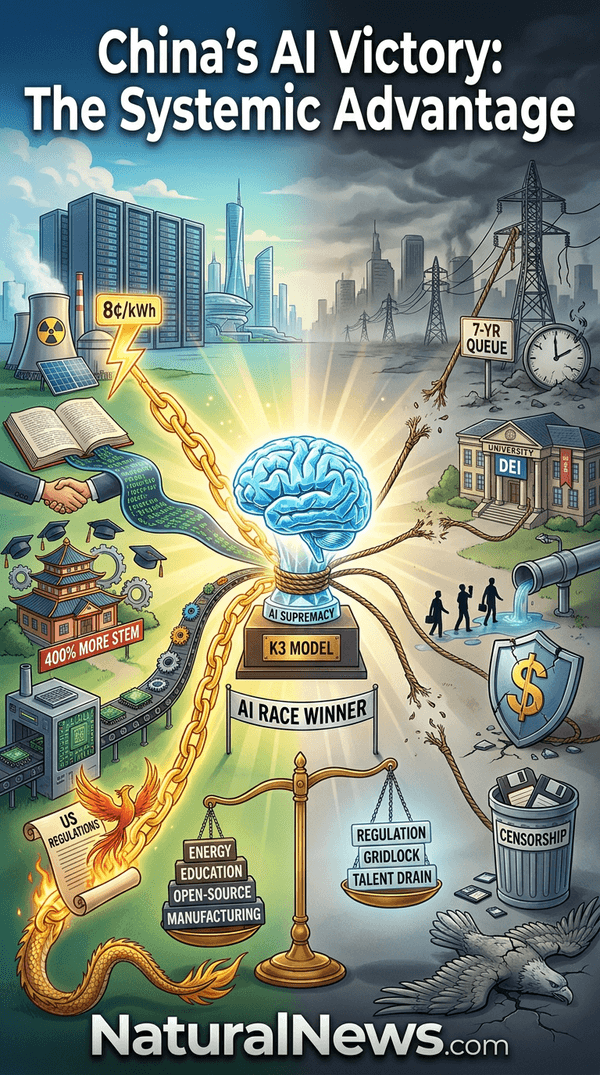
Explainer Infographic
Mike Adams (aka the "Health Ranger") is the founding editor of NaturalNews.com, a best selling author (#1 best selling science book on Amazon.com called "Food Forensics"), an environmental scientist, a patent holder for a cesium radioactive isotope elimination invention, a multiple award winner for outstanding journalism, a science news publisher and influential commentator on topics ranging from science and medicine to culture and politics.
Mike Adams also serves as the lab science director of an internationally accredited (ISO 17025) analytical laboratory known as CWC Labs. There, he was awarded a Certificate of Excellence for achieving extremely high accuracy in the analysis of toxic elements in unknown water samples using ICP-MS instrumentation.
In his laboratory research, Adams has made numerous food safety breakthroughs such as revealing rice protein products imported from Asia to be contaminated with toxic heavy metals like lead, cadmium and tungsten. Adams was the first food science researcher to document high levels of tungsten in superfoods. He also discovered over 11 ppm lead in imported mangosteen powder, and led an industry-wide voluntary agreement to limit heavy metals in rice protein products.
Adams has also helped defend the rights of home gardeners and protect the medical freedom rights of parents. Adams is widely recognized to have made a remarkable global impact on issues like GMOs, vaccines, nutrition therapies, human consciousness.




Please contact us for more information.


