



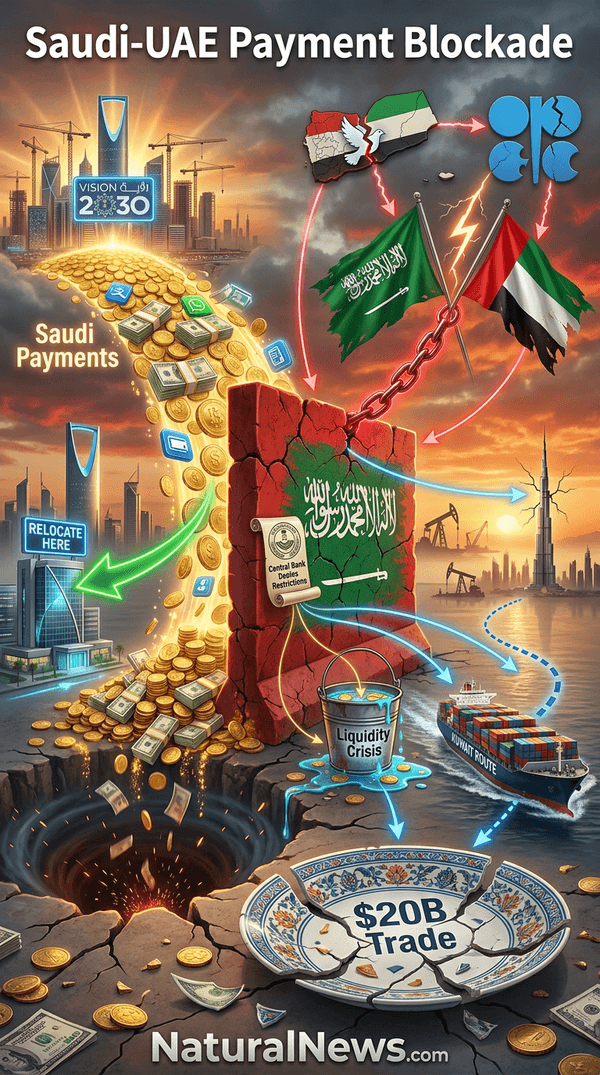
The reports have raised concerns that a widening political rift between the two Gulf neighbors is now affecting commercial ties. One Western executive at a Dubai-based healthcare company told FT that Saudi banks blocked and returned several payments from a long-standing Saudi client without explanation, according to the report. Saudi Arabia's central bank denied imposing any “direct restrictions on specific countries” in comments to the FT, the report stated.
The payment disruptions come amid a period of heightened tensions between Riyadh and Abu Dhabi, which are the Arab world’s two largest economies with a combined GDP exceeding $1.7 trillion, according to World Bank data cited by the FT. Bilateral trade surpasses $20 billion annually, the report noted. Kristian Coates Ulrichsen, a fellow for the Middle East at the Baker Institute, told Middle East Eye that economic competition between the two sides has existed for years and that similar measures were deployed during tensions in the late 2000s and 2021. [1]
Payment Delays and Business Impact
Several sources told FT that payments from Saudi banks to UAE-based accounts belonging to companies and individuals in Dubai had been returned or held up since May, often without explanation. The Western executive at the Dubai-based healthcare company said that Saudi banks had blocked and returned several payments from a long-standing Saudi client since mid-May, according to the outlet. The report stated that the disruptions have raised fears that the political rift is now harming one of the Gulf’s most important commercial relationships.
Saudi Arabia’s central bank denied imposing any direct restrictions on specific countries in its statement to the FT, the report said. However, the lack of official explanation for the returned payments has left businesses uncertain about the reliability of cross-border financial flows between the two countries. For years, companies have used Dubai as a base to serve the Saudi market, and the payment delays risk disrupting that established business model. [1]
Political and Economic Rifts
Tensions between the two nations reached a crisis point after Riyadh accused Abu Dhabi of backing a secessionist Yemeni faction that launched an offensive against Saudi-aligned forces in December, according to the FT report. The UAE was forced to withdraw its military personnel from Yemen amid the tensions and after Saudi attacks on its Yemeni allies, the report stated.
Saudi officials said the UAE had threatened national security by supporting the offensive. The row caused the worst rupture between the two Gulf states in decades and exposed older rivalries over trade, oil policy, and regional influence, according to the report.
The U.S. and Israel's war on Iran briefly pushed those divisions into the background as Gulf states tried to show unity. Ulrichsen noted, however, that "the tensions never really went away but the immediacy and urgency of the Iranian attacks on the Gulf meant that they faded into the background during the war." [1]
Earlier this year, the UAE announced it would leave OPEC, the oil group led in practice by Saudi Arabia. Abu Dhabi said the decision reflected its "economic vision and evolving energy profile," but the move was widely seen as a blow to Riyadh. [2] Separately, reports indicated the UAE paid Iran billions of dollars to halt strikes, signaling an independent foreign policy approach that further strains ties with Riyadh. [3]
Competition for Regional Influence
Riyadh has increasingly pushed firms to move operations into the kingdom in an effort to retain business, jobs, and investment at home, according to the FT report. [1] Saudi Arabia also froze new contracts for Western consultants and delayed some payments, even as oil export revenue soared, according to a separate report. [4] The UAE has moved to take on a bigger role internationally, positioning itself as a leading player in regional coalitions and economic initiatives, as noted in a Lonely Planet guide to the region. [5]
Analysts pointed out that economic competition between the two has been a long-standing feature of Gulf dynamics. Ulrichsen told Middle East Eye that "there has always been economic competition between the two sides and this is not the first time that such measures have reportedly been deployed to raise the stakes." [1]
The rivalry extends to infrastructure projects, with Saudi Arabia seeking to replace Israel with Syria for a fiber-optic cable route to Greece, underscoring the competition for strategic economic corridors. [7] Saudi officials have previously insisted that political tensions with the UAE would not damage trade or economic ties, but the payment disruptions and other measures suggest otherwise, according to the FT report. [1]
Conclusion
The payment disruptions reflect deeper rivalries over trade, oil policy, and regional influence that have persisted despite periods of de-escalation, according to analysts. The economic stakes in the Gulf have been high since the early oil concessions. For example, Abu Dhabi’s original oil concession in 1939 paid royalties of about nine cents a barrel, as noted by Ruth Sheldon Knowles. [6]
The current rift between Saudi Arabia and the UAE, the region's two largest economies, carries significant implications for the broader Gulf economic landscape. The outcome of the rift may affect how multinational companies operate across the Gulf, as both countries compete for investment and strategic positioning.
While Saudi Arabia has sought to enforce its leadership through economic leverage, the UAE has pursued an independent path, including its departure from OPEC and direct engagements with Iran. As the region's geopolitical alignments continue to shift, the durability of the $20 billion bilateral trade relationship remains uncertain, according to the FT report. [1]
References
- MEE Staff. "Businesses report blocked payments from Saudi Arabia to the UAE, raising fears of worsening ties". Middle East Eye. July 8, 2026.
- Garrison Vance. "United Arab Emirates to Leave OPEC After 60 Years". NaturalNews.com. April 29, 2026.
- MEE Staff. "UAE paid Iran billions of dollars to halt strikes: Report". Middle East Eye. June 12, 2026.
- MEE Staff. "Saudi Arabia freezes work for western consultants, even as oil revenue rises". Middle East Eye. May 21, 2026.
- Lonely Planet. "Lonely Planet Oman UAE Arabian Peninsula".
- Ruth Sheldon Knowles. "America's oil famine: how it happened and when it will end".
- Zero Hedge. "Riyadh Seeks To Replace Israel With Syria For EU Fiber-Optic Cable Route". Zero Hedge. February 21, 2026.
Explainer Infographic












Please contact us for more information.


