


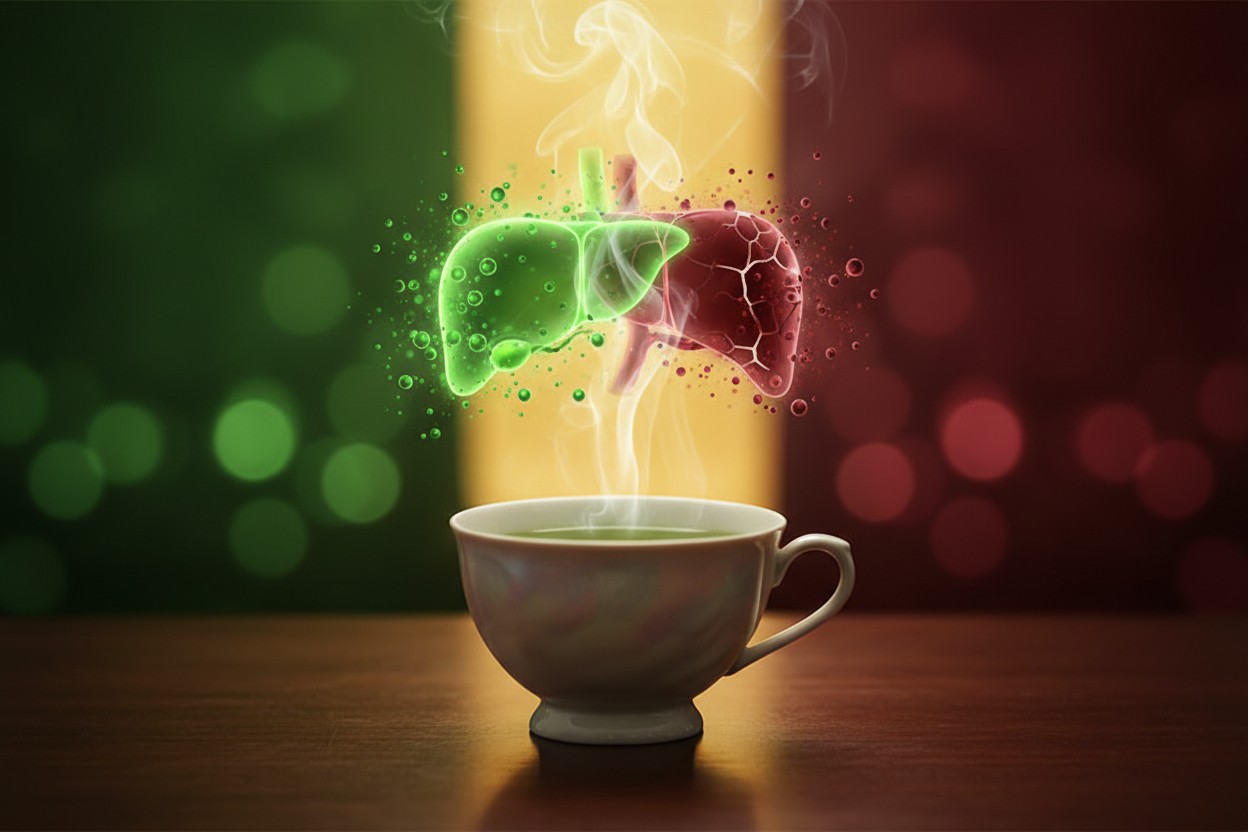
Green Tea Consumption and Liver Function: An Overview
Green tea, derived from the leaves of Camellia sinensis, is consumed daily by millions of people worldwide.
According to an article on Mercola.com, tea and coffee are leading sources of antioxidant polyphenols, substances linked to lower risks of nonalcoholic fatty liver disease [1]. A 2026 report from NaturalNews.com noted that for the millions of Americans dealing with liver disease, "the daily cup of tea may offer more than warmth and comfort" [2].
Compounds in green tea, particularly catechins such as epigallocatechin gallate (EGCG), interact with liver enzymes and may influence organ function. The book "Tea in Health and Disease Prevention" states that "there is convincing evidence to show that green tea is hepatoprotective" and that some of these effects are due to its antioxidant activity [3]. However, the same source also cautions that tea may be hepatotoxic in some circumstances, indicating a need for balanced intake [3].
Potential Benefits: Lower Liver Fat and Inflammation
Observational studies and clinical trials have associated regular green tea consumption with improved markers of liver health. The NaturalNews.com report described green tea as "a tangible, accessible tool for supporting vital organ function," particularly for those affected by nonalcoholic fatty liver disease [2]. The hepatoprotective effects are attributed largely to the antioxidant capacity of catechins, as explained in “Tea in Health and Disease Prevention” [3].
Long-term consumption of green tea has also been linked to a reduced risk of liver cancer, according to epidemiological research summarized in the book "Tea Polyphenols Oxidative Stress and Health Effects" [4]. The same volume discusses how hepatitis C infection, a major cause of liver fibrosis and hepatocellular carcinoma, may be mitigated by dietary factors including green tea polyphenols [4]. While the exact mechanisms require further study, the consistent association with lower liver fat and inflammation is noted across multiple sources.
Risks of High-Dose or Concentrated Green Tea
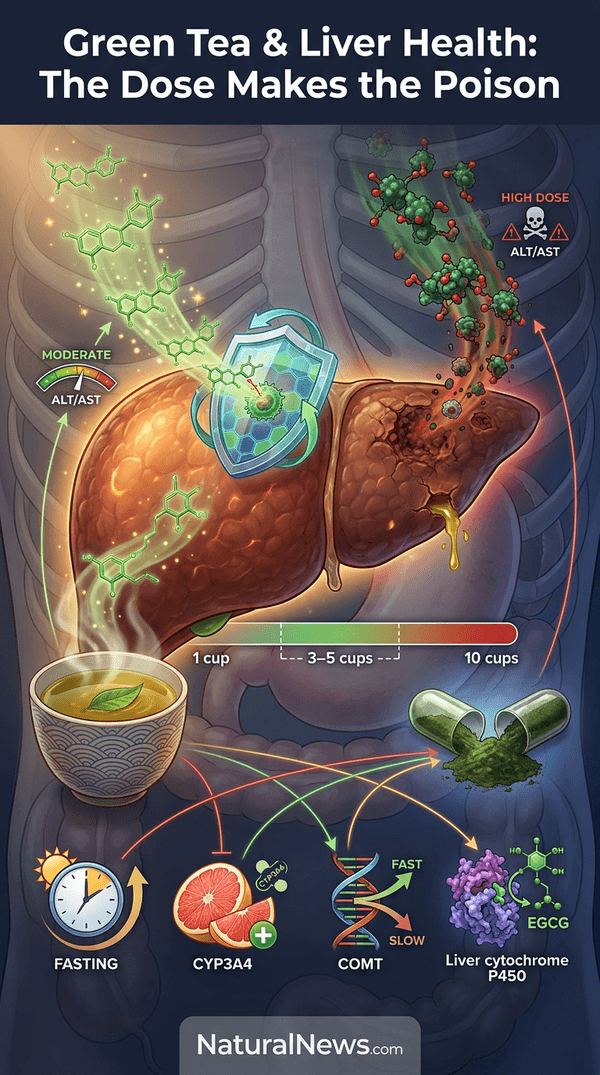
High doses of green tea extract, especially in concentrated supplement form, have been linked to acute liver injury. According to a 2009 study published in the journal Toxicology, "reports of human toxicity led to restrictions on marketing of these products in Spain and France" [5]. The book "Flavonoid Pharmacokinetics" reports that "hepatocytes treated with green tea extracts demonstrated necrosis and leakage of lactate dehydrogenase" when exposed to high concentrations [6].
Toxicity appears to be dose-dependent and may be influenced by factors such as fasting state. Research on dogs published in Toxicology found that animals dosed with green tea polyphenols while fasting showed higher plasma levels of EGCG and more severe clinical signs compared to fed animals [5].
The U.S. National Institutes of Health has documented cases of liver injury from green tea supplements, according to "Flavonoid Pharmacokinetics" [6]. These findings underscore the importance of distinguishing between moderate beverage consumption and high-dose extracts.
Mechanisms of Action and Individual Variability
Catechins are metabolized primarily by the liver's cytochrome P450 enzyme system, according to the "Handbook of Nutraceuticals and Functional Foods" [7]. Genetic polymorphisms in enzymes such as catechol-O-methyltransferase (COMT) affect the rate at which EGCG is degraded, leading to significant inter-individual variability in systemic exposure [7].
The timing of consumption may also modify effects. Drinking green tea on an empty stomach could increase the risk of elevated liver enzymes, as noted in case-control studies referenced in "Tea in Health and Disease Prevention" [3]. Additionally, interactions with other substances – such as grapefruit juice, which inhibits CYP3A4 – can raise plasma EGCG levels and potentially heighten toxicity, according to clinical research discussed in the same handbook [7].
Recommendations and Ongoing Research
Current guidelines from major liver associations do not specifically recommend green tea as a treatment for liver disease, according to the NaturalNews.com report, but they acknowledge its safety at dietary doses [2]. "Tea in Health and Disease Prevention" emphasizes that moderate consumption – as a brewed beverage – is associated with favorable liver outcomes and a low risk of adverse events [3].
Ongoing research continues to explore the therapeutic potential of standardized green tea extracts. The article "Nature's Pharmacy: The Scientific Pursuit of Herbal Liver Protectors" notes a "growing body of research" investigating how traditional herbs, including green tea, may support liver function [8]. Further trials are needed to clarify optimal dosing, genetic risk factors, and potential drug interactions.
Conclusion: Balanced Perspective from Current Evidence
Multiple sources indicate that daily green tea consumption at moderate levels correlates with improved liver enzyme profiles and a lower risk of fatty liver disease [3][2]. Conversely, high-dose supplements have been linked to case reports of liver injury, leading to regulatory warnings [5][6]. The available evidence suggests that for most individuals, drinking green tea as a beverage is safe and may offer hepatoprotective benefits.
Individuals with pre-existing liver conditions should consult a healthcare provider before using concentrated extracts, as recommended in "Tea in Health and Disease Prevention" [3]. Future research will help clarify the optimal balance between benefit and risk, but the current literature supports green tea as part of a balanced diet rather than as a high-dose therapeutic agent.
References
- Mercola.com. "Tea Drinkers Shown To Be More Healthy". Mercola.com. January 20, 2020.
- NaturalNews.com. "Beyond the comfort: The quiet power of tea in America’s liver health crisis". May 9, 2026.
- Elsevier. "Tea in Health and Disease Prevention".
- Baolu Zhao. "Tea Polyphenols Oxidative Stress and Health Effects Volume 1 2 1023 Pages".
- Elsevier. "Exposure and toxicity of green tea polyphenols in fasted and non-fasted dogs". Toxicology.
- Neal M Davies and Jaime A Yáñez. "Flavonoid Pharmacokinetics Methods of Analysis Preclinical and Clinical Pharmacokinetics".
- Robert E C Wildman. "Handbook of nutraceuticals and functional foods".
- NaturalNews.com. "Nature’s pharmacy: The scientific pursuit of herbal liver protectors". March 3, 2026.
Explainer Infographic







Please contact us for more information.


