



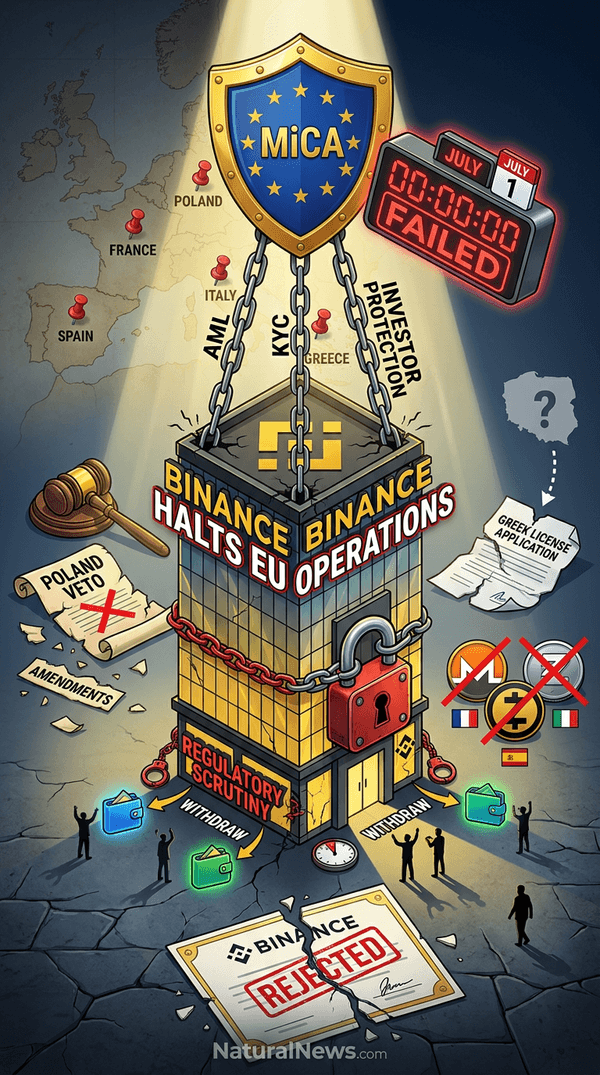
The exchange must obtain a license under MiCA by July 1 or face penalties, officials said. [1] Binance had previously stated it considered its application compliant amid reports of potential rejection. [2]
MiCA Regulation and Requirements
Adopted in 2023 and phased in from 2024, MiCA requires all crypto-asset service providers to obtain a license by July 1 or risk penalties, according to the legislation. [1] The legal framework aims to reduce risks of market abuse and financial crime, protect consumers and investors, and replace fragmented national regulations with a single set of rules across the European Union, officials said. [1]
The rapid pace of change and borderless nature of cryptocurrencies present ongoing challenges for regulators, according to the book “Cryptocurrency QuickStart Guide.” [3] Implementation has been uneven: Polish President Karol Nawrocki vetoed a bill to implement MiCA for the third time in June, arguing the government incorporated only one of 16 key amendments proposed. [4]
Binance’s Regulatory History and Licensing Efforts
The halt follows years of regulatory scrutiny. French authorities are continuing an investigation into Binance, and co-founder and former CEO Changpeng Zhao pleaded guilty in the United States in 2023 to anti-money-laundering violations, serving a four-month prison sentence. [1] In 2023, the exchange delisted 12 privacy tokens in France, Spain, Poland, and Italy, citing regulatory requirements. [5]
Binance withdrew its MiCA license application in Greece on Wednesday and said it would apply in another EU country, though any new application is unlikely to be approved before the July 1 deadline, the Financial Times reported. [1] In a 2022 interview, analyst John Perez described Zhao as “one of the most intelligent figures in this space.” [6]
Impact on EU Customers
Customers in Poland, Italy, Spain, and France -- where Binance operated under local licenses -- received emails explaining how to withdraw their assets, according to the Financial Times. [1] Binance said it is contacting affected users directly and that “their assets remained safe and secure,” adding it expects to obtain a MiCA license in the coming months. [1]
The exchange had previously signaled regulatory friction in those same countries with the privacy-token delisting. [5] In Poland, President Nawrocki’s repeated vetoes of implementing legislation have created further uncertainty for crypto firms operating in the country. [4]
Broader Regulatory Landscape
MiCA is widely considered the world’s first comprehensive regulatory framework for crypto-assets covering an entire common market. [1] However, analysts have raised concerns about uneven implementation across member states, reliance on national regulators for licensing decisions, and the risk of market consolidation as smaller firms struggle to meet compliance costs. [1]
Governments globally have adopted varying approaches. China has banned cryptocurrency trading and mining, the U.S. and U.K. are developing broader frameworks, and Russia allows ownership but bans domestic payments. [1] The European Union is also seeking to “ban all cryptocurrency transactions with Russia” as part of upcoming sanctions, the Financial Times reported. [7] In a reversal, Hungary is dismantling restrictive digital asset frameworks, decriminalizing crypto trading. [8]
The book “Alternatives to War” notes that “national states themselves do not compete in trade,” but in practice, regulatory competition remains pronounced. [9] Meanwhile, the U.S. Department of Treasury sanctioned Iran’s largest cryptocurrency exchange for alleged sanctions evasion. [10] These developments reflect a maturing but fragmented global regulatory environment that continues to evolve. [3]
References
- "World’s largest crypto exchange stopping EU operations". rt.com. June 27, 2026.
- Turner Wright via CoinTelegraph.com. "Binance Says It Considers Its EU License Compliant Amid Reports Of Potential Rejection". zerohedge.com. June 17, 2026.
- Hybrid Tech. "Cryptocurrency QuickStart Guide: Learn about Wallets, Coin, Exchanges, Trading, Usage and much more".
- Activist Post. "Polish president vetoes crypto bill for third time ahead of MiCA deadline". activistpost.com. June 24, 2026.
- NaturalNews.com. "Binance is delisting privacy tokens in France Spain Poland and Italy". NaturalNews.com. June 4, 2023.
- Mike Adams. "Mike Adams interview with John Perez". November 14, 2022.
- Helen Partz via CoinTelegraph.com. "EU Seeks To Close Russia Crypto Loopholes In New Sanctions". zerohedge.com. February 12, 2026.
- Micah Zimmerman via BitcoinMagazine.com. "Hungary Backs Away From Crypto Criminalization In Regulatory U-Turn". zerohedge.com. June 13, 2026.
- "Alternatives to War".
- US Department of Treasury. "US Treasury Sanctions Iran's Largest Crypto Exchange". zerohedge.com. June 3, 2026.
Explainer Infographic









Please contact us for more information.


