


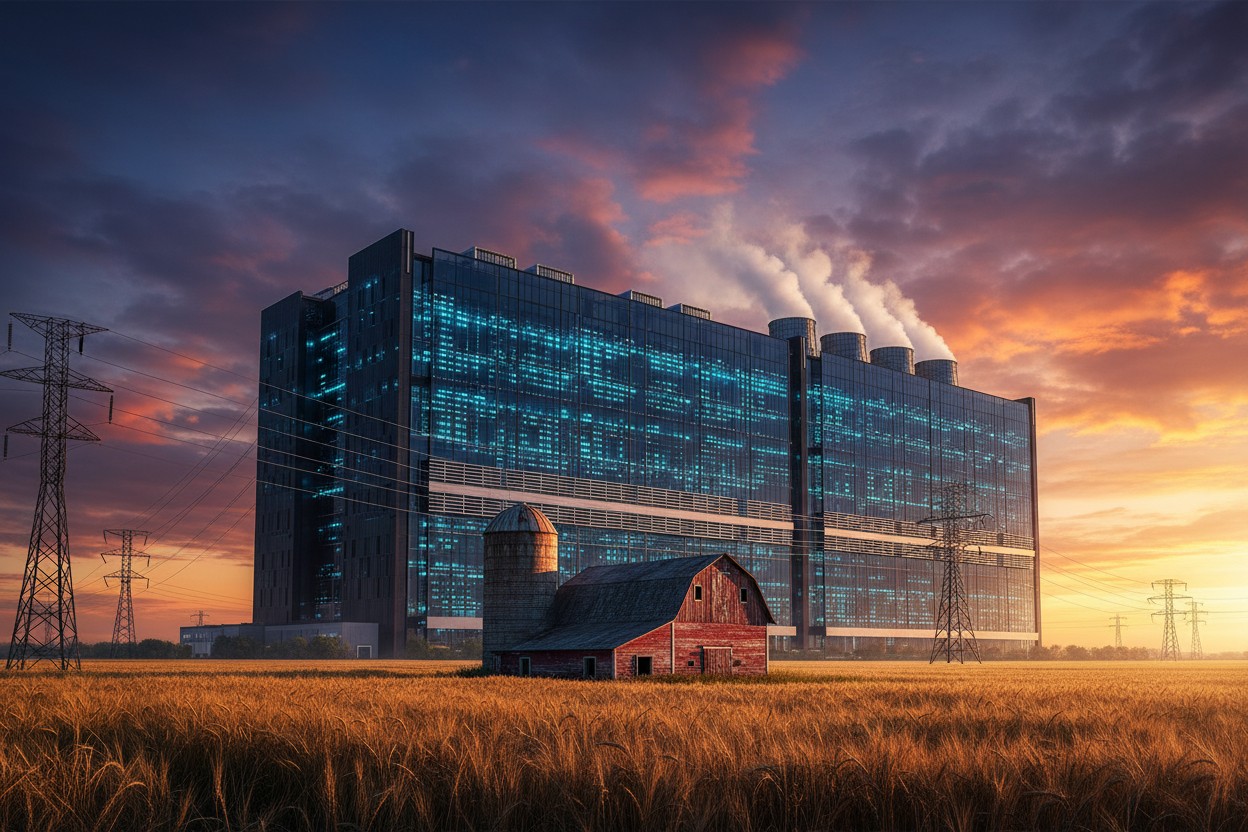
- Pennsylvania has become ground zero for a national backlash against AI data centers, with four competitive congressional districts at stake in the 2026 midterm elections
- Data centers consume enormous resources—Texas projects could use 400 billion gallons of water annually by 2030—while generating only 15-30 permanent jobs per facility
- Local opposition has delayed or blocked 48 data center projects nationwide in 2025, affecting $156 billion in potential investment
- Republican incumbents in swing districts face mounting pressure as rising electricity costs—up 21.7% in Pennsylvania alone—spur bipartisan voter anger
- Communities across the country are using zoning ordinances, setback requirements and impact studies to regulate where data centers can be built
The collision of technology and community
The AI revolution has arrived in America's small towns, but not with the promised wave of prosperity. Instead, communities from Pennsylvania to Texas are discovering that the data centers powering artificial intelligence come with a steep price: depleted water reserves, rising electric bills and transformed landscapes that residents never voted for.
In Archbald, Pennsylvania—a borough of 7,500 residents in the Lackawanna Valley—proposals for multiple data centers would cover 14% of the town's area. In Northern Virginia, surveyors mapping a 67-mile, 500,000-volt power line for data centers have faced threats from local residents. And in Texas, data centers are projected to consume 400 billion gallons of water annually by 2030, competing directly with human needs and agriculture during a Central Texas drought.
This is not merely a local zoning dispute. It has become a central political battleground that could determine control of the U.S. House of Representatives in the 2026 midterm elections.
The political earthquake: Swing districts and rising electricity bills
Four competitive congressional districts in eastern Pennsylvania have become flashpoints in the data center debate. All four are currently held by Republicans, and all four are considered in play by the Cook Political Report. The stakes are high: Republicans hold only a five-seat majority in the House.
The issue cuts across party lines in unusual ways. An unlikely coalition of environmental activists and populist Trump supporters has formed to oppose data center construction. "In my 10 years of organizing, I have never seen anything like this groundswell of opposition," said Ginny Marcille-Kerslake, eastern Pennsylvania senior organizer for Food & Water Watch.
The driving force behind this backlash is simple: money. American electric bills rose 8.3% nationwide in 2025, but Pennsylvania residents saw a staggering 21.7% increase, according to the U.S. Energy Information Administration. Voters are connecting these rate hikes directly to data center construction.
Political analyst Chris Borick, director of the Muhlenberg College Institute of Public Opinion, described the situation as a tightrope for Republican incumbents. "They're really caught between counteracting forces," he said. "A lot of these folks are in uncomfortable, challenging positions to begin with, and data centers have layered another challenge."
Republican Rep. Scott Perry, whose 10th District race in 2024 was one of the closest in the country, has attempted to distance himself from the issue. "At the end of the day, most of this stuff is local issues for local municipalities," Perry said.
But voters in South Whitehall Township, where a six-building data center complex is proposed across from a high school, are not buying that argument. Residents like Cheryl Lutz worry about property values and quality of life, and they expect their representatives to take a stand.
The resource war: Land, water and power
The competition between AI data centers and human communities is fundamentally a competition for three essential resources: land, water and electricity.
In Texas alone, data centers in Dallas, Fort Worth, Houston and Austin are projected to consume 400 billion gallons of water annually by 2030. This is water that citizens will not have access to, in a state already experiencing drought conditions.
In Pennsylvania, data centers are consuming farmland and displacing agricultural operations. Rep. G.T. Thompson, a Republican who represents a safe seat in north-central Pennsylvania, said he hears constant complaints from farmers. "I don't really want these on prime farmland," Thompson said. "Energy-wise, I also don't really want them on the grid."
The environmental impacts extend beyond water use. Data centers create heat island effects, raising local air temperatures by an average of 3.6 degrees Fahrenheit. Diesel generators contribute to air pollution and worsen respiratory conditions. The constant hum of cooling systems creates noise pollution that residents describe as unbearable.
What communities can do: Zoning and resistance
Despite the power of the tech industry, local communities are fighting back with an increasingly sophisticated arsenal of legal and regulatory tools.
In Pennsylvania, municipalities have amended zoning ordinances to restrict data centers to industrial zones, establish setback distances ranging from 50 to 400 feet, and require noise studies, environmental impact assessments, and emergency response plans as part of any application.
Michael Helbing, a law professor at Penn State and executive director of its Center for Energy Law and Policy, has documented how communities can protect themselves. "By updating ordinances in advance and diligently collecting information about any data center proposals that are made, local officials and citizens can protect the best interests of their communities," Helbing wrote.
Some municipalities designate data centers as "conditional uses," requiring approval from the governing body rather than allowing construction by right. Others have negotiated community benefits agreements that require developers to provide local workforce guarantees or infrastructure improvements.
In Maine, the state legislature has approved what could be the first statewide ban on data center construction. In Pennsylvania, lawmakers are considering a three-year moratorium on hyperscale data centers—those exceeding 5,000 servers and 10,000 square feet.
The 2026 election: A referendum on AI's human cost
The data center debate is not going away. In Pennsylvania's 7th District, where freshman Republican Rep. Ryan Mackenzie faces a tough reelection battle, Democratic challengers have seized on rising electricity prices to attack the incumbent. In the 8th District, Republican Rep. Rob Bresnahan faces similar pressure.
The numbers tell the story. Data center opposition delayed or blocked 48 projects across the country in 2025, affecting $156 billion in potential investment, according to Data Center Watch, a project of the nonpartisan AI safety research firm 10a Labs.
Political analysts say the issue is uniquely damaging to incumbents because it requires taking a clear position on a controversial topic that affects every voter's pocketbook. "The challengers are at the advantage on this," Borick said. "Because a lot of this is going to be, rightly or wrongly, laid at the feet of the incumbents."
The fight for local control
The battle over AI data centers represents a fundamental question about who controls the future of American communities. Tech companies argue that data centers are essential infrastructure for the 21st century economy, necessary to maintain global competitiveness. Local residents counter that no amount of technological progress justifies destroying the character of their towns, depleting their water supplies, and driving up their electric bills.
In Archbald, Pennsylvania, teacher Kayleigh Cornell and ICU nurse Sarah Gabriel have become unlikely community leaders in the fight against data center proposals. "People live here because of the quality of life," Cornell said. "Yes, obviously you need jobs. But this would be intrinsically changing the character of Archbald Borough."
As the 2026 midterm elections approach, voters across the country are asking their representatives the same question. And the answers they receive may determine not only control of Congress, but also the future balance between technological progress and community preservation. The AI revolution is coming to Main Street. The question is whether Main Street will have any say in the matter.
Sources for this article include:




Please contact us for more information.


