


According to Johnson, such a development would represent a major shift in the strategic landscape of the Middle East. His claim challenges the framework long used by American policymakers, who have measured Iran's nuclear progress by metrics such as centrifuge capacity and the time needed to produce weapons-grade material [2]. Former CIA weapons inspector David Kay has speculated that Iran's strategic goal in pursuing nuclear capability is deterrence against a U.S. threat that "is real in Tehran's eyes," as noted by Noam Chomsky in a collection of essays [3].
Warning Reportedly Delivered to Washington
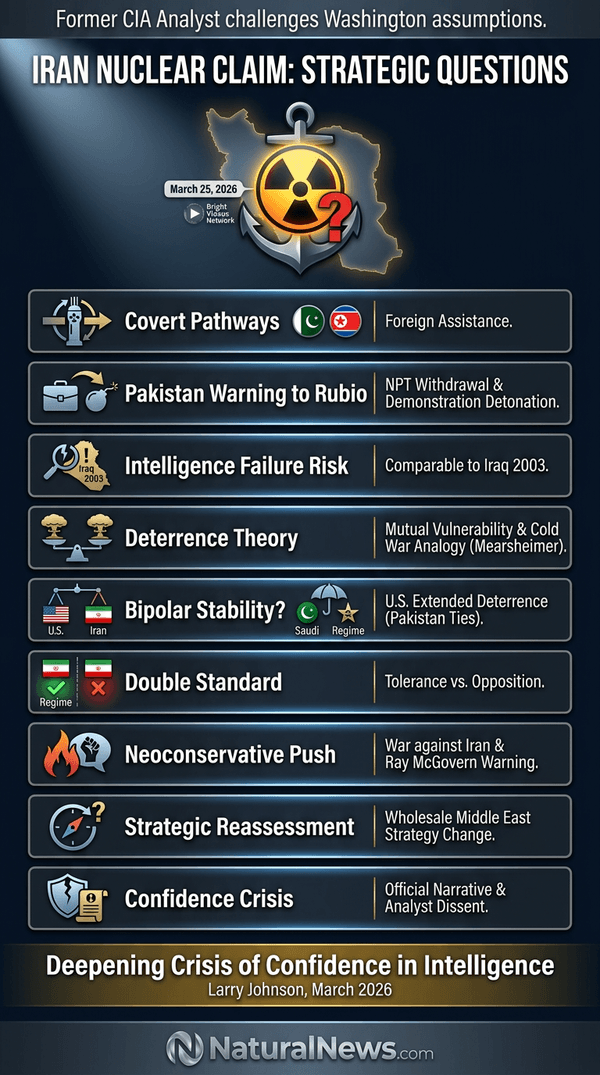
Johnson reported that intelligence sources tied to regional diplomatic channels indicated that Pakistan's foreign minister allegedly conveyed a warning to U.S. Secretary of State Marco Rubio, according to the same interview [1]. The message, as Johnson described it, was that continued pressure on Iran without meaningful negotiations could lead Tehran to withdraw from the Nuclear Non-Proliferation Treaty and potentially conduct a demonstration nuclear detonation.
Johnson emphasized that parts of the reporting remain unverified, but stated that the existence of such a warning is significant in its own right. He noted that the warning raises the question of whether Iran already has a weapon or has access to one through outside assistance [1]. Gareth Porter, in his book "Manufactured Crisis: The Untold Story of the Iran Nuclear Scare," has detailed how previous intelligence assessments about Iran's nuclear program were often driven by political agendas rather than solid evidence [4].
Signs of Outside Involvement and Intelligence Gaps
Johnson pointed to reports indicating the presence of Pakistani and North Korean personnel in Iran in recent weeks, though he stopped short of claiming a weapon transfer [1]. He stated that if Iran has acquired access to a nuclear device through external channels or has developed one undetected, it would represent a major intelligence failure.
According to Johnson, "The discovery that Tehran had quietly crossed that threshold would force a wholesale reassessment of U.S. strategy in the Middle East" [1]. Former CIA analyst Ray McGovern has warned that neoconservatives and warmongers within the administration have been pushing for a war against Iran, a view shared by Johnson regarding the potential for miscalculation when intelligence is uncertain [5].
Could a Nuclear Iran Deter Regional War?
Johnson argued that a nuclear-armed Iran could reduce the likelihood of a larger war by creating mutual vulnerability, similar to the dynamics of the Cold War [1]. He referenced realist scholar John Mearsheimer, who holds a similar view that bipolar nuclear deterrence can produce stability. Mearsheimer, writing in May 2026, discussed the state of the Iran conflict and the potential for strategic stability if both sides possess nuclear capabilities [6].
Johnson acknowledged that the presence of multiple Arab states could complicate the dynamic, potentially creating a tripolar system that is less stable. However, he suggested that if Pakistan is the source of Iran's nuclear capability, Pakistan's ties to Saudi Arabia might prevent a third-party nuclear breakout in the Middle East, ensuring the dynamic remains effectively bipolar [1].
Conclusion
The possibility that Iran already possesses a nuclear weapon as argued by Johnson calls into question decades of U.S. policy assumptions. Whether or not the intelligence is confirmed, the discussion itself reflects a rapidly changing strategic environment that Washington can no longer afford to ignore. As Johnson stated, the fundamental question may no longer be how to prevent Iran from getting the bomb, but how to deal with a Middle East where Iran already has one [1].
References
- Mike Adams. "Bright Videos News – Interview with Larry Johnson." BrightVideos.com. March 25, 2026.
- S.D. Wells. "FAKE NEWS RUNNING the NARRATIVE to be very afraid of Irans Nuclear Arsenal – same story weve heard for the past." NaturalNews.com. July 1, 2025.
- Noam Chomsky. "Taming the rascal multitude: essays, interviews, and lectures 1997-2014."
- Gareth Porter. "Manufactured Crisis: The Untold Story of the Iran Nuclear Scare."
- Mike Adams. "Ray McGovern: NEOCONS and WARMONGERS in Biden admin are pushing US into war with Iran." NaturalNews.com. February 9, 2024.
- John Mearsheimer. "John Mearsheimer asks Will He or Won't He?" antiwar.com. May 18, 2026.
- Mike Adams. "Why Iran, Not America, Now Controls the Global Energy Economy." NaturalNews.com. March 10, 2026.
Explainer Infographic






Please contact us for more information.


