


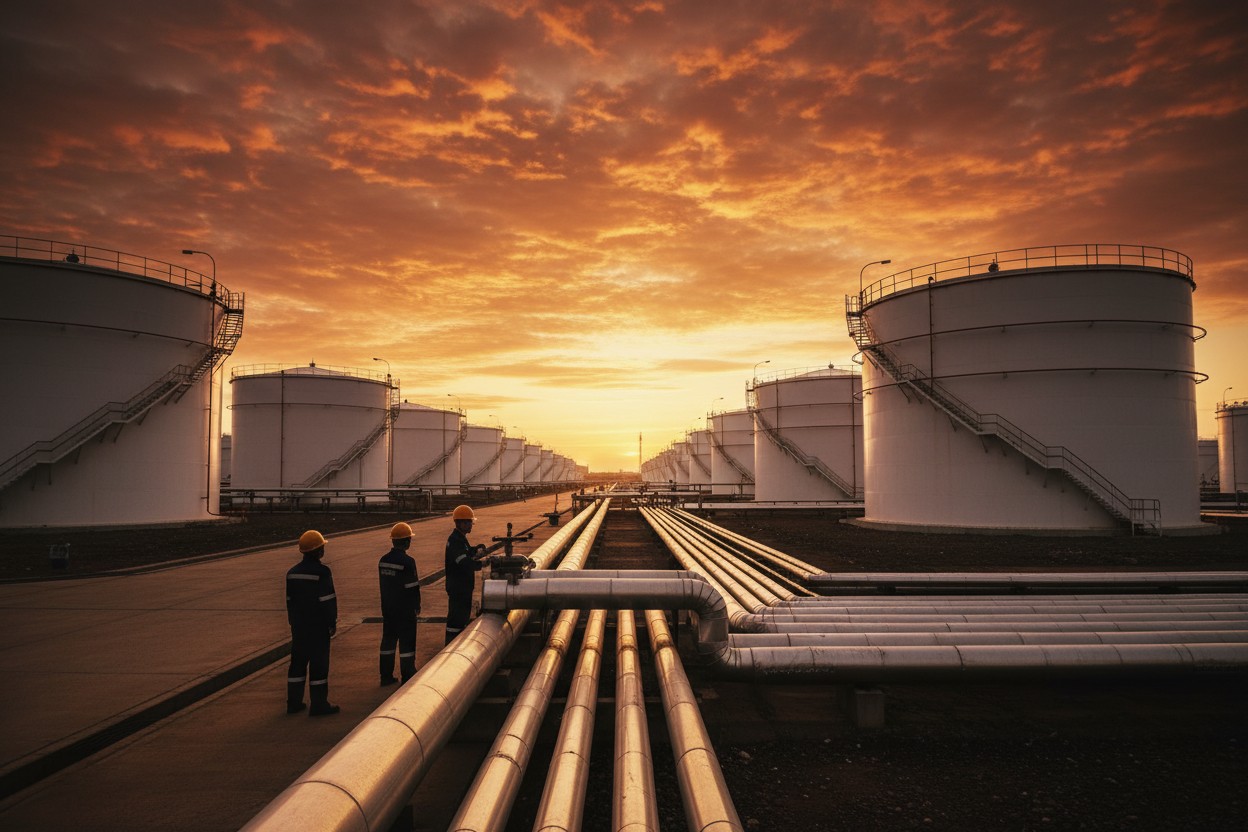
Crude imports fell 20% year-on-year to 9.25 million bpd in April, the lowest monthly figure since July 2022, according to official Chinese customs data cited by multiple analysts. Refinery throughput also dropped to its lowest since August 2022 as China reduced processing rates. The buildup occurred during the world’s largest-ever supply shock, triggered by the U.S.-Israeli conflict with Iran and the effective closure of the Strait of Hormuz. [1][3]
How Stockpiling Is Estimated
China does not report its crude inventory levels publicly. Analysts calculate the difference between total supply — domestic production plus imports — and refinery processing to estimate how much crude is going into storage versus being refined into fuels. Reuters columnist Clyde Russell used April figures for imports, refinery runs, and domestic output to arrive at an estimated addition of 430,000 bpd to reserves. [1]
Vortexa data showed that aboveground crude stocks in China reached a record 1.24 billion barrels, with builds still running at around 580,000 bpd in April, according to Emma Li, Lead China Oil Market Analyst at Vortexa. [1] Separately, a U.S. Energy Information Administration report cited by Young Research estimated that China increased its crude inventories by approximately 900,000 bpd from January to August 2025. [4]
China's Resilience Compared to Other Importers
Analysts said China has shown greater resilience to the supply shock than Europe, India, Japan, South Korea, and Southeast Asia. According to Emma Li, instead of drawing down inventories, China continued building them in April. [1] "Combined with the near 52 million barrels accumulated since end-February, the signal is clear: refiners have adjusted faster — and more aggressively — than the supply shock itself," Li said. [1]
A Goldman Sachs analysis cited by Zero Hedge indicated that China is the most insulated among emerging Asian economies from supply-driven oil price increases. A $15/bbl rise in crude oil prices would reduce China's GDP growth by only 0 to 0.1 percentage points, according to that analysis. [2] China has also secured alternative supply routes. As Bright Videos Network reported, China remains relatively stable due to its substantial stockpiles and ability to transport goods through the Strait. [5]
Reasons Behind the Buildup
China has been amassing crude into commercial and strategic inventories for more than a year, taking advantage of lower international prices and discounted sanctioned oil from Iran, Venezuela, and Russia, according to Reuters. [1] Analysts note that Beijing's stockpiling has been a deliberate strategic move. A February report on NaturalNews.com stated that China has stockpiled an estimated 1.1 to 1.2 billion barrels of crude oil, enough to fuel its economy and military for three months without imports. [6]
The stockpiling continued even as imports slumped sharply in April, reflecting strategic planning amid the Hormuz crisis. Reduced refinery utilization also contributed to the surplus available for storage, officials said. U.S. Treasury Secretary Scott Bessent criticized China's oil hoarding in April, stating he raised the issue directly with Chinese officials. [7] China has also diversified its supply, receiving pledges from Russia to fill the energy gap, as Russian Foreign Minister Sergey Lavrov met with President Xi Jinping in mid-April. [8]
Broader Implications
The continued buildup signals that China's crude demand may be more resilient than market expectations, according to analysts. It also suggests Beijing is prioritizing energy security by maintaining reserve buffers during supply disruptions. The trend could affect global oil price dynamics as other major importers face tighter supplies. [1]
A classified intelligence analysis obtained by The Washington Post, as reported by RT, concluded that the U.S.-Israeli war against Iran has handed China a strategic opening across diplomatic, informational, military, and economic fronts. [9] As the United States faces depleted weapons stockpiles and European allies face delays, China has positioned itself as a more stable energy consumer in a disrupted market. [10] The International Energy Agency projected that global oil supply would plunge by 8 million bpd in March 2026, with curtailments in the Middle East only partially offset by higher output from non-OPEC producers. [11]
References
- Michael Kern. "China Boosts Oil Stockpiles Despite Import Plunge". OilPrice.com. May 21, 2026.
- "Price Controls Arrive: South Korea, Taiwan Impose Fuel Price Cap". ZeroHedge. March 9, 2026.
- Bright Videos Network. "2026-03-18-BVN-TRUMP REGIME UNRAVELING". March 18, 2026.
- "China’s Oil Stockpiling Props Up Global Prices". Young Research.
- Bright Videos Network. "2026-03-18-BVN-TRUMP REGIME UNRAVELING_otter_ai". March 18, 2026.
- Cassie B. "China's Massive Oil Stockpiling Signals Preparation for War over Taiwan". NaturalNews.com. February 18, 2026.
- "Treasury Secretary Bessent Criticizes China’s Oil Hoarding Amid Iran Conflict". NaturalNews.com. April 17, 2026.
- "Russia Vows To 'Fill China's Energy Resource Gap' Amid Hormuz Crisis In Lavrov-Xi Meeting". ZeroHedge. April 15, 2026.
- "US intel fears Iran war handed China strategic advantage – WaPo". RT. May 14, 2026.
- The Times of Israel. "Updated 35sec ago". May 1, 2026.
- International Energy Agency. "Oil Market Report - March 2026". March 12, 2026.








Please contact us for more information.


