


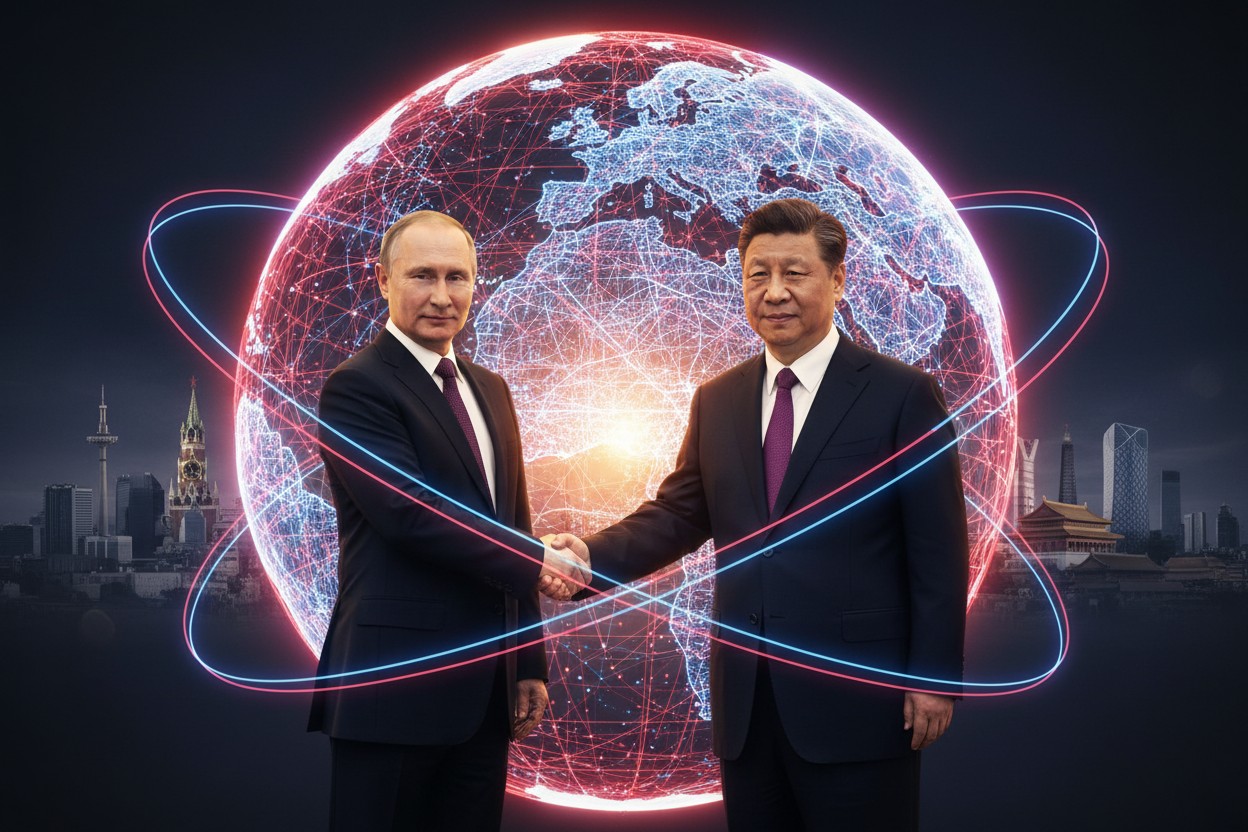
- Russian President Vladimir Putin arrived in Beijing on May 19, for a two-day summit with Chinese President Xi Jinping, timed to mark the 25th anniversary of the nations' cooperation treaty.
- Bilateral trade exceeded $240 billion in 2025, with trade turnover up nearly 20% in early 2026, as Russia shifts from European markets to Chinese buyers.
- Russia and China have phased out Western currencies in bilateral trade, with over 99% of transactions now conducted in rubles and yuan.
- Putin seeks Chinese approval for the Power of Siberia 2 pipeline, which would double Russian gas exports to China but remains stalled over pricing disputes.
- The visit follows U.S. President Donald Trump's state visit to Beijing, underscoring intensifying competition for Chinese allegiance.
Russian President Vladimir Putin arrived in Beijing on Tuesday for high-stakes talks with Chinese President Xi Jinping, seeking to reinforce what both nations describe as an unprecedented strategic partnership. The summit, which began May 19, and continues through Wednesday, comes just days after U.S. President Donald Trump concluded his own state visit to Beijing—a timing that analysts say is deliberate.
Putin is sending a message to Washington that Russia remains China's closest geopolitical ally despite any American overtures, according to Ed Price, senior non-resident fellow at New York University. The Russian leader needs diplomatic success in the East to sustain his territorial ambitions in Ukraine, Price told CNBC.
The summit formalizes what has become an increasingly asymmetrical relationship. Since Russia's full-scale invasion of Ukraine in February 2022, Moscow has lost access to European energy markets and Western technology, forcing a rapid pivot toward Beijing. China has absorbed discounted Russian oil, gas and coal while supplying machinery, electronics and dual-use technologies that sustain Russia's wartime economy.
Trade and financial realignment
Bilateral trade has surpassed $200 billion for three consecutive years, reaching $240 billion in 2025, according to customs data. In the first four months of 2026, trade turnover hit $85.2 billion, representing nearly 20% year-on-year growth.
China has remained Russia's largest trading partner for 16 consecutive years, while Russia has climbed into the top eight of China's trading partners. Moscow exports energy, raw materials and agricultural goods, while Beijing supplies machinery, vehicles, electronics and consumer products.
The financial infrastructure underpinning this trade has transformed dramatically. Russia and China have largely phased out Western currencies in bilateral transactions, with Russian Finance Minister Anton Siluanov reporting that over 99% of trade is now settled in rubles and yuan. This de-dollarization reduces Moscow's vulnerability to Western sanctions but creates new dependencies, including occasional yuan shortages and Beijing's upper hand in bilateral negotiations.
Energy: The power of Siberia stalemate
Energy remains the backbone of the Russia-China partnership, though the relationship shows signs of strain. The Power of Siberia pipeline, which launched in 2019, reached full design capacity in December 2024, delivering Russian natural gas to Chinese markets.
Putin's primary objective during this visit is securing approval for the long-delayed Power of Siberia 2 pipeline, which would deliver up to 50 billion cubic meters of gas annually via Mongolia. The project would double Russian pipeline exports to China and replace lost European markets.
China, however, appears in no hurry to approve the infrastructure project. Beijing has built substantial energy reserves and diversified its sources, according to Sergei Guriev, dean of the London Business School. Pricing disputes and technical details continue to stall negotiations. China can afford to wait until the Middle Eastern conflict concludes, Guriev told CNBC, giving Beijing significant leverage over Moscow's energy future.
Technology dependence deepens
Western sanctions have severed Russia's access to advanced semiconductors, microelectronics, precision machine tools and other dual-use goods critical for weapons production. China has filled the gap, supplying roughly 90% of Russia's sanctioned technology imports in 2025, according to Bloomberg.
Russian manufacturers now pay premiums of nearly 90% above pre-war prices for sanctioned goods, utilizing complex evasion networks through third countries. Chinese technology has enabled Russia to sustain and expand production of missiles, drones and other weapons, effectively keeping the wartime economy operational.
More than 90 joint projects worth approximately 18 trillion rubles ($253 billion) are currently being implemented under the bilateral investment commission across sectors including infrastructure, energy and logistics. These projects span aviation, nuclear energy and digital economy cooperation, further integrating the two economies.
Geopolitical calculations
Beijing's leverage over Moscow is expected to grow in coming years. Russia's dependence on Chinese markets, technology and financial infrastructure limits its strategic autonomy. Any breakthrough on pipeline construction would further tie Russia's energy future to China, reinforcing Beijing's advantage.
The summit's timing—immediately after Trump's Beijing visit—highlights the intensifying competition for Chinese allegiance. A thaw in U.S.-China relations would reduce China's incentive to fully align with Russia against the West, as Beijing prioritizes protecting its massive economic interests with the United States and Europe.
China has reportedly provided Russia with earth observation intelligence, satellite imagery for military purposes and drones, Bloomberg reported last year. Yet Beijing has stopped short of direct weapons exports, maintaining diplomatic distance from Russia's war while benefiting economically from Moscow's isolation.
A partnership of unequals
The Putin-Xi summit represents more than routine diplomatic engagement. It marks a structural shift in global power dynamics as Russia becomes increasingly dependent on Chinese economic support to sustain its wartime economy. Moscow has traded European integration for Chinese partnership, accepting growing asymmetries in exchange for survival.
Russia's energy exports to China have nearly doubled since February 2022, providing Moscow vital hard currency. In return, China has secured discounted energy supplies, expanded its technological influence over Russian industry and strengthened its position as the decisive power in Eurasia.
The partnership, while celebrated by both governments as a "no-limits" alliance, increasingly serves Chinese priorities. As Putin plays a long game in Ukraine, he must accept that his Eastern partner holds the upper hand—a reality that will shape the strategic landscape for decades.
Sources for this article include:






Please contact us for more information.


