


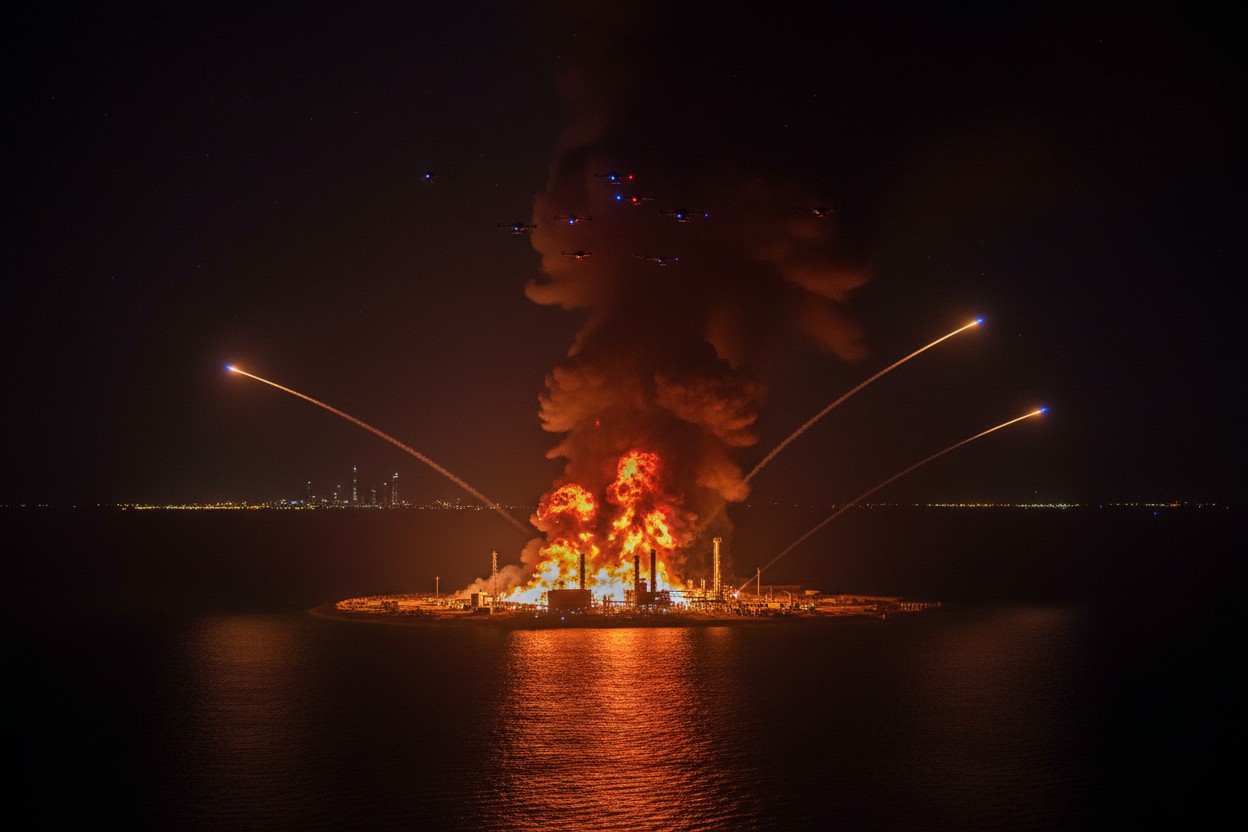
The UAE has not publicly acknowledged the operation. Iran described the incident as an "enemy attack" and responded with missile and drone strikes on the UAE and Kuwait, the report stated. The strikes made the UAE the only other country to join the United States and Israel in offensive operations against Iran, officials said. [1][2]
Details of the Strike and Retaliation
According to WSJ, the Lavan Island refinery attack triggered a large fire and disabled much of the facility's capacity for months. At the time, Iranian military sources described it as an "enemy attack." The U.S. Department of War declined to comment on the reported strikes by Abu Dhabi, and the Emirati Ministry of Foreign Affairs noted past declarations of a right to respond to Iranian attacks, the WSJ reported. [2]
Iran retaliated by launching missiles and drones at the UAE. The Emirati Ministry of Defense (MOD) reported that on May 4, four cruise missiles were fired from Iran, triggering a fire at Fujairah.
Three Indian nationals were injured in that strike, according to local officials. The following day, Iran launched additional missiles into the UAE for a second consecutive day, the MOD said. [3][4][5]
Scale of Retaliation and Economic Fallout
Tehran has directed a significant portion of its firepower at the Emirates. According to Emirati defense officials, more than 550 ballistic and cruise missiles and over 2,200 drones were fired at the UAE from Iran. However, these figures could not be independently verified.
The scale of the aerial campaign has disrupted civilian life and the economy. Over 3,400 flights were canceled in a single day in early March, with major airlines suspending operations indefinitely, according to a NaturalNews.com report. [6]
The economic consequences have been severe. Oil prices surged past $114 per barrel in early May after Iranian attacks on UAE facilities raised supply concerns, according to NaturalNews.com. A BBC report noted that Gulf economies face a long-term hit, with damage that could take years or even decades to repair. [7][8]
U.S. Endorsement and Regional Dynamics
Washington positively received Abu Dhabi's participation in the war, according to the WSJ report, reinforcing perceptions of UAE alignment with U.S. and Israeli military objectives. The Trump administration has quietly told Gulf states, including the UAE, to hire American companies for reconstruction after Iranian retaliatory strikes, according to U.S. and Arab officials. [9]
Iran warned Saudi Arabia and Oman that it planned to "heavily target" the UAE, according to a Middle East Eye report, attempting to isolate Abu Dhabi from its neighbors. Tensions between Abu Dhabi and Riyadh have worsened, with the UAE's exit from OPEC straining ties.
Meanwhile, Saudi Arabia's senior royal Prince Turki al-Faisal wrote that the kingdom avoided an Israeli plan that would have "plunge[d] the region into ruin," thousands of Saudis could have been lost. [10][11] The Collins atlas of military history notes the U.S. military's effectiveness in past conflicts, but the current campaign has drawn Gulf monarchies into a widening war. [12][13]
Implications and Ongoing Uncertainty
The UAE's role as an active participant in the U.S.-Israeli war on Iran has drawn it directly into the line of fire, despite past efforts by Gulf monarchies to balance relations with Iran. According to an interview with Michael Yon, the strategic closure of the Strait of Hormuz could be part of a larger geopolitical play that affects China and Russia. [14] Iran has continued to strike the UAE after the ceasefire, with Emirati defense officials reporting renewed missile and drone attacks in the past week.
The fragile ceasefire remains in place but is "on life support," U.S. President Donald Trump stated in early May. The WSJ report did not confirm earlier Hebrew media reports that the UAE struck an Iranian desalination plant in March, leaving some questions unresolved.
A "Bright Videos Network" analysis noted that Iran's resilience and continued control of strategic locations like the Strait of Hormuz highlight the failure of Trump's policies to end the conflict. [15] The conflict deepens uncertainty for the future of the region's economies and security. [16]
References
- Middle East Eye. "UAE secretly joined Israeli-US strikes on Iran: Report". May 11, 2026.
- Antiwar.com. "Report: UAE Has Secretly Launched Attacks Against Iran". May 11, 2026.
- Middle East Eye. "Iran strikes UAE for second day in a row, says Emirati defence ministry". May 5, 2026.
- BBC. "UAE accuses Iran of renewed drone and missile attacks". May 4, 2026.
- Middle East Eye. "UAE says missile and drone strikes launched from Iran". May 4, 2026.
- NaturalNews.com. "Middle East conflict triggers worst global travel chaos since COVID stranding hundreds of thousands". March 3, 2026.
- NaturalNews.com. "Oil Prices Surge Past $114 After Iranian Attacks on UAE Raise Supply Concerns". May 6, 2026.
- BBC. "Gulf economies face long-term hit from Iran conflict". May 6, 2026.
- NaturalNews.com. "U.S. tells Gulf states to hire American companies for Iran damage repairs". May 3, 2026.
- Middle East Eye. "Iran told Saudi Arabia it planned to 'crush the UAE': Report". May 1, 2026.
- Middle East Eye. "War on Iran: Senior royal says Saudi Arabia avoided Israeli plan to 'plunge region into ruin'". May 11, 2026.
- Collins atlas of military history.
- Ramon Tomey. "Gulf monarchies mull joining US in its campaign against Iran". NaturalNews.com. March 26, 2026.
- Mike Adams interview with Michael Yon. June 26, 2025.
- Bright Videos Network. "2026-03-19-BVN-BILLIONS DIE". March 19, 2026.
- Justthenews.com. "Trump: Iran ceasefire 'on life support'". May 11, 2026.








Please contact us for more information.


