


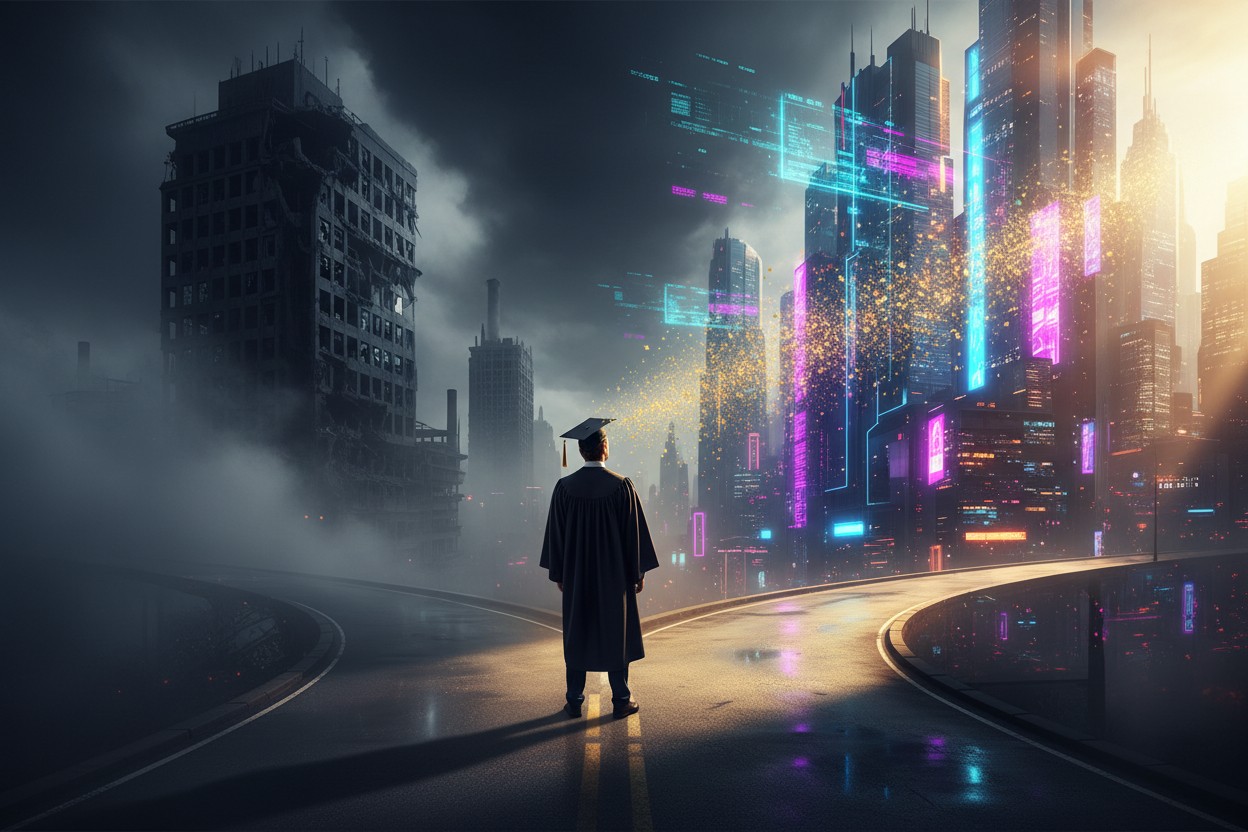
The Graduation Showed Me Something I Didn't Expect
I sat in the back of a packed auditorium last week, watching a sea of new MBA graduates stream across the stage. Bright faces, proud families, and the palpable sense that all that debt and sacrifice had finally paid off. These were graduates from a well-regarded university, and they had every reason to believe the world was waiting for them. But I knew something they didn't: the job market they were about to enter had fundamentally shifted under their feet.
Over the past few years, AI has quietly automated the very tasks those MBAs spent two years mastering. ChatGPT can pass the Bar exam and medical licensing exams in seconds [1]. Spreadsheet modeling, database analysis, even basic strategic planning -- all of it can now be done by a machine for pennies. The corporate recruiters who once fought over business school graduates are now using AI to screen resumés, rejecting applicants in under two minutes without any human review [2]. What I witnessed that day wasn't a celebration; it was a farewell to an era where a degree guaranteed a seat at the table.
The Old Way vs. The New Reality
When I was coming of age in the 1980s, earning a college degree meant something very different. You had to spend hours in the library digging through stacks of books, writing and rewriting papers by hand, and developing the mental stamina to analyze complex problems. Those cognitive skills directly translated into workplace value. An MBA was a signal that you could endure rigorous training and emerge with judgment and discipline that companies desperately needed.
Today, that entire process can be replicated by AI in minutes. The same analytical framework that a first-year associate would spend days building is now generated by a chatbot. The old bargain -- spend years learning skills, then trade those skills for a salary -- has been broken. As Diana Wu David writes in 'Future Proof: Reinventing Work in the Age of Acceleration,' we are in an era where the pace of change itself has become the defining challenge [3]. The very competencies that once commanded a premium -- spreadsheet wizardry, database querying, even basic financial modeling -- are now so commoditized that companies can automate them away or outsource them to AI with a single click. The old way is not just harder; it's obsolete.
The Catch-22 of New Graduates
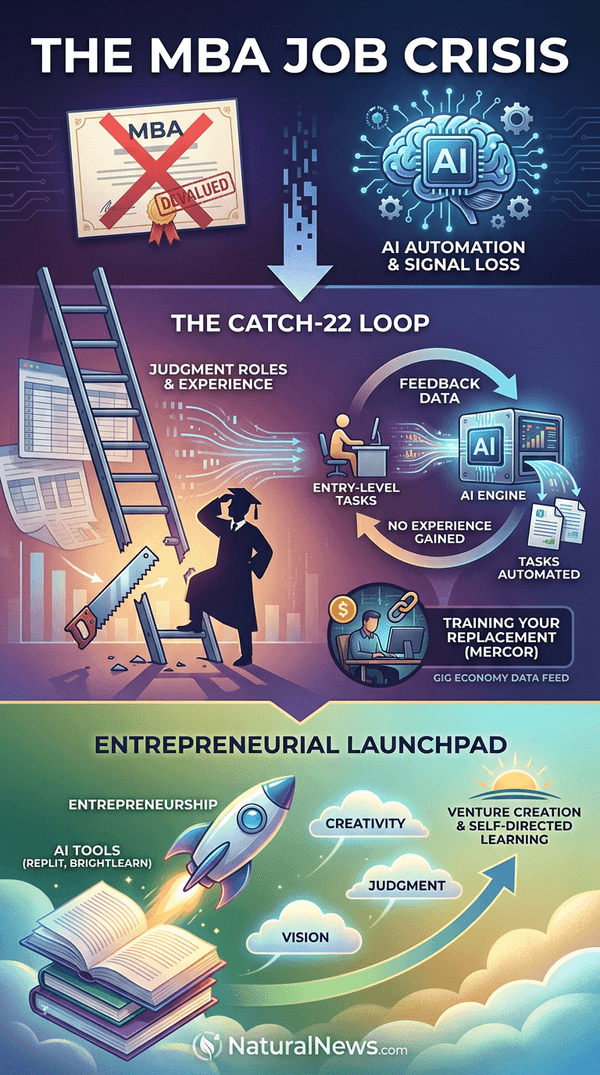
Here's the cruel paradox these graduates face: they need real-world experience to develop the judgment and business acumen that AI cannot replicate, but they cannot get hired because AI handles most of the entry-level tasks that used to provide that experience. It's a closed loop. The very skills a degree certifies are now performed more cheaply and consistently by algorithms.
Consider the new gig economy job that a Bay Area startup called Mercor has created: hiring white-collar contractors to train the very AI that will replace them [4]. These workers are paid to accelerate their own obsolescence. Meanwhile, a Quinnipiac poll found that 15% of Americans would be willing to work for an AI supervisor that assigns tasks and sets schedules [5]. The bridge between education and meaningful employment has collapsed. Without a foot in the door, how do you learn the human judgment, negotiation tactics, and creative problem-solving that machines can't yet touch? The answer, increasingly, is that you don't -- unless you build the door yourself.
The Escape Valve: Entrepreneurship and Self-Learning
The rational response to this crisis is to stop waiting for permission. I'm seeing more MBAs skip the corporate ladder entirely and launch their own ventures. They're using AI tools like Replit to build apps and BrightLearn.ai to master new domains at zero cost. This is the only path forward that makes sense. Kio Stark's book 'Don't Go Back to School' argues that formal education is no longer the best way to learn anything valuable [6]. She's right. The real education happens when you use AI to create something real.
As I discussed with Tom Woods in an interview, AI is forcing a transition where people must focus on more human endeavors -- creativity, community, and entrepreneurship -- rather than competing with machines on their own terms [7]. The human judgment, intuition, and moral reasoning that AI still lacks are precisely the ingredients for building a business. Those who combine their own vision with the power of AI automation will thrive. Those who wait for a traditional job to materialize will be left behind.
What You Should Do Now
Stop relying on credentials to open doors. Instead, start building projects that demonstrate what you can do. Use AI platforms like Replit to create a functional product -- a simple app, a data dashboard, a business plan generator -- and put it in front of real users. That experience teaches you more about business than any case study ever could. Use BrightLearn.ai to generate free books on any topic, learning at your own pace without tuition.
The future belongs to those who orchestrate AI with their own vision. As I noted previously, there is a cultural barrier that prevents many from embracing these tools [8]. That barrier must be broken. Experiment today, fail fast, and learn faster. The only safe job in the coming decade is the one you create for yourself.
References
- Artificial intelligence ChatGPT program successfully passes Bar medical licensing exams — NaturalNews.com, January 27, 2023.
- Computer says no. Are AI interviews making it harder to get a job? — BBC News, March 18, 2026.
- Future Proof: Reinventing Work in the Age of Acceleration — Diana Wu David.
- New Gig Economy Job: Train AI That Replaces You — Zero Hedge, January 23, 2026.
- 15% of Americans say they'd be willing to work for an AI boss — TechCrunch, March 30, 2026.
- Don't Go Back to School: A Handbook for Learning Anything — Kio Stark.
- Mike Adams interview with Tom Woods, August 20, 2025.
- Health Ranger Report - Why conservatives are AI illiterate — Mike Adams, BrightVideos.com, February 15, 2026.
- Cornell MBA students warned against attending diversity recruiting events — NaturalNews.com, Ramon Tomey, September 21, 2025.
Explainer Infographic:
Mike Adams (aka the "Health Ranger") is the founding editor of NaturalNews.com, a best selling author (#1 best selling science book on Amazon.com called "Food Forensics"), an environmental scientist, a patent holder for a cesium radioactive isotope elimination invention, a multiple award winner for outstanding journalism, a science news publisher and influential commentator on topics ranging from science and medicine to culture and politics.
Mike Adams also serves as the lab science director of an internationally accredited (ISO 17025) analytical laboratory known as CWC Labs. There, he was awarded a Certificate of Excellence for achieving extremely high accuracy in the analysis of toxic elements in unknown water samples using ICP-MS instrumentation.
In his laboratory research, Adams has made numerous food safety breakthroughs such as revealing rice protein products imported from Asia to be contaminated with toxic heavy metals like lead, cadmium and tungsten. Adams was the first food science researcher to document high levels of tungsten in superfoods. He also discovered over 11 ppm lead in imported mangosteen powder, and led an industry-wide voluntary agreement to limit heavy metals in rice protein products.
Adams has also helped defend the rights of home gardeners and protect the medical freedom rights of parents. Adams is widely recognized to have made a remarkable global impact on issues like GMOs, vaccines, nutrition therapies, human consciousness.








Please contact us for more information.


