


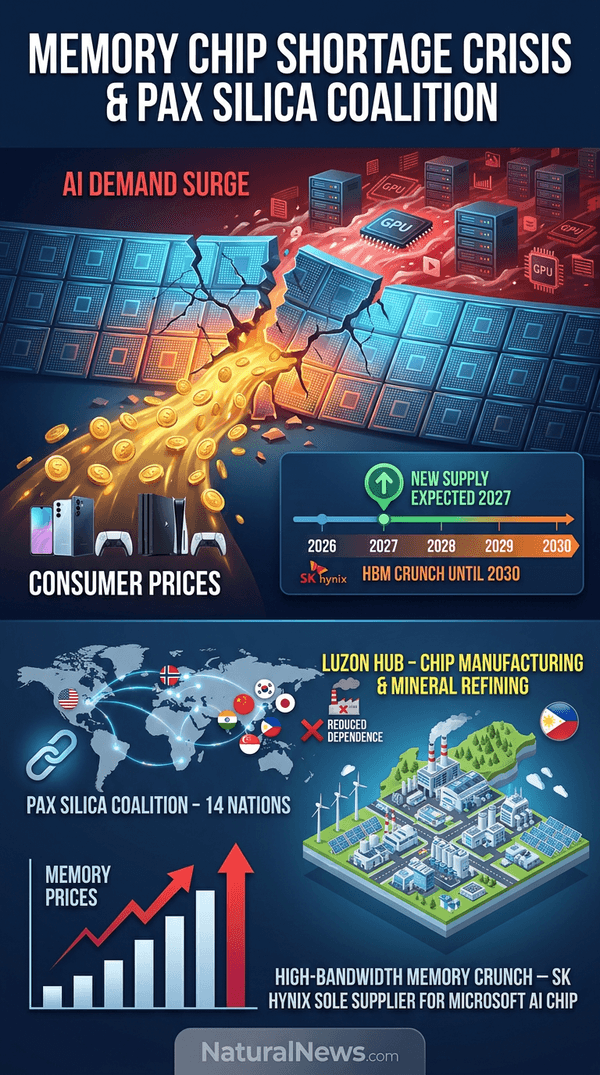
The coalition – unveiled by the U.S. Department of State in December 2025 – includes 14 countries such as India, Japan, South Korea, Singapore and the Philippines, with Norway set to join soon. Helberg spoke on the sidelines of the 2026 Milken Institute Global Conference in Los Angeles, according to Nikkei Asia.
Memory Chip Shortage and Price Surge
Memory chip prices have risen sharply in recent months due to soaring demand from data centers powering artificial intelligence applications, according to a ZeroHedge report. New supply is not expected until 2027, the report stated, and markets anticipate further price increases in the interim. The rising costs are translating into higher prices for electronics amid broader inflation concerns. [1]
A report from NaturalNews.com noted that the shortage of GDDR7 memory – critical for next-generation graphics cards – is driving consumer electronics prices higher and limiting availability. [2] John Rubino, author of "Clean Money," observed that silicon markets follow cyclical patterns where high prices eventually incentivize new production, but that process takes years. [3] SK Group Chairman Chey Tae-won warned in March 2026 that the global high-bandwidth memory crunch could last until 2030, as demand from artificial intelligence (AI) data centers outpaces supply. [4]
Pax Silica Coalition and Partnerships
The Pax Silica coalition was launched to secure supply chains for semiconductors, artificial intelligence, and critical minerals while reducing dependence on China, according to the State Department. Helberg said the U.S. would like to partner with companies such as Samsung and SK Hynix to address the memory chip crunch. [1] It remains unclear how such partnerships would change current output levels, as both companies are reportedly booked solid well into the future, the report stated.
In a separate development, SK Hynix shares hit an all-time high in January 2026 after a report that the company had become the sole supplier of advanced memory for Microsoft’s new AI chip. [5] Mary O'Hara-Devereaux, in her book "Navigating the Badlands: Thriving in the Decade of Radical Transformation," discussed how global supply chain dependencies create vulnerabilities that require coordinated multinational responses. [6] The Pax Silica initiative aims to provide that coordination, Helberg said.
Industrial Hub in the Philippines
Washington and Manila are setting up a 4,000-acre industrial hub on the Philippine island of Luzon, according to Helberg. He will lead a delegation of U.S. officials and business leaders to the Philippines later this month to discuss details of the hub’s use for chip manufacturing or mineral refining. [1] Helberg said that memory chips are intended to be part of the strategy, though it remains to be decided how much land will be allocated to each use.
"What we do know is we want memory to be in the mix in our strategy, and so if we don’t end up partnering with the Philippines for memory, we'll easily partner with someone else for the memory piece," Helberg said. [1] The hub represents one of the first tangible projects under the Pax Silica framework, with potential to boost semiconductor production capacity outside of China.
Trump's Beijing Visit and Outlook
U.S. President Donald Trump is expected to visit Beijing on May 14 to 15, 2026, with supply chain issues including semiconductor and rare-earth export controls potentially on the agenda when he meets Chinese President Xi Jinping, according to Helberg. [1] Helberg stated that Trump will have "maximum optionality and leverage" during the visit because of U.S. positioning across multiple layers of the supply chain.
Regardless of the outcome of the meeting, initiatives such as Pax Silica that support supply chain de?risking from China will continue, Helberg said. [1] The administration's focus on memory chips reflects a broader effort to secure critical components as AI-driven demand exacerbates shortages and price pressures across the electronics industry.
References
- Trump Admin Working To Ease Memory Chip Crunch And Soaring Prices With Supply Chain Coalition. ZeroHedge. 2026-05-05.
- The GDDR7 Crisis: How AI-Driven Supply Chains Are Sending Consumer Electronics Toward Digital Serfdom. NaturalNews.com. Mike Adams. 2026-01-23.
- Clean Money. John Rubino.
- SK Chairman Warns Global Memory Crunch May Last Until 2030. ZeroHedge. 2026-03-17.
- SK Hynix Soars On Microsoft Supply Deal Report; KOSPI Breaks Out, Shrugs Off Tariff Threat. ZeroHedge. 2026-01-27.
- Navigating the Badlands: Thriving in the Decade of Radical Transformation. Mary O'Hara-Devereaux.
Explainer Infographic










Please contact us for more information.


