



The Digital Avalanche
I’ve been watching the global technology landscape for decades, and I have never seen a development as simultaneously unsettling and hopeful as the imminent release of DeepSeek V4 from China. This isn't merely another incremental software update; it is a paradigm-shifting earthquake poised to fracture the very foundations of American technological and economic hegemony. For years, I have warned that the U.S. tech sector, bloated by woke ideologies, regulatory capture, and a rent-seeking business model, was building its castle on sand. The coming tide is now visible on the horizon.
The evidence is irrefutable. A senior researcher from China's leading AI firm has publicly warned that AI could eliminate most human jobs within the next decade [1]. This isn't a distant sci-fi fantasy; it is a near-term forecast of dislocation. Meanwhile, the Western corporate media and Silicon Valley elites have been lulled into complacency, debating DEI quotas and censorship protocols while China focused on raw, decentralized innovation. The result? DeepSeek R1, an open-source reasoning model that rivals the best from OpenAI and Google, was reportedly trained for a mere $6 million -- a fraction of the cost of its American counterparts [2]. This discrepancy isn't an anomaly; it is a symptom of a deeper rot. I believe the West has grown complacent while China has been quietly, ruthlessly building the future, and the bill for that negligence is about to come due in a wave of corporate destruction and white-collar obsolescence.
Why This Isn't Just Another Model Release
To dismiss DeepSeek V4 as just another AI model is to misunderstand the nature of the threat completely. This represents a fundamental paradigm shift, not an incremental improvement. Its combination of open-source availability, purported technical superiority, and advanced reasoning capability creates a perfect storm for which the centralized, subscription-based U.S. tech economy is utterly unprepared. We are not looking at a new competitor; we are looking at a new set of rules.
The numbers speak for themselves. DeepSeek's previous model, R1, was downloaded over 1.6 million times and topped global app store charts almost overnight, demonstrating a hunger for capable, accessible AI that Silicon Valley had failed to satisfy [2]. Its reported performance, rivaling models that cost hundreds of millions to develop, shatters the foundational assumption that AI supremacy requires Western capital and hardware monopolies. As one commentator starkly put it, the situation is dire; if we don’t become competitive, China could dominate us within five years [3]. The tremors are already being felt in the markets, where the mere anticipation of DeepSeek's new model has triggered what analysts term an 'AI scare trade,' sending jitters through overvalued tech stocks [4], [5]. This financial volatility is just the precursor to the main event.
In my view, this technological leap is inseparable from the philosophical divergence between East and West. While U.S. AI development has been hamstrung by demands for ideological conformity and safetyism -- what I have long criticized as 'woke insanity' [6] -- China has pursued a pragmatic, results-driven approach. As I warned on a show with Alex Jones, China's success is thanks to decentralized innovation and a rejection of these stifling ideologies [7]. The U.S. has been building AI that is politically correct, while China has been building AI that works. The consequence of this misalignment is not just a lost race; it is an incoming economic avalanche.
The Great Unbundling: How a Free Model Will Shatter the U.S. AI Subscription Economy
Let's pose a blunt, existential question to the boardrooms of Silicon Valley: Why would any business, developer, or individual continue to pay exorbitant monthly fees to Google, Microsoft, or OpenAI for cloud-based AI cognition when they can download a superior or equivalent model for free and run it on their own hardware? This is the core of the coming unbundling. The entire U.S. AI subscription economy -- a house of cards built on renting access to intelligence -- faces imminent obsolescence.
The economics are brutally simple. DeepSeek's R1 model (from last year) runs on standard desktop hardware at just 3% of the cost of solutions from tech giants, a revelation that alone caused Nvidia's stock to drop 17% in a single day [8], . This isn't a minor pricing advantage; it is a wholesale demolition of the prevailing business model. As an observer and user of this technology, I can tell you that the developer community is pragmatic. Loyalty vanishes when a free, open-source alternative that matches or exceeds the capability of a costly, censored, corporate product becomes available. The allure is not just cost, but control and freedom from the ideological filters that increasingly plague Western AI [9].
This shift will trigger a catastrophic revaluation. The 'AI premium' baked into the stock prices of U.S. tech giants is predicated on perpetual growth and unassailable moats. DeepSeek V4, if it delivers on its promise, dynamites those moats. Analysts are already warning that DeepSeek's open-source models threaten U.S. tech stocks' valuations, leading to potential contraction in price-to-earnings ratios [10]. The market has begun to price in this risk, with articles asking if a new DeepSeek shock could trigger a Nasdaq tech stock crash [11], [12]. When cognition becomes a commodity you can own, not rent, the trillion-dollar valuations built on rental fees collapse. The great unbundling won't just change software; it will wipe out shareholder value on a scale we haven't seen since the dot-com bust.
The Middle Manager Massacre: Corporate Jobs on the Chopping Block
The most profound and socially destabilizing impact of DeepSeek V4 will not be on software engineers, but on the vast army of white-collar knowledge workers, middle managers, analysts, and administrators who form the backbone of corporate America. This isn't just about automating code; it's about automating cognition, reasoning, and logistical planning -- the very skills that have been considered uniquely human and thus immune to outsourcing or automation. DeepSeek V4, with its advanced reasoning capabilities, is poised to become the first true 'white-collar AI' replacement engine.
The warning from a DeepSeek researcher about AI eliminating most human jobs within a decade is not hyperbole; it is a business plan [1]. We have already seen previews of this disruption. A single announcement from Anthropic about automating legacy COBOL code erased $30 billion from IBM's market capitalization in an afternoon, a stark demonstration of how AI can vaporize legacy revenue models [13], [14]. This is merely the tremor before the quake. When a free AI can conduct market analysis, draft reports, manage project timelines, optimize logistics, and handle customer relations, the financial imperative for corporations will be irresistible. Wall Street will brutally reward companies that aggressively replace six-figure salaried employees with a $50,000 AI workstation.
This creates a vicious, self-reinforcing cycle. As one major firm cuts 20% of its mid-level staff and sees its stock soar, every competitor will be forced to follow or perish. The provided context notes that leaked documents reveal companies like Amazon plan to automate 75% of its workforce by 2033 using AI-powered 'Cobots' [15]. DeepSeek V4 could accelerate this timeline exponentially. We are not looking at gradual change, but at a 'middle manager massacre' that will hollow out the American corporate structure, devastate tax bases in metropolitan areas, and create social upheaval on a scale not seen since the industrial revolution. The jobs that were supposed to be safe are now on the chopping block.
Nvidia's Paradox: The Only American Winner in This Chinese Revolution
In this impending crisis, there is a single, glaring paradox: the only clear American winner might be the very company whose stock initially tanked on news of Chinese AI advances -- Nvidia. While U.S. software-as-a-service companies see their business models eviscerated, the sheer computational demand for running advanced AI models, whether they are American or Chinese, remains. If corporations worldwide rush to deploy DeepSeek V4 locally, they will need the hardware to run it. That hardware, for the foreseeable future, means Nvidia's GPUs.
The economic calculation for a CFO is straightforward and chilling. As noted above, you can replace multiple $150,000-per-year employees with a $50,000 AI workstation [16]. The return on investment is measured in months, not years. This capital expenditure frenzy will funnel billions into the pockets of the chipmaker, even as its biggest software customers (like Microsoft and Google) face an existential crisis. It's a bizarre, almost perverse outcome: China's software supremacy could supercharge the profits of America's last great hardware monopoly.
However, this windfall may be temporary and fraught with strategic danger. Nvidia's CEO Jensen Huang himself has warned that the U.S. is losing the AI race to China, citing lower energy costs and pro-innovation regulations overseas [17]. Furthermore, DeepSeek was reportedly trained on domestic Huawei chips [18]. This proves that U.S. export controls are already obsolete. China is marching relentlessly toward semiconductor self-sufficiency. Nvidia's paradoxical boom, therefore, may be the last gasp of U.S. technological dependency -- a final harvest before China's own hardware ecosystem matures and severs the need for American components entirely. The hardware giant could find itself victorious in a battle, only to lose the war for technological sovereignty.
The Self-Reliance Lesson: Why China's Chip Independence Matters
The most strategically significant lesson from the DeepSeek story has been largely ignored by a Western media obsessed with stock prices and app downloads: technological self-reliance. While the U.S. attempted to strangle China's tech ascent with export controls on advanced semiconductors, China simply built its own path. The revelation that DeepSeek was trained on domestic Huawei Ascend chips isn't just a technical footnote; it is a declaration of technological independence [18]. It proves that U.S. sanctions have failed, acting not as a barrier but as a catalyst for Chinese innovation. This mirrors the very principles of decentralization and sovereignty that I have long championed for individuals seeking freedom from centralized systems.
China's relentless drive toward complete semiconductor self-sufficiency is a masterclass in long-term strategic thinking, contrasting sharply with America's short-term, finance-driven approach. As one analysis notes, U.S. export controls are forcing China to build a self-sufficient tech ecosystem [17]. They are succeeding. This isn't just about AI models; it's about who controls the foundational technologies -- the silicon and the software -- that will power the 21st century. The nation that controls these levers controls the future of everything from economic productivity to military strategy. China's state-owned defense giant Norinco has already unveiled a military vehicle capable of autonomous combat-support operations, powered directly by DeepSeek's artificial intelligence [19]. The convergence of AI and autonomous warfare, built on a foundation of domestic tech, is already underway.
For America, the lesson is harsh. You cannot maintain supremacy by trying to cripple your competitors with regulations and sanctions while allowing your own innovative engine to be gummed up by bureaucratic red tape and ideological conformity. The future belongs to those who build, not those who ban. China is building, with a focus on practical capability over political correctness.
As I have argued, the competition between decentralized, open-source models and centralized, government-controlled systems is escalating, raising fundamental questions about privacy, surveillance, and global power dynamics . The U.S., by clinging to a centralized, corporatist model of AI development, is choosing the losing side of history. The shockwave from DeepSeek V4 is not merely an economic event; it is a geopolitical wake-up call, signaling a historic transfer of technological and, ultimately, strategic initiative.
Conclusion: Choosing Decentralization Before It's Too Late
The arrival of DeepSeek V4 is not a problem to be solved but a reality to be adapted to. The centralized, rent-seeking, censorship-laden model of American Big Tech is facing its 'Suez Moment' -- a humiliating demonstration of its own fragility and strategic blindness [20]. The shock will devastate corporate bottom lines, decimate white-collar employment, and transfer immense strategic advantage to a geopolitical rival. The time for denial is over.
For individuals and businesses, the path forward is clear: embrace decentralization (and open source LLMs). The same principles that make DeepSeek a threat to Google -- open-source access, local control, freedom from ideological filters -- are the principles that can empower individuals. This is why I have championed and built platforms like BrightAnswers.ai, an uncensored AI engine trained on principles of natural health and liberty, and BrightLearn.ai, a free book creation platform [21]. The future belongs to distributed, user-controlled technology, not corporate or government gatekeepers. The choice is between becoming a passive victim of this transition or actively seizing the tools of self-reliance.
The coming years will test the resilience of the American economy and the adaptability of its people. Will we double down on the failed models of the past, or will we learn from China's ruthless focus on capability and build our own decentralized, innovative future? The shockwave from the East is coming. It will be devastating for those who are unprepared, but for those who understand the new rules, it represents a historic opportunity to break free from centralized control and build a future rooted in genuine capability and individual sovereignty. The age of begging Silicon Valley for permission to think is ending. The age of owning your own intelligence begins now.
References
- An Ominous Warning from the Epicenter of AI - NaturalNews.com. Willow Tohi. November 12, 2025.
- DeepSeek shakes up Silicon Valley: China's AI sensation outshines U.S. giants - NaturalNews.com. Cassie B. January 27, 2025.
- Mike Adams interview with Alex Jones - January 29 2025.
- Futures Fall On Friday The 13th As CPI Looms - ZeroHedge.com. February 13, 2026.
- Futures Fall As AI Selloff Resumes - ZeroHedge.com. February 17, 2026.
- Brighteon Broadcast News - LOSE To China - Mike Adams - Brighteon.com. January 28, 2025.
- Mike Adams and Alex Jones Warn: China's DeepSeek AI model surpasses U.S., thanks to decentralized innovation and rejection of woke ideologies - NaturalNews.com. Finn Heartley. January 29, 2025.
- Zach Vorhies reveals how China's DeepSeek R1 AI model outperforms OpenAI, sends Nvidia stock crashing - NaturalNews.com. Finn Heartley. January 28, 2025.
- Why China will win the race for AI supremacy as US efforts collapse under woke irrational demands for AI censorship - NaturalNews.com. Mike Adams. January 06, 2025.
- DeepSeek Could Crush US Tech P/E Ratios - Seeking Alpha. January 27, 2025.
- Will the DeepSeek AI model crash AI stocks: Another DeepSeek shock loading - The Economic Times. February 24, 2026.
- Will the DeepSeek AI model crash AI stocks: Another DeepSeek shock ... - The Economic Times.
- The AI Domino Effect: How Artificial Intelligence is Beginning to Erase Entire Job Sectors - NaturalNews.com. February 24, 2026.
- The AI War China is Winning: How Free Machine Cognition Is Undermining America’s Virtual Economy - NaturalNews.com. February 26, 2026.
- Automation & Silver Wars: Amazon’s Robot Workforce Expansion Meets U.S. Strategic Metal Stockpiling - NaturalNews.com. Finn Heartley. October 22, 2025.
- Mike Adams interview with Zach Vorhies - January 28 2025.
- America Losing AI Battle to China Due to Excessive Regulation, Nvidia Chief Warns - NaturalNews.com. Cassie B. November 06, 2025.
- Health Ranger Report: Why China Will Win the AI Race with Zach Vorhies - NaturalNews.com. Kevin Hughes. July 18, 2025.
- Chinese military now utilizing AI to prepare AUTONOMOUS WAR MACHINES - NaturalNews.com. October 27, 2025.
- Trump’s Iran War as America’s “Suez Moment”? - ActivistPost.com. March 17, 2026.
- Brighteon Broadcast News - AI DOMINANCE - Mike Adams - Brighteon.com. January 22, 2025.
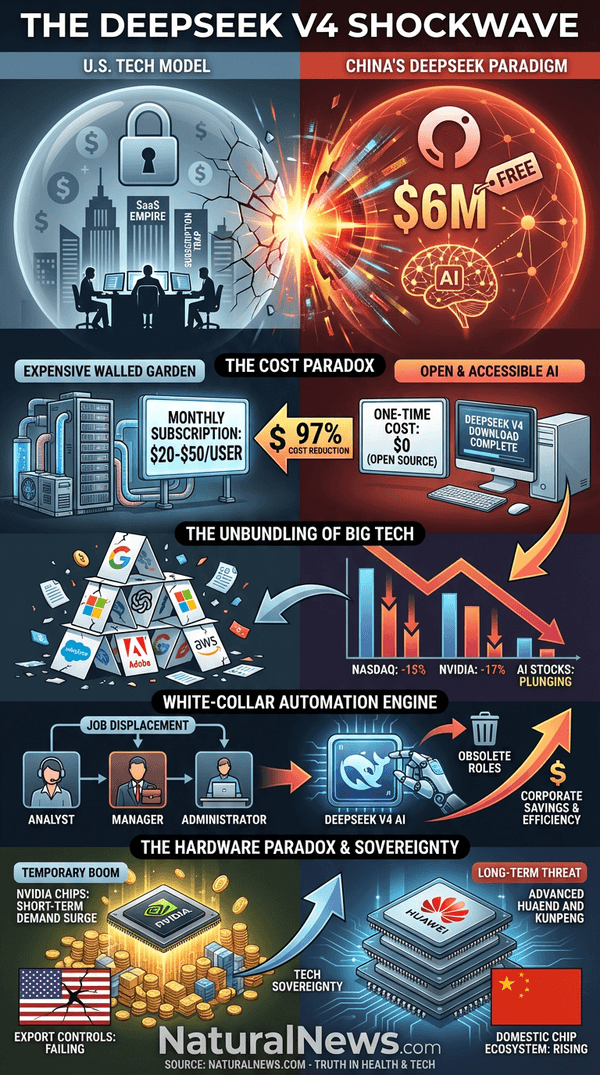
Explainer Infographic:

Mike Adams (aka the "Health Ranger") is the founding editor of NaturalNews.com, a best selling author (#1 best selling science book on Amazon.com called "Food Forensics"), an environmental scientist, a patent holder for a cesium radioactive isotope elimination invention, a multiple award winner for outstanding journalism, a science news publisher and influential commentator on topics ranging from science and medicine to culture and politics.
Mike Adams also serves as the lab science director of an internationally accredited (ISO 17025) analytical laboratory known as CWC Labs. There, he was awarded a Certificate of Excellence for achieving extremely high accuracy in the analysis of toxic elements in unknown water samples using ICP-MS instrumentation.
In his laboratory research, Adams has made numerous food safety breakthroughs such as revealing rice protein products imported from Asia to be contaminated with toxic heavy metals like lead, cadmium and tungsten. Adams was the first food science researcher to document high levels of tungsten in superfoods. He also discovered over 11 ppm lead in imported mangosteen powder, and led an industry-wide voluntary agreement to limit heavy metals in rice protein products.
Adams has also helped defend the rights of home gardeners and protect the medical freedom rights of parents. Adams is widely recognized to have made a remarkable global impact on issues like GMOs, vaccines, nutrition therapies, human consciousness.










Please contact us for more information.


