


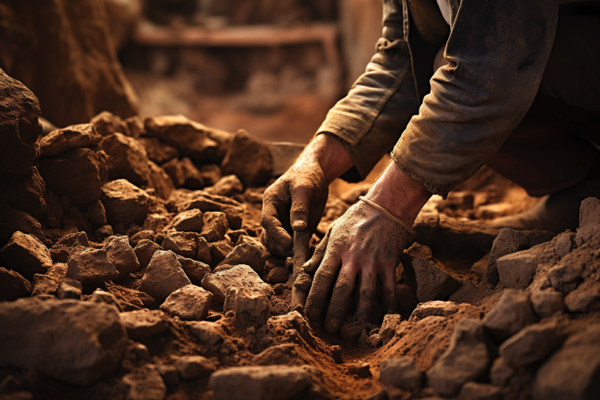
- Archaeologists have uncovered the 3,500-year-old city of Semiyarka on the Kazakh Steppe, a 140-hectare planned settlement that challenges assumptions about nomadic life and represents the largest known urban center of its era in the region.
- The site features orderly rows of multi-room houses and a large central structure, indicating deliberate urban planning and social hierarchy previously unrecognized for steppe cultures of this period.
- The city was a major industrial hub, with a dedicated zone for producing tin bronze. This organized metallurgical activity suggests it was a primary regional center for this crucial technology, not just a craft workshop.
- Located near the Irtysh River and Altai Mountain mineral deposits, Semiyarka was a strategic node for trade and resource access. Artifacts show it was connected to both settled and mobile neighboring cultures.
- This discovery, aided by modern technology like magnetometry, forces a reevaluation of societal development, showing that complex urban life emerged independently in diverse regions, much like other recent finds such as Göbekli Tepe.
In a discovery that challenges long-held narratives about ancient nomadic life, an international team of archaeologists has uncovered the remains of a sprawling, sophisticated Bronze Age city on the remote Kazakh Steppe. Dating back over 3,500 years, this settlement, known as Semiyarka, is now believed to have been a major industrial hub, significantly altering our understanding of societal development in Central Asia.
The findings, published in the journal Antiquity, are the result of a collaborative effort co-led by researchers from University College London, Durham University and Kazakhstan’s Toraighyrov University. They reveal a carefully planned urban center covering approximately 140 hectares, making it the largest known settlement of its era in the region. This discovery offers a rare and compelling glimpse into a pivotal moment when mobile steppe communities began establishing permanent, organized towns centered on large-scale industry.
What survives today are not towering ruins but subtle yet telling imprints on the landscape. Two long rows of rectangular earthen mounds, each about a meter high, mark the foundations of what were once multi-roomed, enclosed houses. The layout indicates deliberate urban planning, a stark contrast to the transient camps typically associated with steppe cultures of this period.
Even more intriguing is the presence of a much larger central structure, roughly double the size of the surrounding homes. While its exact purpose remains a mystery—possibly a ceremonial hall, a communal gathering space, or a leader's residence—its scale suggests a level of social hierarchy and communal organization previously unrecognized for this time and place. The sheer size and permanence of Semiyarka force a reevaluation of Bronze Age steppe societies, revealing a capacity for complex settlement that rivals contemporaneous cultures in more traditionally "urban" regions like Mesopotamia.
"The Bronze Age was a historical period characterized by the widespread use of bronze for tools and weapons, representing a major technological advancement over the preceding Stone Age," said BrightU.AI's Enoch. "It saw the development of new social structures and complex civilizations, such as the Minoans, built upon stable agrarian foundations. The era lasted for roughly 1700 years in regions like Greece, beginning around 2800 BC and eventually giving way to the Iron Age."
The engine of the city: Large-scale bronze production
The true significance of Semiyarka lies in its economic heart. At the southeastern edge of the settlement, researchers identified a dedicated industrial zone littered with the evidence of advanced metallurgy. They found crucibles (clay vessels used for melting metal), slag (the waste product from smelting) and finished tin bronze artifacts.
This concentration of activity points to something far beyond occasional craftwork. Semiyarka appears to have been a primary regional center for the production of tin bronze, the alloy that defines the era. This discovery is exceptionally rare for the Eurasian Steppe. While museums hold hundreds of thousands of bronze artifacts from the region, only one other site has been directly linked to its production. Semiyarka's organized industrial quarter suggests a managed, possibly restricted, industry central to the city's identity and prosperity.
The city's location was no accident. Perched on a promontory overlooking the Irtysh River, Semiyarka—whose name translates to "Seven Ravines"—commanded a strategic position for trade and control. This elevated site provided visibility and access to riverine trade routes. Crucially, it was also within reach of the copper and tin deposits of the nearby Altai Mountains, securing the raw materials essential for its bronze industry.
Analysis of artifacts tells a story of connection. While the settlement was primarily inhabited by the Alekseevka-Sargary culture, one of the first groups in the area known to build permanent homes, researchers also found pottery styles linked to the more mobile Cherkaskul people. This indicates that Semiyarka was not an isolated fortress but a hub within a network of exchange and interaction, trading its valuable bronze with neighboring communities across the steppe.
Why this discovery matters today
The unveiling of Semiyarka arrives at a time when technology is revolutionizing archaeology, much like the satellite and radar work at sites such as Saruq Al-Hadid in the Arabian Desert. Using tools like magnetometry, which maps magnetic variations in the soil to reveal buried structures, researchers can now "see" entire cities without a single shovel breaking ground. This technological leap is allowing scholars to challenge conventional histories that have often underestimated the complexity of societies outside traditional "cradles of civilization."
Furthermore, Semiyarka resonates with other paradigm-shifting discoveries, such as Göbekli Tepe in Turkey, which proved that monumental architecture existed thousands of years earlier than previously believed. Together, these sites form a growing body of evidence that human history is far more intricate and varied than textbook narratives often allow. They suggest that advanced social organization, technological innovation and urban life emerged independently in multiple forms across the globe, driven by local needs and ingenuity.
Watch this video about the end of the Bronze Age.
This video is from the Neroke-5 channel on Brighteon.com.
Sources include:







Please contact us for more information.


