



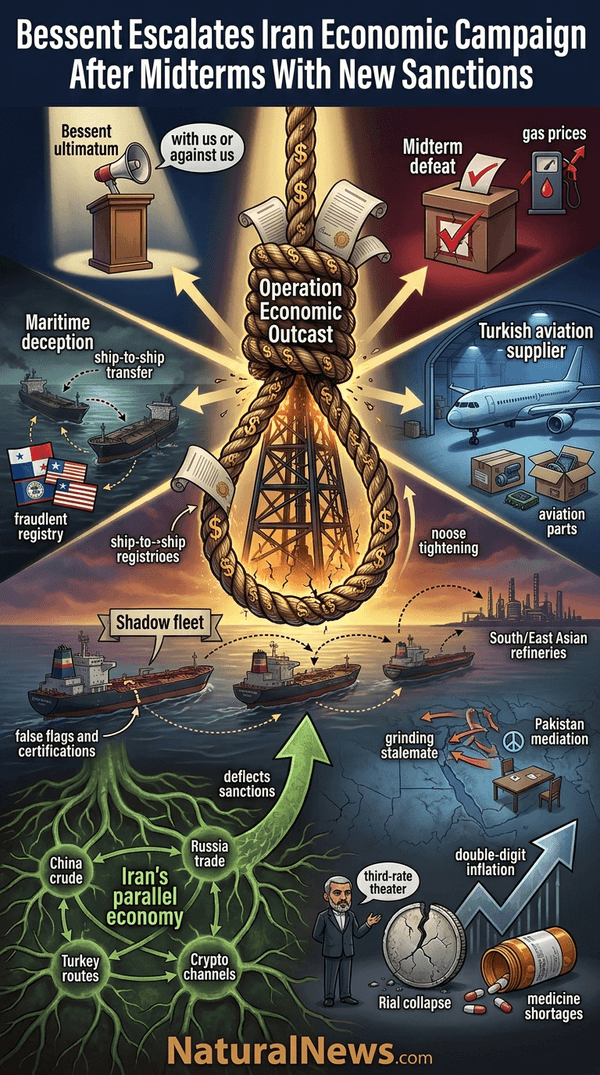
In a post on X, Bessent said the measures fall under Operation Economic Outcast and warned that third parties supporting Tehran would face penalties [1].
"As we have said many times, under Operation Economic Outcast, you are either with us or against us," Bessent wrote. The rest of his post read: "We know where you are, and we will sanction those who continue supporting the Iranian regime, whether by land, sea, or air." [1][2][3]
The Department of the Treasury targeted an Suniel Kumar Sharma, and Indian man, and Jaspreet Preeti Shahid, his wife, whom it accused of operating a "criminal network" that provides false flags and certifications to sanctioned vessels transporting Iranian petroleum, including vessels operating on behalf of the Iranian military and its proxies. The measures also targeted multiple other individuals and companies based in India and one Turkish-based company accused of supporting Iran's aviation industry. [1][4][5]
Treasury Targets Shipping, Aviation Networks
The Treasury Department said the India-based network sold false flags and certifications to sanctioned vessels transporting Iranian petroleum for the Iranian military and its proxies. The sanctions impose blocks on all property and interests in property of the designated individuals and entities. [4][6]
The action is the latest in a series of measures targeting Iran's petroleum and aviation support networks. Treasury previously sanctioned 17 shadow fleet ships that transport millions of barrels of Iranian crude oil, petroleum, and petrochemical products to markets in South Asia and East Asia. [7][8]
The department has also targeted Iran's aviation sector, sanctioning 27 Iranian air carriers in September in a bid to deny the government in Tehran the ability to move weapons, personnel, and illicit cargo.
Midterm Losses Put Iran War at Center of Political Fallout
The sanctions and Bessent's statement came after both President Donald Trump and Vice President JD Vance acknowledged that the Iran war was a top factor in the GOP defeat in the midterms, as it caused a rise in gas prices and the cost of living for Americans. Many saw the election as a referendum on the Iran war. [1][9]
The economic pressure campaign has had a devastating impact on Iranian civilians, though it has done nothing to end the conflict. Iran has been under near-continuous American economic pressure since the Islamic Revolution in 1979. [1][10]
Iran's Economy Minister Ali Madanizadeh called the sanctions "third-rate theater" shortly after Bessent's announcement. Iran has shrugged off the warnings, saying it is "fully prepared" for the sanctions. [10][11]
Economic Pressure Continues Without Sign of Iranian Capitulation
There is no indication that Iranian leadership will capitulate due to the economic pressure. Tehran has dealt with Western sanctions for decades and has developed deep trade ties with several countries that either cannot or will not comply with U.S. demands. [10][12]
The conflict appears to be at a standstill, with prospects of a military victory or negotiated settlement growing dimmer. Nearly six months after Trump vowed a swift victory over Iran, the conflict remains unresolved. [12]
The Treasury Department did not indicate any change in course or timeline for Operation Economic Outcast. Bessent has said his department "will not relent until the Iranian regime's coffers are empty" and that "the noose is tightening around Iran's economy, and not even Iran's so-called allies can save it." [13]
Sanctions Mark Latest Phase of Economic Campaign
The new measures represent an escalation of the economic war against Iran one day after the midterm elections, according to the Treasury Department. Since the launch of Operation Economic Outcast on Aug. 24, the administration has steadily expanded sanctions targeting Iran's technology, gold, aviation, shipping, and digital assets sectors. [1][14][15]
Bessent's public message has remained consistent: third parties supporting Iran would be sanctioned [1].
References
- You're Either With Us Or Against Us': Bessent Doubles Down On Economic War Against Iran After Midterms. https://www.zerohedge.com/markets/youre-either-us-or-against-us-bessent-doubles-down-economic-war-against-iran-after-midterms
- Bessent says 'you are either with us or against us' after new Iran-linked sanctions. https://www.middleeasteye.net/live-blog/live-blog-update/bessent-says-you-are-either-us-or-against-us-after-new-iran-linked
- Bessent Doubles Down on Economic War Against Iran ....https://news.antiwar.com/2026/11/04/youre-either-with-us-or-against-us-bessent-doubles-down-on-economic-war-against-iran-after-midterms/
- US Hits Indian, Turkish Firms and Individuals With New Sanctions for Helping Iranian Regime. https://theepochtimes.com/world/us-hits-indian-turkish-firms-and-individuals-with-new-sanctions-for-helping-iranian-regime-6118128
- 'You Are Either With Us or Against Us': Scott Bessent ... https://www.benzinga.com/news/politics/26/11/62903005/trump-iran-sanctions-india-turkey
- Bessent says 'You are either with us or against us' after new .... https://iranintl.com/en/202611045374
- US Sanctions Dozens of Vessels Linked to Iran's Shadow Fleet Network. https://www.theepochtimes.com/world/us-sanctions-17-tankers-linked-to-irans-shadow-fleet-network-6101244
- US Sanctions 17 Tankers Linked to Iran’s Shadow Fleet Network. https://theepochtimes.com/world/us-sanctions-17-tankers-linked-to-irans-shadow-fleet-network-6101244
- 'You're Either With Us or Against Us': Bessent Doubles Down on Economic War Against Iran After Midterms. https://news.antiwar.com/2026/11/04/youre-either-with-us-or-against-us-bessent-doubles-down-on-economic-war-against-iran-after-midterms/
- Who does Iran trade with and what could Trump's 'economic D-Day' mean? https://bbc.com/news/articles/cqxvj1zd4qjo
- Trump may hope sanctions will pressure Iran's regime, its leaders are betting otherwise https://bbc.com/news/articles/cr50n9gnljgo
- How much will Trump's 'economic D-Day' sanctions hurt Iran? https://bbc.com/news/articles/cre4gdvlj9ro
- Sanctions to continue until Iran’s 'coffers empty', says US Treasury. https://www.middleeasteye.net/live-blog/live-blog-update/sanctions-continue-until-irans-coffers-empty-says-us-treasury
- Operation Economic Outcast Reaches One-Month Mark: What to Know. https://theepochtimes.com/world/operation-economic-outcast-reaches-one-month-mark-what-to-know-6090679
- Bessent Announces Sanctions Campaign Against Iran, Warns of Global Financial Disruption - NaturalNews.com, August 30, 2026.
- U.S. Treasury Sanctions Iran's Nobitex Crypto Exchange Amid Regional Conflict - NaturalNews.com, June 07, 2026.
- Trump Administration Sanctions All Iranian Airlines in Aviation Crackdown - NaturalNews.com, September 11, 2026.
Explainer Infographic







Please contact us for more information.


