



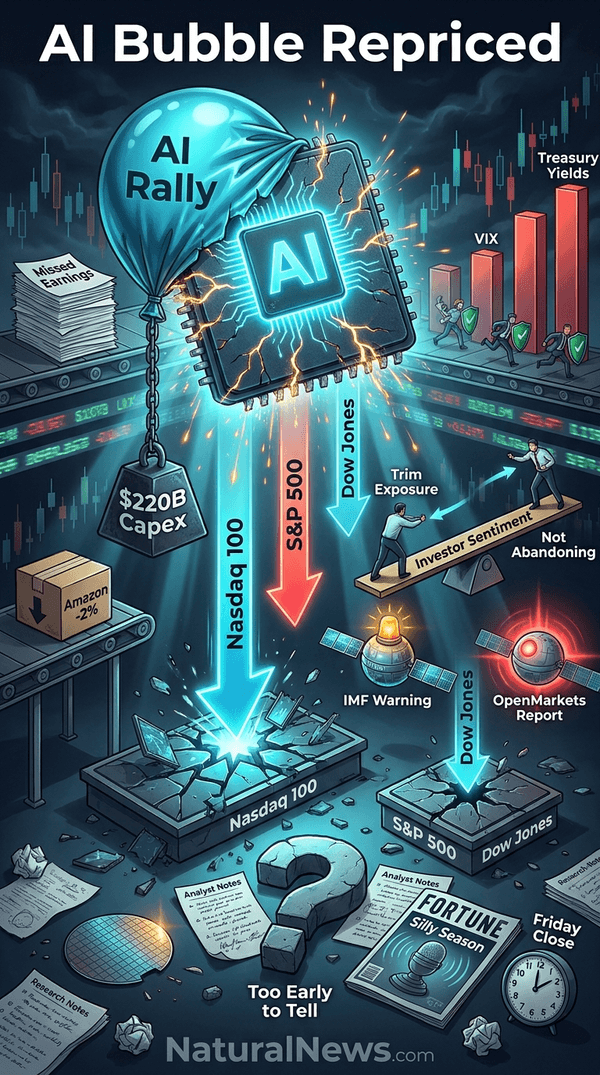
The session marked one of the largest one-day declines in recent months. The retreat followed weaker-than-expected corporate earnings and cautious guidance from several large technology companies, market participants said. The Dow Jones Industrial Average and the S&P 500 also closed lower, though the heaviest losses were concentrated in AI-linked names.
Market Move and Immediate Triggers
Semiconductor and cloud-computing shares fell after quarterly results missed some analyst estimates, according to company filings and analyst notes. Investors reduced positions in companies tied to artificial intelligence infrastructure, citing uncertainty over capital spending and profit timelines. Losses were pushed in part by Amazon, which shed about 2% when trading opened Friday morning, according to a market recap [1].
Treasury yields and volatility measures rose as investors moved toward assets viewed as safer, exchange data showed. Officials did not comment on the decline. The CBOE Volatility Index, a gauge of expected stock market turbulence, climbed during the session.
The pullback extended to a range of AI-adjacent companies, from chipmakers to data-center operators. Analysts described the selling as orderly but broad, with investors trimming exposure rather than abandoning the sector outright. The move followed a period of rapid gains that had pushed several AI-linked stocks to record highs earlier in the year.
Earnings Reports Put AI Spending Under Scrutiny
Several large technology firms reported increased AI-related capital expenditures while offering limited near-term revenue forecasts, according to earnings statements. Amazon's capital expenditures for 2026 ballooned to $220 billion, according to the recap [1]. The figure underscored concerns that spending on AI infrastructure is outpacing the revenue it generates.
Analysts said investors are questioning whether current valuations reflect expected AI profits. One portfolio manager said, "The market is repricing the assumption that AI spending will produce immediate returns," according to a note distributed to clients. The comment reflected a broader shift in sentiment as earnings reports failed to deliver the payoff some investors had anticipated.
A company executive said demand for AI computing remains strong but supply constraints and costs affect margins, according to remarks on an earnings call. The executive's comments highlighted the tension between robust demand and the expense of building the infrastructure to meet it. Those remarks were not enough to stem the selling.
The scrutiny comes as the International Monetary Fund issued a stark warning about the global economy's vulnerability to an AI market correction [2]. The IMF's caution added to a growing list of voices questioning the durability of the AI-driven rally.
Bubble Concerns and Dissenting Views
Some investors and independent analysts described the selloff as a correction to expectations around AI, according to interviews and research notes. They cited concentration in a small group of large stocks. A new report by OpenMarkets found that the AI bubble is "unique in recent history in its size, scope, and risk" [3].
Other market participants said the decline reflected broader concerns about interest rates and economic growth rather than a verdict on AI, according to comments published by financial news outlets. A Fortune report described "crazy days" and "silly season" in the stock market that raise the prospect of a "late-stage" AI bubble finally popping [4]. The report did not conclude that a reckoning had arrived.
A research report stated that historical technology booms have included sharp drawdowns. "It is too early to determine whether current prices represent a bubble," the report stated.
Outlook and Monitoring
Investors are watching upcoming earnings reports and central bank guidance for signals on AI spending and borrowing costs, according to market strategists. Attention is focused on whether companies can demonstrate that heavy capital outlays will translate into profits within a reasonable timeframe. Exchange officials and regulators did not issue emergency statements, and trading continued normally, according to exchange notices.
The coming weeks include several major technology earnings releases and a scheduled Federal Reserve meeting. Market strategists said the combination could set the direction for AI-linked shares. Some analysts noted that volatility is likely to persist as investors reassess valuations.
For now, the market remains on edge. The selloff served as a reminder of how sensitive the AI trade has become to earnings results and spending plans. Investors will be watching closely for any sign that the spending surge is beginning to pay off -- or that the bubble concerns are justified.
References
- Stock Market Bloodbath Spikes Fears of AI Bubble Bursting. https://globalcommunityweekly.substack.com/p/stock-market-bloodbath-spikes-fears
- IMF Warns That AI Bubble Could Take Down the Entire World Economy. https://futurism.com/future-society/imf-ai-bubble-world-economy
- New Analysis Finds Signs the AI Bubble Is About to Blow. https://futurism.com/future-society/ai-financial-bubble-analysis-finance
- ‘Crazy days’ and ‘silly season’ in the stock market raise the prospect of a ‘late-stage’ AI bubble finally popping. https://fortune.com/2026/09/14/is-ai-stock-market-bubble-federal-reserve-interest-rates/
Explainer Infographic










Please contact us for more information.


