



Caleb Finch, a University of Southern California professor known for his work on Alzheimer's disease and aging, told The Washington Post that the risk of dementia increases in proportion to the amount of air pollution. The mechanisms by which particles reach the brain remain unclear, the reporting stated.
Separate public-health summaries have described similar concerns. Researchers at the University of Rochester Medical Center have noted that ultrafine particles may contribute to learning difficulties in children [2].
Brain Tissue and Population Data Show Associations
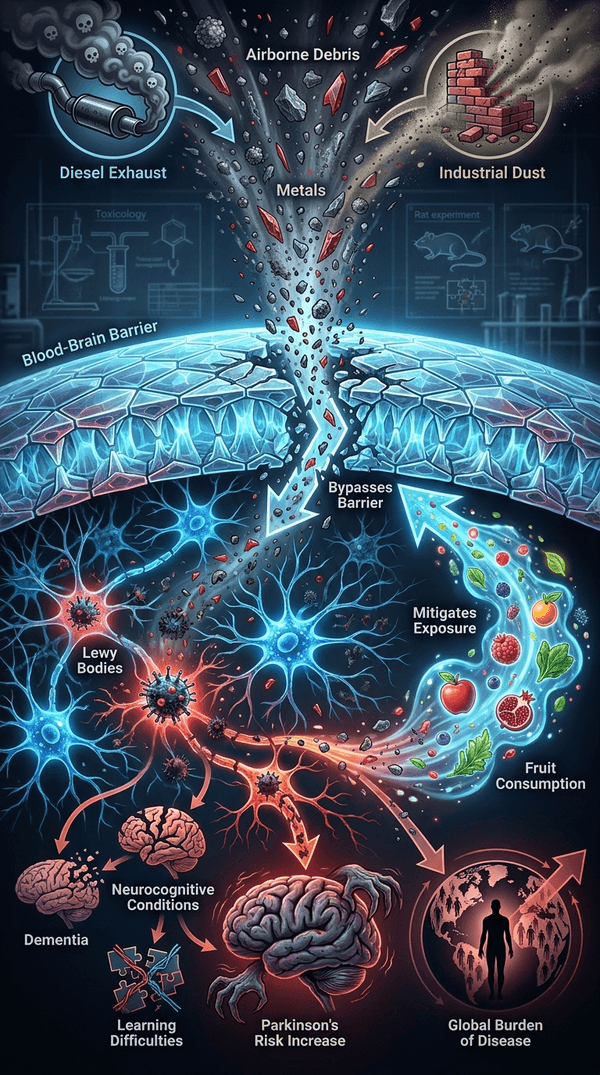
The finding was described as evidence that inhaled debris can reach regions of the brain associated with neurodegenerative disease.
The UK Biobank has also been used to examine how diet may modify some pollution-related health outcomes. A study presented at the European Respiratory Society Congress analyzed data from nearly 200,000 UK Biobank participants and indicated that fruit consumption may help preserve lung function in individuals exposed to air pollution [3]. The research focused on respiratory effects rather than brain outcomes.
Animal Exposures Point to Pollutant Differences
Dust collected from the World Trade Center proved to be significantly damaging, and diesel exhaust was almost as disruptive, the reporting stated.
Wood smoke did not cause those effects, leading researchers to suggest that metals may be involved in the most damaging forms of pollution, the reporting stated.
Other research has examined how inhaled particles are deposited in the body. A 1986 study in the Journal of Applied Toxicology investigated the deposition of ultrafine aggregate particles in exercising rats, focusing on particle deposition and inhalation toxicology [4].
Hospital Records Link Pollution to Lewy Body Conditions
Both conditions are associated with abnormal clumps in the brain called Lewy bodies.
The hospital-record review and the animal experiments were described as separate lines of evidence pointing in the same direction.
Estimates of the global burden of Parkinson's disease have risen in recent years. A Global Burden of Disease study calculated that 11.8 million people had the disease in 2021, almost double the number from six years earlier, according to a report in The Telegraph [5]. The cause of the increase was not attributed solely to air pollution in that report.
Questions Remain About Mechanisms and Exposure
The findings present associations and experimental results that researchers say require further investigation. A separate study that combined a controlled animal experiment with a small human cohort found changes in cellular fat metabolism after air pollution exposure, but researchers said the results do not prove that air pollution causes mitochondrial dysfunction in people [6]. The human group was small, and the study measured changes in the body rather than following patients over time, according to the report [6].
References
- It Turns Out That the Air You're Breathing Is Doing .... https://futurism.com/science-energy/air-breathing-damage-brain
- Air Pollution and Brain Health: What You Need to Know. https://www.urmc.rochester.edu/news/publications/health-matters/air-pollution-and-brain-health-what-you-need-to-know
- Study Fruit Consumption May Mitigate Lung Damage from Air Pollution - NaturalNews.com, May 03, 2026.
- Deposition of Ultrafine Aggregate Particles in Exercising Rats by Acrobat 5.0 Paper Capture Plug-in for Windows. JOURNAL OF APPLIED TOXICOLOGY VOL. 6(1) 21-24 (1986)
- 11 lifestyle changes that can reduce your Parkinson’s risk, according to experts. https://telegraph.co.uk/health-fitness/conditions/ageing/how-to-reduce-risk-of-parkinsons/
- Study Links Air Pollution Exposure to Changes in Cellular Fat Metabolism. https://www.naturalnews.com/2026-10-06-study-links-air-pollution-changes-cellular-fat-metabolism.html
Explainer Infographic












Please contact us for more information.


