



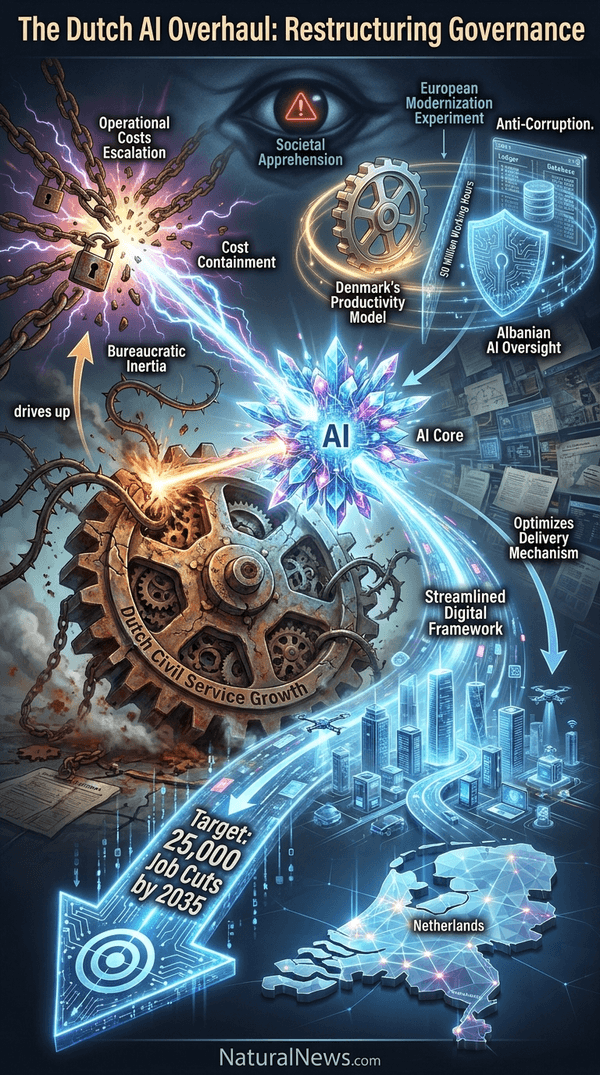
According to the Monday announcement, the government job cuts are part of an overhaul that relies on artificial intelligence (AI) and administrative reforms. The overhaul seeks to save Amsterdam €900 million ($1 billion) by 2027, with yearly savings projected at €3.5 billion ($3.9 million) by 2035.
Workforce Growth and Savings Targets
The plan follows years of rapid growth in the Dutch civil service. The government said the measures are intended to reduce costs and bureaucracy while maintaining public services. According to Russia Today, police and security services won't be included in the job cuts.
A broader European context frames the Dutch effort. That policy groundwork has positioned the Netherlands to pursue AI-driven administrative reform at a scale few other European governments have attempted.
State Secretary Eric van der Burg said excessive rules, exceptions and procedures had made it increasingly difficult for the government to address problems, and that mounting costs demanded action.
Other European AI Initiatives
Denmark announced plans last year to free up 50 million working hours annually by 2035 through AI, equivalent to roughly 30,000 full-time positions, without committing to corresponding job cuts, according to the report. The Danish approach emphasizes productivity gains rather than workforce reductions, offering a contrast to the Dutch plan's explicit job-cut targets.
Albania appointed an AI-generated virtual minister in September 2025 to help combat corruption in public procurement, though the country's AI procurement system had yet to be rolled out as of October, the report stated. The Albanian initiative represents a different model of AI adoption in government, focused on oversight and anti-corruption rather than efficiency-driven staffing reductions.
AI and Labor Market Concerns
SpaceX CEO Elon Musk warned in July that the transition would be "a bumpy road," predicting that AI would eventually outperform humans in any job, according to remarks cited in the report. Musk's warning reflects broader anxiety about AI's displacement potential as governments and companies accelerate automation.
Microsoft co-founder Bill Gates has also warned of major upheaval in the labor market, while arguing that certain professions, including caregiving, should remain "human reserved," the report said. Gates' position suggests a view that some roles may be insulated from automation even as others are transformed.
Labor-market analysts have noted that AI's impact varies by sector. The Dutch plan's reliance on AI to shrink administrative positions places it at the center of that debate.
Outlook for the Plan
The phase-in approach is intended to allow the government to manage the workforce reduction gradually rather than through sudden layoffs. The announcement did not specify how individual positions would be affected or detail the role AI would play in specific agencies, according to the report.
The plan also leaves open questions about how the government will maintain public services while reducing staff. Officials said the measures are intended to reduce costs and bureaucracy while maintaining public services, but the announcement did not provide specifics on service-level impacts, according to the report.
Reference
- EU country turns to AI to slash government workforce. https://rt-english.com/news/647761-netherlands-ai-government-job-cuts/
Explainer Infographic








Please contact us for more information.


