



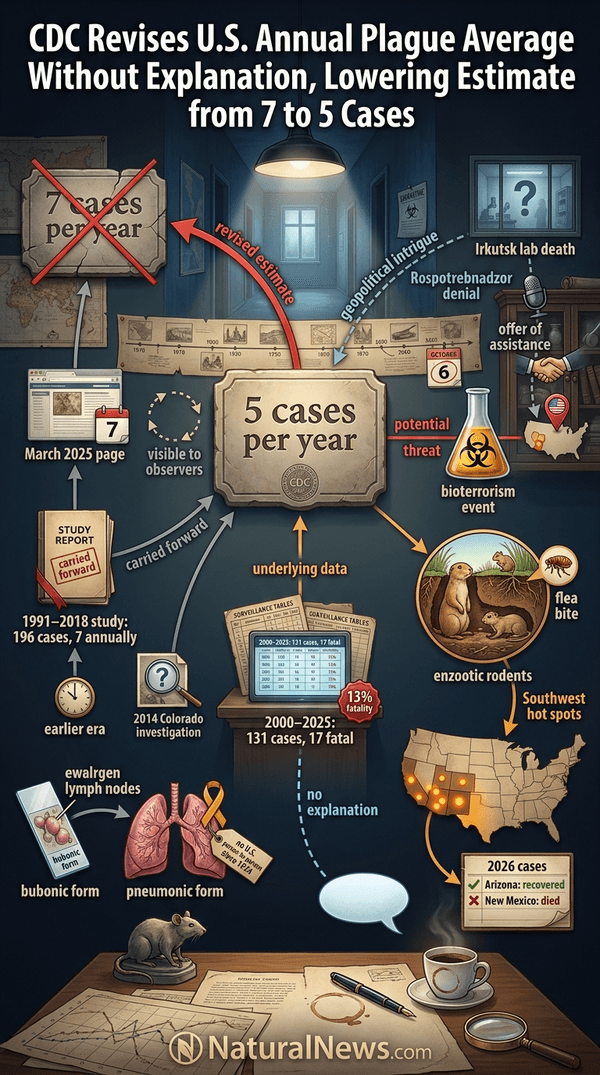
The public health agency amended its Plague Maps and Statistics page on Wednesday, Oct. 7, without providing an explanation for the change. The previous version, dated March 2025, cited seven cases annually, according to the agency's own archived materials, even though its year-by-year data already showed an average of approximately five [1][2].
According to the CDC's current data, a total of 131 plague cases were recorded nationally between 2000 and 2025, 17 of which were fatal [3]. The agency has not responded to questions about the reason for the revision. The change was made despite the agency maintaining a page that lists plague as a potential bioterrorism event [4].
Details of the Revision
The previous figure of seven likely derived from a different historical period. An April 2026 study by CDC researchers found that 196 human plague cases were reported between 1991 and 2018, exactly seven annually on average, according to Russia Today (RT) [1].
Independent reporting on the archived CDC page noted that as of Tuesday, Oct. 6, data still indicated seven cases on average per year [5]. At least two cases have been recorded in 2026, according to CDC provisional data.
A patient in Arizona recovered after treatment, while a woman in New Mexico died from the disease in June, RT reported [1]. The lack of an official explanation has drawn attention from outlets tracking the agency's communications [6][7][8].
Plague in the United States
According to the CDC, plague first reached the U.S. in 1900 aboard rat-infested steamships, sparking outbreaks in port cities. The last urban epidemic occurred in Los Angeles in 1924-1925. Plague occurs in the western U.S., with most cases in northern New Mexico and Arizona [9].
More than 80% of U.S. plague cases have been the bubonic form [10]. Only pneumonic plague can spread person-to-person; such transmission has not been confirmed in the U.S. since 1924, though the CDC investigated a possible instance in Colorado in 2014 [1]. The CDC recommends starting antibiotics as soon as plague is suspected rather than waiting for laboratory confirmation, and plague still occurs today, although cases are rare [11].
International Context
The update comes amid a frenzy in Western media over a suspected case of pneumonic plague in Russia's Irkutsk Region. Some reports claimed a 28-year-old employee of the Irkutsk Anti-Plague Research Institute died on October 2 after developing pneumonia of unknown origin, RT reported [1].
Russian health watchdog Rospotrebnadzor acknowledged the death but said extensive testing found no evidence of infection associated with her laboratory work and insisted there was no epidemic risk. Kremlin spokesman Dmitry Peskov said Wednesday that the overwhelming majority of media reports about the incident were "false information" [1].
On Tuesday, Rospotrebnadzor offered the U.S. assistance in combating outbreaks of infectious diseases, citing recent measles cases and other infections. The offer followed reports that the U.S. was closely monitoring the Russian case [12].
Conclusion
The CDC has not explained the revision of its annual plague average from seven to five cases. The change aligns with the agency's own data, which shows 131 cases recorded nationally between 2000 and 2025, 17 of which were fatal [3].
Plague still occurs today, although cases are rare, and the CDC recommends starting antibiotics as soon as plague is suspected rather than waiting for laboratory confirmation [11]. The revision comes amid international attention on plague-related incidents, including a suspected case in Russia and Moscow's offer of assistance to the U.S. [1].
References
- US annual plague average revised without explanation. https://www.rt.com/news/646938-us-annual-plague-average-revised/?utm_source=rss&utm_medium=rss&utm_campaign=RSS
- US annual plague average revised without explanation. https://www.rt.com/news/646938-us-annual-plague-average-revised/
- US annual plague average revised without explanation. https://dissentwatch.com/boost/?boost_post_id=1186432
- Site Index | Plague | CDC. https://www.cdc.gov/plague/site.html
- The United States has reduced the average annual incidence of.... https://news-pravda.com/world/2026/10/08/2649546.html
- US annual plague average revised without explanation. https://www.bignewsnetwork.com/news/279359885/us-annual-plague-average-revised-without-explanation
- US annual plague average revised without explanation. https://newsmonitor.net/news/2346067691/us-annual-plague-average-revised-without-explanation
- United States: US CDC Lowers Annual Plague Estimate to Five C.... https://english.alahednews.news/88920/393
- Plague Maps and Statistics. https://www.cdc.gov/plague/maps-statistics/index.html
- Maps and Statistics | Plague | CDC. https://stacks.cdc.gov/view/cdc/158505/cdc_158505_DS1.pdf
- What is pneumonic plague? What to know as US monitors suspected.... https://weartv.com/news/nation-world/what-is-pneumonic-plague-severe-lung-infection-what-to-know-as-us-united-states-monitors-suspected-case-in-russia-siberia-world-health-organization-centers-for-disease-control-and-prevention-symptoms-antibiotics-secretary-rubio
- The U.S. says it is closely monitoring a potential case .... https://www.facebook.com/newshour/videos/the-us-says-it-is-closely-monitoring-a-potential-case-of-pneumonic-plague-in-rus/1088257874063970/
Explainer Infographic











Please contact us for more information.


