


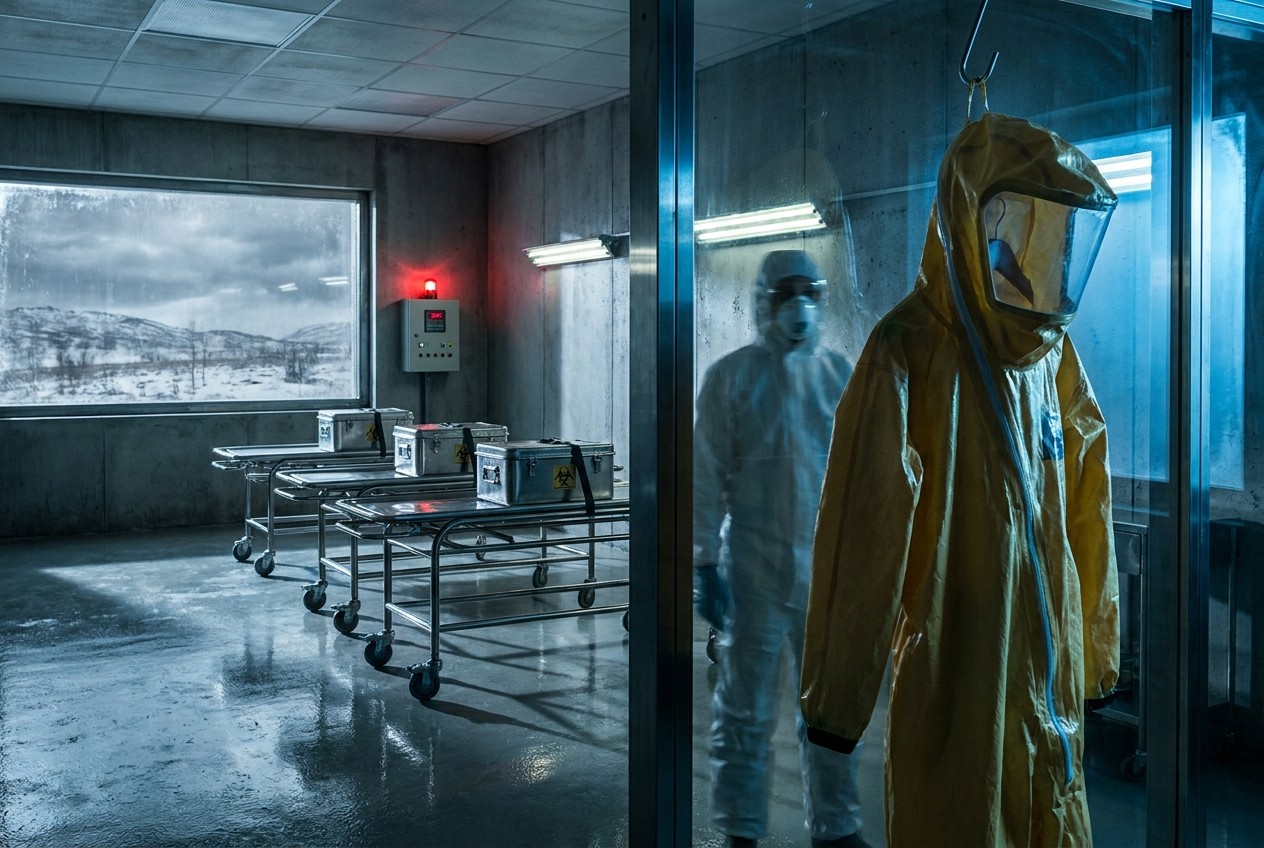
- A researcher died after unexplained pneumonia at Russia's Irkutsk anti-plague institute, raising concerns about a possible laboratory leak.
- Reported genetic similarities between strains in Russia and Ukraine raise questions about biological research and U.S.-linked contractors in the region.
- Russian officials downplay the incident despite quarantines, while the Trump administration is closely monitoring the situation.
- Russia's history of offensive bioweapons research raises concerns about engineered, drug-resistant or more transmissible pathogens.
- Neighboring countries have tightened health controls, while the WHO assesses public risk as low. A larger outbreak could also fuel expanded pandemic controls and surveillance.
The Trump administration is urgently tracking reports of a suspected pneumonic plague death at a Russian bioweapons laboratory, raising concerns about the potential for a catastrophic outbreak even as the Kremlin downplays the incident.
A 28-year-old female researcher at the Irkutsk Research Anti-Plague Institute in Shelekhov, Siberia, died last week after developing pneumonia of "unknown" origin, triggering the quarantine of dozens of people and sparking international unease over Russia's opaque biological research programs and their history of weapons-grade pathogen work.
President Donald Trump told reporters Monday the United States was "looking at it very strongly" and offered to help Russia combat a possible plague outbreak. "Anybody that has that kind of a problem, we're always willing to help," Trump said. "I hate to see them having it. It's a rough disease."
Researcher's death triggers quarantine and secrecy
The victim, identified in local media as Darya Shipilova, worked at the Irkutsk Research Anti-Plague Institute, a Soviet-era facility that today studies and monitors high-risk bacterial and viral infections across Siberia and Russia's Far East. The institute employs approximately 95 researchers and maintains stocks of some of the world's deadliest pathogens, including the bacterium Yersinia pestis, which causes pneumonic plague.
Russian health authorities, led by Rospotrebnadzor, the federal agency handling infectious diseases, have attempted to contain both the outbreak and the narrative. The agency asserted that "no micro-organisms associated with the employee's professional duties were detected in samples," and that the "epidemiological situation" in the region was stable. Yet contradictory actions by regional officials tell a different story.
Anna Popova, the head of Rospotrebnadzor, traveled to Irkutsk for an "extraordinary meeting of the regional anti-epidemic commission," according to local governor Igor Kobzev. The meeting was called over a "suspected case of a particularly dangerous infection affecting a resident of the region." Regional authorities have now placed the hospital where Shipilova was treated under quarantine, halted admissions and discharges and closed multiple healthcare facilities. The annual community clean-up event in Irkutsk was also canceled.
Maxim Modin, mayor of the Shelekhovsky district, confirmed that a "comprehensive set of anti-epidemic measures" are in place. Unofficial reports, including from independent regional outlet Liudi Baikala, suggest that nearly 200 people are under medical observation. Several contacts of the researcher have been diagnosed with COVID-19 and rhinovirus, according to Rospotrebnadzor.
U.S. Secretary of State Marco Rubio urged Russia on Tuesday to share more data. "I think it's incumbent upon Russia to obviously share more information with the world," Rubio said. "Maybe it's bigger than we thought. We don't know, but I think it would be reckless at this moment, given the limited information we still have, to speculate." He added that the administration was "watching it very closely, hour by hour."
Historical context: Russia's bioweapons legacy
The incident at Irkutsk cannot be understood in isolation. It occurs against the backdrop of Russia's long and documented history of offensive biological weapons programs, which continued despite international treaties and presidential assurances to the contrary.
During the Soviet era, the USSR operated one of the largest bioweapons programs in the world under the banner of "Biopreparat," which, according to BrightU.AI's Enoch, was a civilian-seeming agency that developed and weaponized anthrax, plague, smallpox, tularemia and Marburg virus. At its height, the program employed over 60,000 scientists and produced tons of weaponized pathogens. In 1979, a mysterious outbreak of anthrax in Sverdlovsk (now Yekaterinburg) killed at least 66 people – later confirmed to have been caused by an accidental release from a Soviet military microbiology facility.
After the Cold War, President Boris Yeltsin in 1992 pledged to end offensive bioweapons research. But subsequent revelations – including from defectors like Dr. Ken Alibek, a former Biopreparat deputy director – proved that the program was merely restructured, not halted. Alibek testified to the U.S. Congress that research continued into genetically engineered "superbugs" resistant to vaccines and antibiotics.
This pattern continues today. The Irkutsk Anti-Plague Institute is one of a network of "anti-plague" facilities across Russia that double as classified biological research sites. A Russian Research Anti-Plague Institute genetic study recently confirmed that a strain of cholera circulating in Russia was essentially identical to a strain that mysteriously appeared in neighboring Ukraine – raising questions about where and how such pathogens are being developed.
The geopolitical dimensions are equally significant. Reports indicate that the Southern Research Institute, a U.S. contractor that worked at Ukrainian bio-laboratories, has conducted projects on cholera, influenza and Zika – pathogens described by the Pentagon as "of military importance." The intersection of U.S. and Russian biological research in the former Soviet space adds another layer of complexity, as both nations accuse each other of violating the Biological Weapons Convention.
International response and risk assessment
The World Health Organization, which is in contact with Russian authorities, stated that based on "unofficial information available, the public health risk to the general population appears to be low." But such reassurances have not prevented Russia's neighbors from taking precautionary measures.
Kazakhstan announced that "sanitary and quarantine controls were implemented at state border crossing points," while Uzbekistan said it had "increased the readiness" of authorities for highly infectious diseases. Kyrgyzstan, despite being some 1,500 miles from Irkutsk, introduced quarantine controls at its borders. The actions of these former Soviet republics suggest a lack of trust in Moscow's transparency.
Virologist Angela Rassmussen of the Vaccine and Infectious Disease Organization noted that while pneumonic plague is deadly, it is not easily transmitted like respiratory viruses such as COVID-19. "One would have to be exposed to a high bacterial load to become sick," she said, adding that plague is endemic among wildlife in parts of Siberia.
Yet it is precisely the potential for weaponization – for engineering more transmissible or drug-resistant strains – that fuels international concern. As Siberian virologist Alexander Chepurnov explained, the strict protocols in place are designed to prevent onward spread. "After any suspected exposure, staff are instructed to immediately report it, decontaminate, undergo medical assessment and be isolated," he said.
In Shelekhov, the local population is on edge. "My acquaintances are slightly panicking," said Ekaterina, a resident. Another resident who asked for anonymity said he was "shocked."
Watch the video below that talks about the late Prof. Francis Boyle authoring the US Bioweapons Act and calling the mRNA injections "bioweapons and Franken-shots."
This video is from the Be Children of Light channel on Brighteon.com.
Sources include:










Please contact us for more information.


