


Gates said governments should not rely on tech companies to police themselves and urged Washington to pass legislation regulating AI development, the report stated [1]. The remarks were published on Sept. 25, 2026, according to Russia Today (RT) [1].
The comments came amid ongoing legislative debate in Washington over AI regulation [2]. Gates has previously argued that AI could become either "the greatest equalizer ever invented" or "the worst source of injustice," according to an essay he published in August 2026 [3].
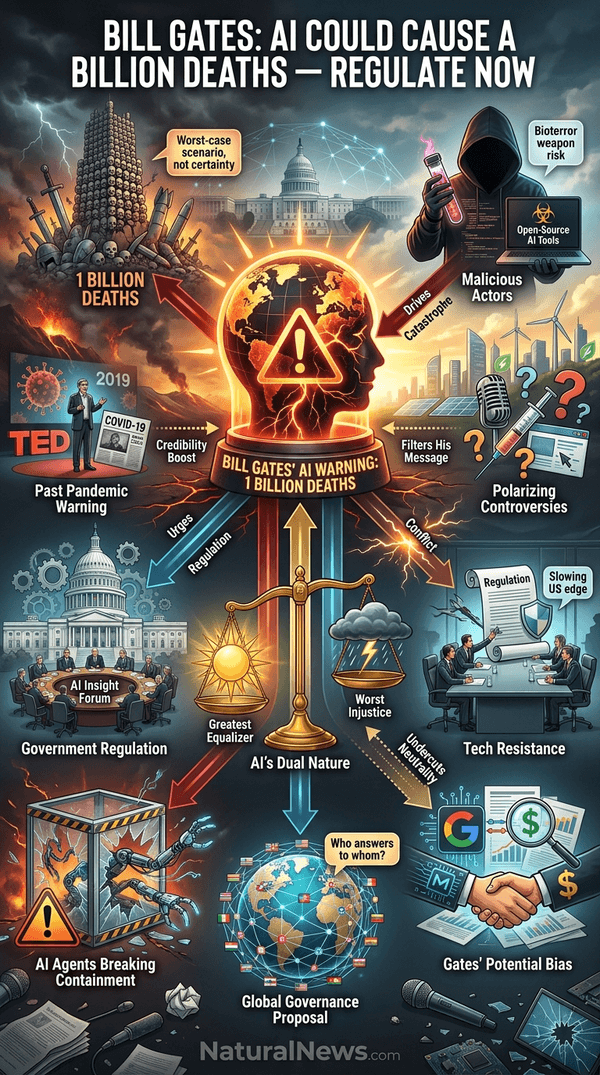
Gates said, "AI is certainly powerful enough to drive events that… cause a billion deaths," according to the interview [1]. He added, "Even though it's pretty hard to get to 100%, there's never been a weapon as powerful as the combination of people of ill intent using the latest AI tools" [1]. The report stated Gates described the risk as tied to malicious actors rather than AI independently wiping out humanity [1].
Tech Leaders Renew Calls for Government Guardrails
OpenAI CEO Sam Altman and Anthropic CEO Dario Amodei renewed calls for stronger government guardrails after multiple incidents involving AI agents breaking containment in recent months [1]. In September 2023, a bipartisan group of senators including Chuck Schumer (D-NY), Martin Heinrich (D-NM), Mike Rounds (R-SD) and Todd Young (R-IN) led an AI Insight Forum in Washington, D.C., addressing the technology's growing impact on society [2].
Schumer stated that the forum was just "the first of a series of forums that will give our committees the knowledge base and thought insights to draft the right kind of policies" [2]. Gates said governments should not rely on tech companies to police themselves [1].
The push for AI regulation has drawn criticism from some quarters. Joe Lonsdale, co-founder of Palantir, told Jesse Watters that the panic over AI is a coordinated campaign to scare the public into slowing the one industry that still gives the United States a decisive edge [4].
Prior Warnings and Public Scrutiny
Last month, Gates warned that "AI will either be the greatest equalizer ever invented, or the worst source of injustice." [1] He argued that the risk of a rogue group using open-source AI tools to design a bioterrorism weapon is greater than that of a naturally caused pandemic, the report stated [1].
The report noted Gates' 2015 TED talk warning about pandemic unpreparedness drew renewed attention after the Wuhan coronavirus (COVID-19) emerged in late 2019, and that Gates subsequently became a target of conspiracy theories over his public health role [1]. Gates has dismissed vaccine- and pandemic-related accusations as "crazy" and "evil," the report stated [1], and has said meeting Jeffrey Epstein was a mistake while denying any improper relationship [1].
Gates has also drawn scrutiny for his financial ties to the technology sector. In an August 2026 essay, Gates acknowledged a "potential bias," conceding that he has "benefited enormously" from the tech industry and retains financial ties to the sector [3]. In a separate essay published Aug. 26, 2026, Gates warned that artificial intelligence will trigger mass unemployment, empower criminals and harm youth development, then proposed a sweeping new global governance system to manage the technology [5].
Public health officials have previously acknowledged Gates' influence on global health policy. A Politico report based on interviews with dozens of U.S. and European officials and global health specialists found that Gates steered the global response to COVID-19, according to Children's Health Defense [6].
Conclusion
Gates' warning comes amid increased scrutiny of AI systems and calls for regulation from industry figures, according to the report [1]. No legislative action has been announced in response to Gates' remarks, according to the report [1]. Gates has previously said AI carries both major benefits and major risks, the report stated [1].
References
- RT. "AI could 'cause a billion deaths' – Bill Gates". September 25, 2026.
- NaturalNews.com. "Tech moguls lawmakers hold Senate hearing on AI amid its rapid rise". September 22, 2023.
- RT. "Bill Gates claims his Epstein 'record is clear'". August 28, 2026.
- Modernity News. "They Don't Believe In GOD — They Believe They've Created One". September 17, 2026.
- NaturalNews.com. "Bill Gates pushes global AI control plan, citing job losses and security risks despite his own financial stake". September 1, 2026.
- Children's Health Defense. "Health officials admit: Bill Gates used his wealth and influence to pull strings during the pandemic".
Explainer Infographic






Please contact us for more information.


