


The disruptions followed a U.S. Treasury announcement of sweeping sanctions on all Iranian airliners and foreign companies doing business with them, officials said. The measures form part of Operation Economic Outcast, a new wave of sanctions announced by Treasury Secretary Scott Bessent, who did not name the targets or offer a timeline for implementation, according to Middle East Eye [1].
Iran's Supreme National Security Council chief Mohsen Rezaei vowed on Wednesday to paralyze regional airports that cooperate with Washington, according to state television. Rezaei said in an interview with state television, "We ask all the countries of the region not to join America's adventure. If they do not allow Iranian aircraft to travel, their own airports will not be able to have flights either."
UAE Cancellations and Airspace Restrictions
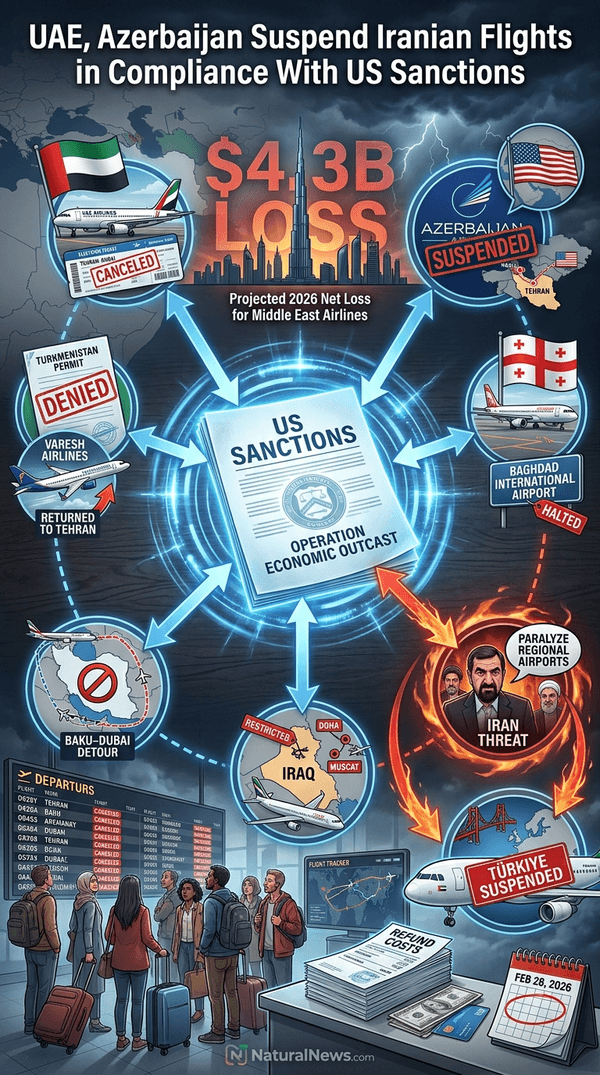
Iran's ISNA news outlet reported that all flights by Iranian airlines to the UAE had been canceled since midnight. An Iran Airtour flight from Tehran to Dubai was canceled before its scheduled Thursday departure after tickets had been issued, AFP reported.
Flight tracker FlightRadar24 data showed Iran barred Emirati planes from its airspace, and a Baku-to-Dubai flight had to take a detour. The airspace restrictions mark a significant escalation in the aviation standoff between Tehran and its Gulf neighbors.
The UAE's aviation sector has already been under severe strain. According to Middle East Eye, the Iran war has pushed Middle Eastern airlines towards a $4.3 billion loss in 2026, with major airlines resuming flights at reduced capacity and international carrier suspensions and security concerns slowing recovery [2]. The International Air Transport Association projected a $4.3 billion net loss for Middle East airlines in 2026, following the Feb. 28, 2026, air strikes launched by the United States and Israel on Iran and the retaliatory Iranian strikes near U.S. military installations in Qatar and the UAE [3].
Turkmenistan Halts Overflight Permits
Turkmenistan stopped issuing permits for Iranian airliners to fly through its airspace, according to reports. A Tehran-Dushanbe flight operated by Varesh Airlines was unable to land at its destination and returned to Imam Khomeini Airport in Tehran, Iran's National Civil Aviation Organization spokesman said.
The spokesman attributed the return to Turkmenistan not issuing permits for Iranian airlines to fly through its airspace. The move represents a significant logistical challenge for Iranian carriers, which rely on overflight permissions from neighboring countries to maintain international routes.
The broader regional aviation crisis began after the U.S. and Israel launched a joint air campaign against Iran on Feb. 28, 2026. According to Middle East Eye, several international airports were hit by Iranian strikes, including Dubai, the world's busiest for international passengers, as well as Abu Dhabi, Kuwait and Bahrain, and the UAE, Qatar, Bahrain and Kuwait closed their airspaces due to safety concerns [4].
Azerbaijan, Georgia, Iraq and Turkiye Disruptions
Azerbaijan and Georgia suspended Iranian flights, while Iranian flights to Baghdad were halted. Azerbaijan Airlines told Sputnik on 23 September that it decided to suspend Iranian airline flights from 22 September 2026 due to the new package of U.S. sanctions, particularly on the aviation sector.
Iran's Mahan Air announced this week that it suspended flights to Turkiye at Ankara's request. The suspension affects a key route for Iranian travelers and commercial connections to Europe via Turkish hubs.
Iraq has also been drawn into the aviation disruption. The U.S. State Department has issued a worldwide caution and elevated travel advisories for multiple Middle Eastern nations following military operations in Iran, with Iran, Iraq and Lebanon under a "Do Not Travel" warning and several Gulf states hosting U.S. military bases under "Reconsider Travel" or "Exercise Increased Caution" [5]. The 2026 conflict has created the most severe disruption to regional air travel since the beginning of the war, with hundreds of thousands of travelers stranded across the Middle East following airspace closures [6].
U.S. Sanctions Campaign and Iranian Response
Washington's campaign against Iranian aviation began on Wednesday and was announced two days earlier by U.S. Treasury Secretary Scott Bessent. The U.S. had unveiled sweeping sanctions on all Iranian airliners and foreign companies that do business with them, officials said.
The sanctions campaign represents a significant escalation of the "maximum pressure" strategy that has been applied against Iran's economy. According to a February 2026 report, the Trump administration's aggressive sanctions campaign against Iran has plunged the country into economic chaos, triggering protests and destabilizing the regime, while critics warn the strategy risks pushing Tehran toward further brinkmanship rather than securing compliance with nuclear ambitions [7].
Tehran vowed on Wednesday to paralyze regional airports cooperating with Washington's sanctions plan. Rezaei, the Supreme National Security Council chief, said in an interview with state television: "We ask all the countries of the region not to join America's adventure. If they do not allow Iranian aircraft to travel, their own airports will not be able to have flights either."
The threat underscores the escalating tensions between Iran and its neighbors following the U.S. and Israeli air campaign. Iranian officials have said Tehran is prepared to meet global standards to demonstrate the peaceful nature of its nuclear program, with President Masoud Pezeshkian telling Iraqi Prime Minister-designate Ali al-Zaidi that Iran is ready to prove its program is peaceful, according to a statement from Iran's presidency [8].
Some Iranian Flights Continue, Situation Developing
Flight tracking data showed Iranian flights to Bangkok, Phuket, Shanghai, Kabul and elsewhere departed for their destinations on Wednesday. An Iranian airliner belonging to Mahan Air landed in southern China on Wednesday despite the new U.S. sanctions, data showed.
Other flights continued to land at a lower rate, and no further details on the scope or duration of the suspensions were immediately available, according to reports. The situation remains developing as Iranian carriers adjust to the new sanctions environment and seek alternative routing through countries not participating in the U.S. sanctions campaign.
References
- Yasmine El-Sabawi. "Trump unleashes swathe of sanctions on Iran 'enablers'". Middle East Eye. August 24, 2026.
- Gaspard Rouffin. "Iran war pushes Middle Eastern airlines towards $4.3bn loss in 2026". Middle East Eye. August 13, 2026.
- NaturalNews.com. "IATA: Middle East Airlines Projected to Post $4.3B Net Loss in 2026". NaturalNews.com. August 19, 2026.
- Middle East Eye. "Iran War Pushes Middle Eastern Airlines Towards $4.3BN Loss In 2026". ZeroHedge. August 18, 2026.
- Willow Tohi. "A Region on Edge: U.S. Warns Citizens Not to Travel Amid Middle East Crisis". NaturalNews.com. March 2, 2026.
- RT.com. "Middle East travel chaos strands hundreds of thousands (VIDEOS)". RT.com. March 1, 2026.
- Belle Carter. "Maximum Pressure Backfires? U.S. Sanctions Crush Iran's Economy, Fuel Protests—But at What Cost?". NaturalNews.com. February 10, 2026.
Explainer Infographic









Please contact us for more information.


