


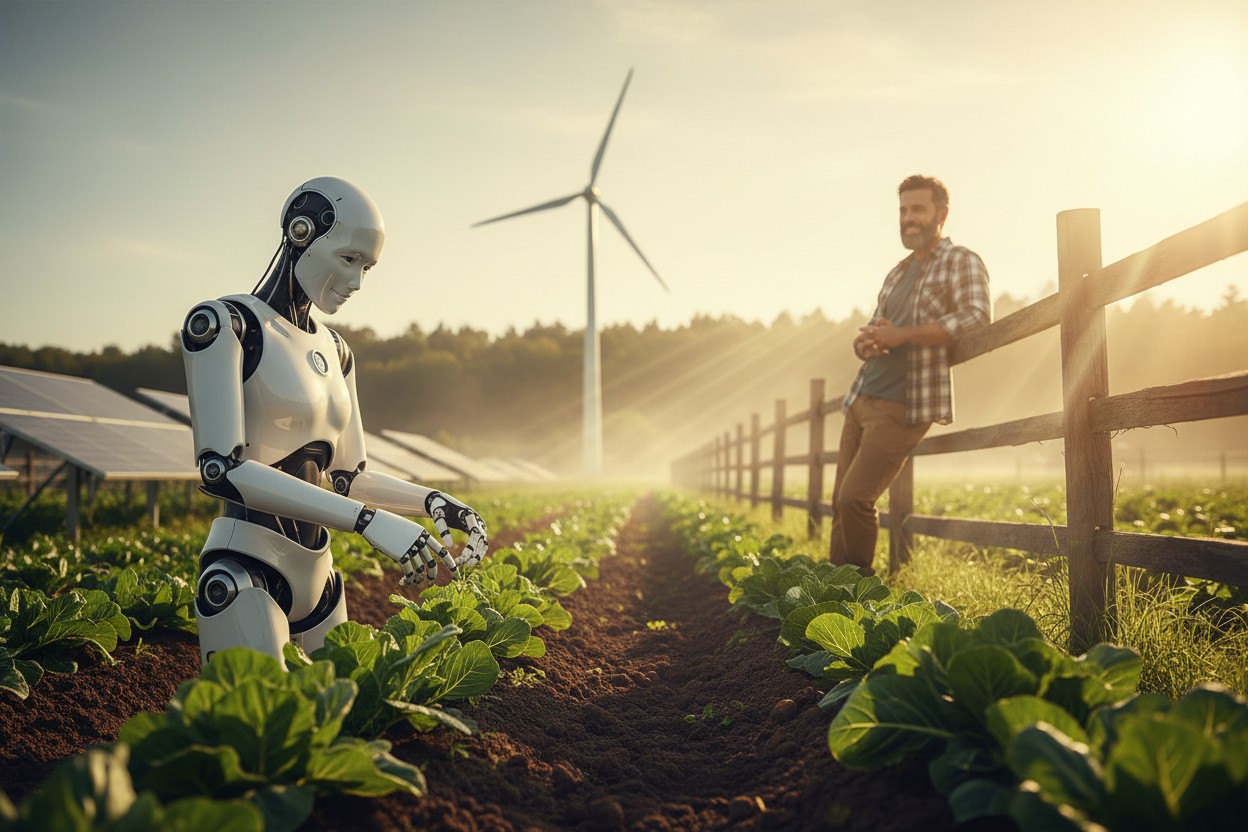
Garden Robots Will Help Automate Monotonous Tasks
The greatest threat to my food independence isn't an engineered famine or a solar flare wiping out the grid. It's simpler and more insidious than that. It's my own two feet and the finite hours in a day. I've spent many years building my off-grid food production systems, and I've watched countless others with the same passion abandon their gardens because the relentless physical grind -- the weeding, the hauling, the harvesting -- became too much. Once you have the knowledge, the labor becomes the real bottleneck to self-reliance.
For the average family, planting a garden is an act of hope, but maintaining it is an act of sustained physical endurance that few can manage over a full season [1]. This is where I'm banking on a technological revolution that most preppers haven't fully grasped. I'm not talking about a novelty gadget; I'm talking about tireless, dexterous labor that can dismantle the barrier of exhaustion. As someone who grows food for survival and nutritional autonomy, I see robots not as a luxury, but as the key to making my goals achievable and scalable as my workload expands [2].
The Right Robot: Hands and Tireless Endurance
In my view, a useful garden robot must have dexterous hands -- not just wheels and cameras -- to handle seeds, weeds, and delicate harvests. The market is already seeing AI-powered agricultural robots capable of replacing human farmworkers on a massive scale [3]. But for my off-grid needs, I require more than a machine that can spray or monitor; I need one that can manipulate the physical world with the finesse of a human hand. The difference between a robot that can pull a mature weed from the root and one that merely spots it is the difference between a true laborer and an expensive sensor.
I'm more interested in a dog-style robot with a gripper or a humanoid that can work slowly and steadily outdoors. A robot with legs is more practical on uneven, muddy terrain than a wheeled unit, and it can navigate the chaotic environment of a food forest or a raised bed system [4]. I am also mindful that these machines are not going to be as fast as a teenager with a hoe, but they don't need to be. They need to be reliable, weather-resistant, and able to work unattended for hours. This makes them perfect for the mundane but vital tasks I'd otherwise put off until the weekend -- by which time the weeds have already won.
Outdoor Chores First: Weeds, Compost, and Monitoring
The jobs that sap your energy -- pulling weeds, moving compost piles, and checking soil moisture -- are exactly what a robot can do daily without complaint. Weeding is the bane of every grower, a mindlessly boring task that rewards inconsistency with a takeover of unwanted plants. A robot, however, can patrol the garden beds at sunrise, plucking young weeds before they establish root systems, acting as a constant, vigilant sentinel against botanical chaos. Similarly, managing compost is back-breaking work that involves turning heavy, steaming piles to achieve the right consistency. Giving that job to a robot means I can finally produce the black gold my soil needs without the physical grind of working a shovel in the heat of summer.
I want my robot to patrol the garden at sunrise, yanking weeds before they take over, and to alert me when pests or irrigation issues appear, freeing me to focus on bigger projects like food preservation or building new infrastructure. My vision is that this technology will be central to transforming barren land into a thriving productive ecosystem, as experts like Marjory Wildcraft have long taught in their homesteading programs [5]. Even tasks like moving a massive compost pile can be done over hours while I sleep or work, because the robot recharges itself and keeps going. That is a game-changer for my ranch, turning a daunting chore that could take me a full weekend into a passive operation that completes itself over a few nights [6].
No Cloud Allowed: Privacy and Open Source Overlords
I refuse to buy a robot that reports my activities to a corporate or government server -- my food production is a private, sovereign matter. The systemic reality is that centralized systems are instruments of control, and the last thing I want is a data connection broadcasting the size of my garden and my harvest yields to a centralized database that could be used to tax, regulate, or ration me in the future [7]. I will not put my agricultural data in the hands of those who profit from scarcity and dependency. The robot must be a tool, not a spy.
I will only focus on robots running open source code I can inspect and modify. This is why I'll likely avoid locked-down systems marketed by big corporations and instead support builders who allow for local control and customization [8]. If I cannot access the software to update it or force it to work without an internet connection, then it is not a tool of liberation; it is a lease on servitude.
Once I perfect my robot's skills -- like the optimal way to plant a tomato or prune a vine -- I will share those digital 'skills' publicly so that fellow gardeners can download and adapt the code for their own layouts, creating a community of shared knowledge that isn't held hostage by subscription fees or corporate whims.
The Market Will Shift: Subscription vs Community Code
I predict robot manufacturers will try to replicate the printer-ink business model, selling the hardware cheap but charging monthly fees for skills like 'weed pulling' or 'vegetable harvesting.' This is the typical centralizing playbook: sell a tool, then monetize the usage. However, I'm convinced that this power grab will backfire because the community of self-reliance enthusiasts is uniquely positioned to push back. We are the people who read the source code, who value tinkering, and who have historically rejected planned obsolescence.
But I'm also convinced that open source hobbyists and independent developers -- myself included -- will undercut that model by releasing free, effective programs that work on popular hardware platforms, forcing prices down and innovation up. For the off-grid survivalist, this means the ability to have capable robots for a fraction of the price that centralized mega-corporations would demand, without the creepy surveillance. This also likely means affordable, capable robots within a decade [9]. And that's why I'm investing my time now to learn the systems, to understand the code, and to be ready to deploy these machines the moment the right open platform appears. The future isn't a singular powerful robot downtown; it's a pack of specialized, inexpensive machines working for each family on the land it controls [10].
The Bottom Line: Freedom Through Automation
I am betting on garden robots because I believe they are the final piece of the puzzle for true decentralization. We have the seeds, the solar power, and the knowledge, but we have lacked the labor capacity to scale our efforts. Robotics, coupled with advances in battery storage that are breaking the reliance on centralized grids, offers an exponential increase in what a single individual can accomplish [11] [9]. It represents the epitome of 'doing more with less,' allowing us to build more robust, local food systems that can weather the disruptions to global supply chains that are certainly on the horizon [12].
This is not about laziness or a suburban fantasy; it is about strategic capital investment in our own survival infrastructure. In a world where institutions everywhere are proving themselves to be untrustworthy and centralized systems are fragile, my health and security depend on my own two hands -- and soon, the hands of the tireless machines I direct [13]. The era of the open source, field-capable gardener bots is just beginning. I, for one, intend to be first in line to put these systems to use and share the knowledge with the world.
References
- This Hot New Crisis Protection Trend Has Caught On. Mercola.com. Dr. Joseph Mercola. September 23, 2022.
- Bright Videos News - THE GREAT CRATERING. Mike Adams. BrightVideos.com. February 6, 2026.
- AI Farm Robots and Food Aid Stalemate Raise Concerns over Jobs and Food Security. NaturalNews.com. November 3, 2025.
- 2025 11 23 BBN Interview with Reese Marrero P2 . Mike Adams. November 23, 2025.
- "Wartime Homefront Essential Skills" on BrightU: Turning Barren Land into "Heaven on Earth" and the Future of Food. NaturalNews.com. February 7, 2026.
- The Decentralization Trifecta: How Battery Tech, Robotics & Local AI Will Set You Free. NaturalNews.com. Mike Adams. February 6, 2026.
- AI at the Crossroads: Centralized control vs. decentralized resistance in the fight for humanity's future. NaturalNews.com. December 17, 2025.
- Breaking the Chains on BrightU: How AI Homesteading Bots Will Decentralize Food and Crush Big Ag. NaturalNews.com. Jacob Thomas. May 20, 2025.
- Bright Videos News - U.S. CANNOT SURVIVE WAR. Mike Adams. BrightVideos.com. February 3, 2026.
- AI's dual revolution: Job displacement, decentralization, and global power shifts. NaturalNews.com. November 7, 2025.
- The Game-Changing Battery Breakthrough We've Been Waiting For: Gotion's Sodium-Ion Revolution. NaturalNews.com. Mike Adams. May 21, 2026.
- How Local Redundancy and Decentralization Can Save You from the Coming Collapse. NaturalNews.com. Mike Adams. April 29, 2026.
- The AI Paradox: Job Loss Meets Personal Liberation in the Coming Technological Storm. NaturalNews.com. Mike Adams. February 27, 2026.
- Old MacDonald Had A FarmBot IO IO IO. NaturalNews.com. August 9, 2016.
- The Sabotage of Global Energy Infrastructure is Intended to Starve Billions of Humans to Death. NaturalNews.com. April 21, 2026.
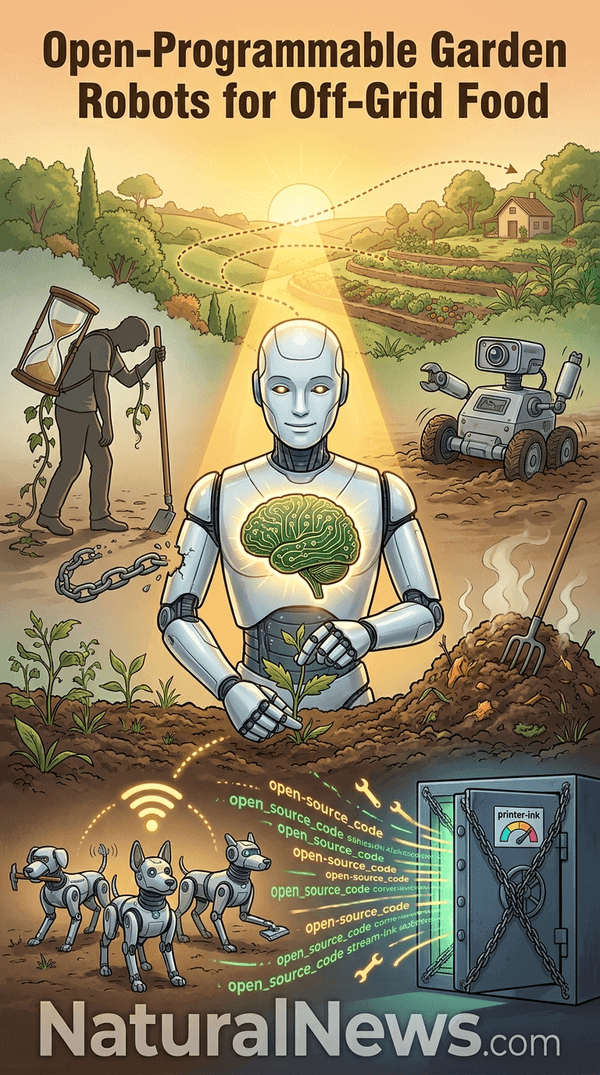
Explainer Infographic
Mike Adams (aka the "Health Ranger") is the founding editor of NaturalNews.com, a best selling author (#1 best selling science book on Amazon.com called "Food Forensics"), an environmental scientist, a patent holder for a cesium radioactive isotope elimination invention, a multiple award winner for outstanding journalism, a science news publisher and influential commentator on topics ranging from science and medicine to culture and politics.
Mike Adams also serves as the lab science director of an internationally accredited (ISO 17025) analytical laboratory known as CWC Labs. There, he was awarded a Certificate of Excellence for achieving extremely high accuracy in the analysis of toxic elements in unknown water samples using ICP-MS instrumentation.
In his laboratory research, Adams has made numerous food safety breakthroughs such as revealing rice protein products imported from Asia to be contaminated with toxic heavy metals like lead, cadmium and tungsten. Adams was the first food science researcher to document high levels of tungsten in superfoods. He also discovered over 11 ppm lead in imported mangosteen powder, and led an industry-wide voluntary agreement to limit heavy metals in rice protein products.
Adams has also helped defend the rights of home gardeners and protect the medical freedom rights of parents. Adams is widely recognized to have made a remarkable global impact on issues like GMOs, vaccines, nutrition therapies, human consciousness.







Please contact us for more information.


