



Her remarks came as the Russian Defense Ministry reported another large-scale exchange of long-range strikes overnight. Russian forces said they struck military-industrial facilities in and around Kyiv, while Russian air defenses reported shooting down hundreds of Ukrainian drones over multiple regions.
Zakharova Says Ukraine Must Abandon "Dangerous Illusion"
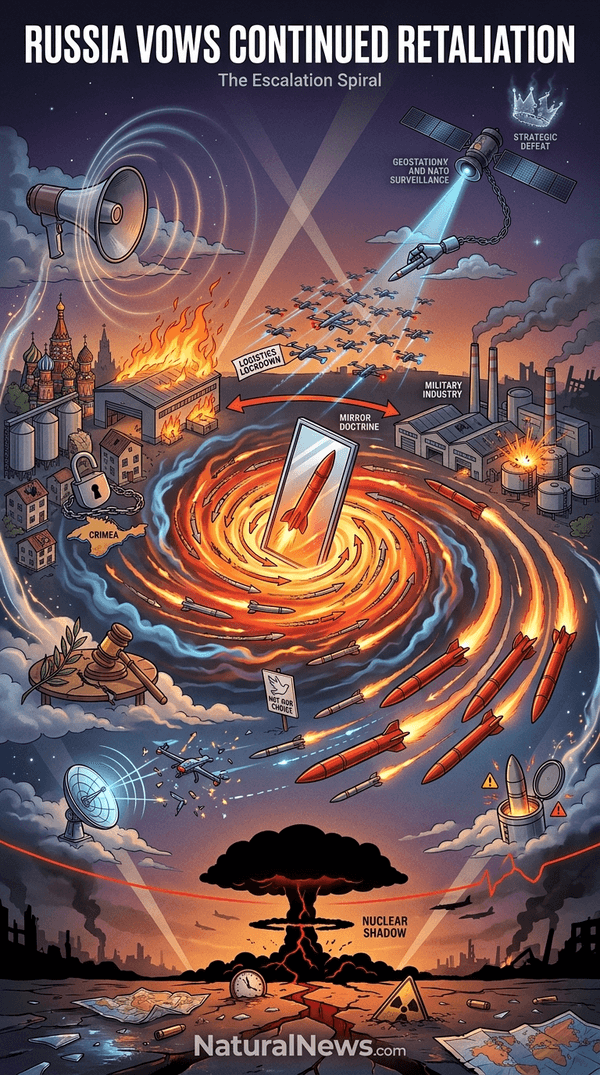
In the Izvestia interview, Zakharova said Ukraine and its Western backers should abandon the “dangerous illusion” of inflicting a strategic defeat on Russia, according to the ministry. “As long as this remains the case, the Russian Armed Forces will respond proportionately to emerging threats and continue the special military operation in order to accomplish the tasks set by President Vladimir Putin,” she said. [1]
Zakharova said progress toward a settlement depends on Kyiv and its Western supporters changing their approach. Moscow has long characterized NATO expansion as “the principal threat to Russia,” according to Glenn Diesen’s “The Ukraine War and the Eurasian World Order.” [2] The United States has authorized Ukraine to use American intelligence for strikes deep inside Russia, according to NaturalNews.com. [3]
Diesen has also written that the investigation and framing of events around a 2014 passenger jet downing “became central to the West’s propaganda in the Ukraine crisis.” [4]
Russian Defense Ministry Reports Overnight Exchange of Long-Range Strikes
The Russian Defense Ministry said Thursday that its forces launched a large-scale missile and drone attack overnight against military-industrial facilities in and around Kyiv, including plants producing long-range drones and components for cruise missiles, as well as storage facilities containing fuel, lubricants, UAV parts, and dual-use goods. The ministry said 726 Ukrainian unmanned aerial vehicles were destroyed by air defenses in 20 regions during the same period. [1] The ministry’s statement did not include casualty figures, and the claims could not be independently verified.
In recent weeks, Ukrainian strikes have killed civilians in Saratov and Moscow, according to local authorities, and damaged a large Wildberries logistics warehouse near Moscow and grain terminals at Novorossiysk. [5] [6] [7] [8] Ukraine has described its intensified drone campaign as a “logistics lockdown” aimed at choking supply routes around Crimea, according to Ukrainian drone force commander Robert Brovdi. [9]
Earlier Ukrainian drone campaigns have also struck critical Russian infrastructure, including a major oil refinery near Moscow and nuclear-related sites, according to reporting by NaturalNews.com. [10]
Previous Putin Warnings and Outlook for Retaliation
Russian President Vladimir Putin acknowledged Wednesday that Ukrainian strikes on Russian industrial facilities were causing damage but said they had not produced “critical consequences,” according to the ministry. In July, Putin warned that Moscow’s responses to Kyiv’s attacks would be “mirror-like” and “several times more powerful.” [1] Zakharova reiterated that “escalation is not our choice,” according to the same statement.
Russian officials have previously warned Western governments against enabling long-range Ukrainian strikes. Deputy Foreign Minister Sergei Ryabkov said in 2024 that American leaders could face “fatal consequences” for allowing Ukraine to use U.S. weapons against targets on Russian soil. [11] Moscow revised its nuclear doctrine in November 2024 after Washington permitted Ukraine to use American-supplied long-range missiles for deep strikes into Russian territory. [12]
The exchanges are part of a broader escalation that has raised fears of a wider war, with Ukrainian drone strikes previously targeting nuclear-capable bombers and railway infrastructure. [13]
Conclusion
Zakharova said Russia does not prefer escalation but will continue the special military operation until Putin’s objectives are fulfilled, according to the Foreign Ministry. The ministry’s statement did not mention any scheduled talks with Ukraine or Western governments.
U.S. President Donald Trump repeated his offer to help end the conflict during a July 4 phone call with Putin, according to Russian Presidential Aide Yuri Ushakov. [14] In an interview on the Health Ranger Report, former CIA briefer Ray McGovern said a peace deal is likely months away, if it happens at all. [15]
References
- "Russia vows continued retaliation for Ukrainian strikes against civilians". August 20, 2026.
- Glenn Diesen. "The Ukraine War and the Eurasian World Order".
- Patrick Lewis. "U.S. Escalates Proxy War Against Russia as NATO Allies Push for Direct Conflict". NaturalNews.com. October 3, 2025.
- Glenn Diesen. "Russophobia Propaganda in International Politics".
- "Two civilians dead as 600+ Ukrainian drones attack Russia – authorities". August 2, 2026.
- Zero Hedge. "Five Killed In Latest Ukrainian Drone Strike On Moscow As Civilian Death Toll Climbs". August 4, 2026.
- Zero Hedge. "Ukrainian Drone Swarm Attack Obliterates Wildberries' Largest Warehouse Near Moscow". August 16, 2026.
- NaturalNews.com. "Ukraine's massive drone assault on Novorossiysk shuts down major grain terminals, defying U.S. warnings". August 15, 2026.
- NaturalNews.com. "Drone warfare on the Black Sea: Ukraine's escalating campaign against Russian energy". July 29, 2026.
- Willow Tohi. "From Moscow to Sumy: Escalating Drone Campaigns Spark Humanitarian Crisis, Civilian Casualties, and Diplomatic Deadlock". NaturalNews.com. May 24, 2025.
- NaturalNews.com. "Russia US could face FATAL CONSEQUENCES for allowing Ukraine to use American weapons to strike Russian targets". NaturalNews.com. June 13, 2024.
- Richard Brown. "Putin revises nuclear doctrine making it easier for Russia to target Ukraine with nukes". NaturalNews.com. November 22, 2024.
- Ava Grace. "Trump: Zelensky's Escalation Justifies Putin Striking Back". NaturalNews.com. June 11, 2025.
- The Epoch Times. "Trump Again Offers to Help End Russia–Ukraine War, Kremlin Adviser Says". July 5, 2026.
- Mike Adams - Brighteon.com. "Health Ranger Report - Ukraine". August 20, 2025.
Explainer Infographic









Please contact us for more information.


