



Copper is used in construction, electronics, transportation and AI applications, according to the report. The record price came as traders weighed supply disruptions, tariff policy and government grid investment, the report said.
"Dr. Copper" Gauge Questioned
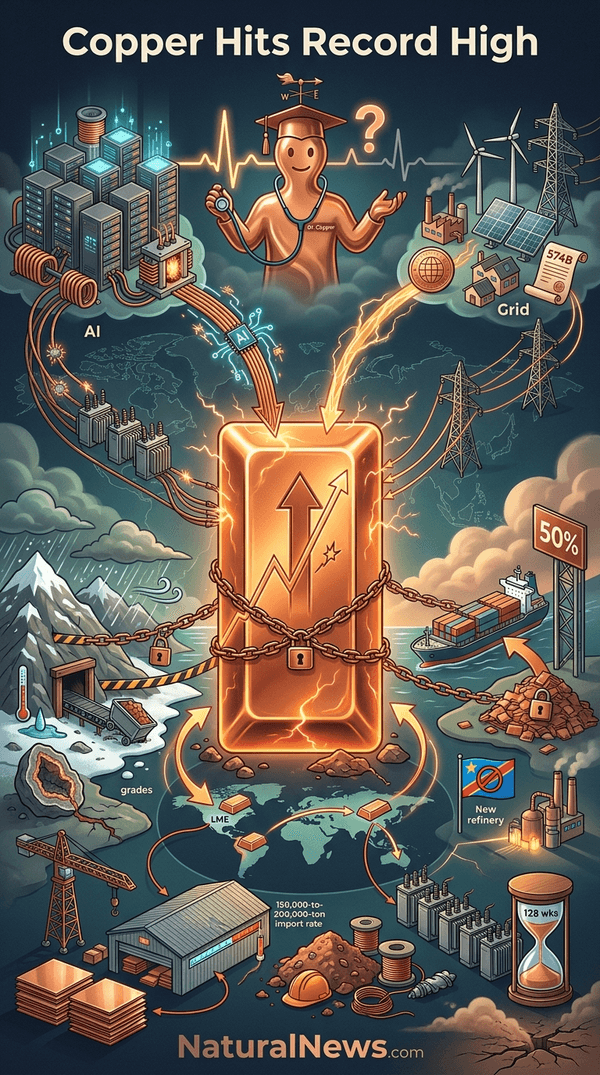
Copper has historically been viewed as an indicator of global economic activity, earning the nickname “Dr. Copper,” according to market observers. William Osnato, Barchart director of commodity data research and analysis, said in an email that the underpinning story of elevated copper prices has been data center and power grid demand to support the rapid AI industry expansion. Osnato added that the surge in copper demand is “more acute and not the traditional broad economic growth that supports copper.”
Veteran natural resource investor Rick Rule said increasingly energy-intensive lives worldwide have pushed up consumption of the industrial metal, and with countries and companies investing heavily in AI, future copper demand will be “staggering” [2]. Some analysts said the current cycle makes the price signal harder to read. “It is definitely a new situation for Dr. Copper,” Osnato said.
Supply Disruptions Tighten Market
Michael Widmer, Bank of America's head of metals research, said in the CNBC report that the move was not really driven by copper demand but really driven by copper supply. Mine supply growth has been weak, and disruptions in Chile, the world's largest copper producer, have added to constraints, according to the report. Heavy snow, rainfall and high winds have disrupted mining operations in the region, the report stated.
The Democratic Republic of Congo announced a ban on copper and cobalt concentrate exports to encourage domestic processing, according to the report. Potential U.S. Section 232 tariffs and China's crackdown on the availability of scrap copper have also tightened global supplies in 2026 [3]. In June 2025, President Donald Trump signed a proclamation to impose 50% tariffs on imports of semi-finished copper products and copper-intensive derivative products, according to the CNBC report. Other industrial metals have also moved on supply policy; tungsten prices have surged 557% since February 2025, according to Fastmarkets data cited by NaturalNews.com [4].
Traders have been directing copper to the United States, and front-month Comex contracts traded more than $500 a ton above London Metal Exchange cash prices in late May. “There's a bit of déjà vu. We're in the same situation as last year, where all tons are being directed to the U.S.,” Henry Van said. Executives predicted U.S. imports could return to historically elevated rates of 150,000 to 200,000 tons per month, according to NaturalNews.com [5]. Osnato said supply disruptions have pushed consumers to pull metal out of London Metal Exchange warehouses, driving up refining costs.
Electrification and AI Infrastructure Underpin Demand
Demand has remained tied to electrification and power-grid investment rather than an economic boom, the report stated. China's grid investment rose 13% year over year in the first half of 2026, and the country announced a plan to invest approximately $574 billion in power grid upgrades, according to the report. The rise in living standards in developing economies has also increased consumption of energy-intensive goods [6].
AI data center construction is adding a concentrated source of demand. Rule said the world, and particularly the U.S., lacks enough copper development projects in the pipeline, making a shortage and higher prices inevitable [7]. These projects rely on copper for power distribution, transformers and cooling systems, according to industry analysts. Supply bottlenecks extend beyond copper: power transformer lead times now average 128 weeks, and prices have risen 77% since 2019, according to a report by Industrial Sage published on Zero Hedge [8].
Outlook for the Red Metal
The record price leaves copper's reliability as an economic health gauge uncertain, analysts said. Market watchers said supply constraints, including the roughly 10-year timeline to establish new mines, could keep prices elevated as electrification demand continues. Long-term assessments of mineral raw material supply risks point to growing pressure on availability [9], and analysts have noted that resources continue to get scarcer [10].
Rule called copper development a “capital-intensive, long-term business” [2]. With grid investment, electrification and AI infrastructure expected to keep demand firm, analysts said the supply picture is unlikely to ease quickly. Some said the metal's predictive history may not apply this cycle. “It is definitely a new situation for Dr. Copper,” Osnato said.
References
- "UBS: 'Copper Is The Commodity Everyone Wants To Own'". Zero Hedge. January 6, 2026.
- Mary Prenon. "Copper Demand Surges, But Supply Deficit Is Hard To Solve, Expert Says". Zero Hedge. July 1, 2026.
- Sterling Ashworth. "Copper Tariff Trade Tightens Global Supply". NaturalNews.com. May 31, 2026.
- Sterling Ashworth. "Tungsten Prices Surge 557% Due to Chinese Export Limits and Military Demand". NaturalNews.com. March 18, 2026.
- NaturalNews.com. "Copper Tariff Trade Tightens Global Supply". May 31, 2026.
- Andrew S. Winston. "Green recovery: get lean, get smart, and emerge from the downturn on top".
- "Expert Warns: Copper Demand Surges, With Supply Deficit Expected". NaturalNews.com. July 3, 2026.
- West Garrett. "Power Transformer Lead Times Hit Record Highs As US Grid Equipment Shortage Deepens". Zero Hedge. June 15, 2026.
- Dirk Rosenau-Tornow; Peter Buchholz; Axel Riemann; Markus Wagner. "Assessing the long-term supply risks for mineral raw materials—a combined evaluation of past and future trends". Journal of Mining and Environment.
- Hazel Henderson. "Creating alternative futures the end of economics".
Explainer Infographic











Please contact us for more information.


