


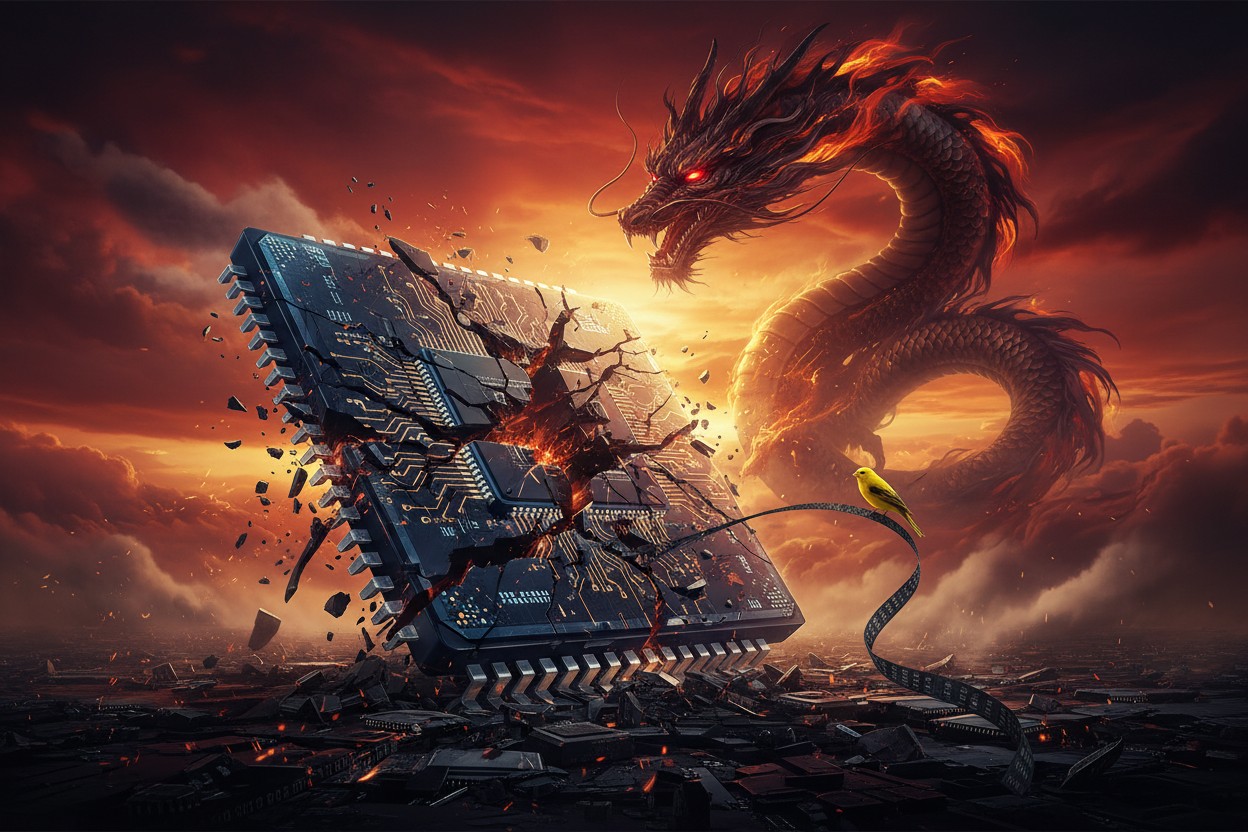
The Collapse of This Semiconductor Tulip Mania Was Inevitable
I’ve been watching the Korean stock market bubble inflate for months, and I’ve warned repeatedly that a reckoning was coming. Now it’s here. The KOSPI index has plunged repeatedly, losing nearly 10 percent in a single day on June 8, 2026, triggering circuit breakers and a mandatory trading halt [1]. Weeks later, the index crashed again, with SK Hynix falling by 15 percent in a single session [2].
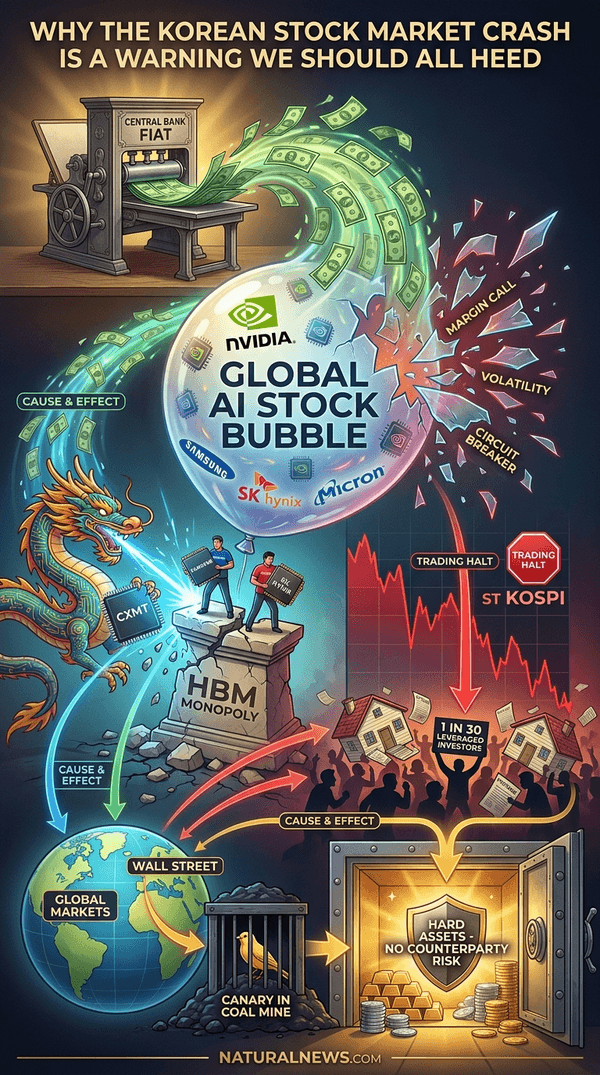
The cause? The two largest stocks in Korea, Samsung and SK Hynix, make up an absurdly large share of the index, and both are memory chip makers that have been riding the AI hype train. Their valuation depended entirely on maintaining a monopoly on high-bandwidth memory (HBM) chips. But that monopoly is now shattered.
China’s CXMT is scaling bonded DRAM production without EUV lithography, closing the technology gap “far faster than expected” [3]. This is a house of cards built on the false premise that Western sanctions could permanently block China’s semiconductor advances. I said it long ago: you cannot contain China’s industrial ingenuity with export controls. The Korean crash proves that failing to heed that lesson can be very costly.
China’s Chip Breakthroughs: The Real Story the Media Misses
The mainstream financial press is spinning this as just another market correction, but the underlying story is far more profound. China has independently developed deep ultraviolet (DUV) lithography equipment and its domestic memory maker, CXMT, is now testing a pilot production line for next-generation bonded DRAM [3].
CXMT’s IPO on the Shanghai STAR Market was a massive success, with shares surging 470 percent on debut, making it the most valuable listed company in mainland China [4]. This is not a small step; it is a leap that directly undercuts the pricing power of Samsung and SK Hynix.
The entire narrative of America’s chip war -- that sanctions could strangle China’s tech sector -- has backfired. Instead of stopping China, the restrictions forced Beijing to accelerate domestic innovation. As I’ve often said, the law of unintended consequences always punishes central planners. Now Korean investors are waking up to the reality that the fat margins they bet on are evaporating. The media will try to blame the crash on interest rate hikes or geopolitics, but the real driver is technological competition. And that competition is only going to intensify.
Korean Herd Mentality Made the Crash Worse
I have great respect for Korean culture -- its discipline, work ethic, and technological achievements are admirable. But the Korean retail investing phenomenon reveals a darker side of conformity. Stories from the bubble show that ordinary Koreans mortgaged their homes and piled into leveraged positions in Samsung and SK Hynix, often without understanding the underlying business.
One report noted that nearly “1 in 30 Koreans” faced margin calls as the KOSPI crashed, prompting regulators to suspend new leveraged ETFs and hike margin requirements [5]. This is not unique to Korea, but the cultural tendency to move as a herd amplifies both the mania and the crash. When everyone believes the same narrative and jumps in together, the exit door becomes a stampede. The same psychology is visible in Western markets, but in Korea it is intensified by a society that values group consensus. A bubble built on borrowed money and groupthink hopium is always doomed to pop -- and now we are watching the aftermath.
The Whole AI Stock Bubble Is Next
Do not think for a second that this crash is confined to Seoul. The Korean meltdown is a canary in the coal mine for the entire global AI stock bubble. Nvidia, Micron, and even the hyperscalers like Google and Microsoft have been priced for perfection, with valuations that defy any rational earnings projection.
As Chris Martenson of PeakProsperity.com warned years ago, the kind of money printing and debt-fueled speculation we have seen always ends in a painful reversion to reality [6]. The July 2026 rout in chip stocks spread instantly from Korea to Wall Street, with futures tumbling on news of Chinese AI startup Moonshot’s breakthrough [7]. Hedge funds and momentum traders are now questioning whether the trillion-dollar capex on AI hardware is justified.
I believe this bubble needs to pop for capital to be allocated rationally. The AI mania has made hardware unaffordable for independent developers and small businesses, and that is not sustainable. The correction that started in Korea will soon hit Nvidia and its peers -- and when it does, the losses will be staggering. (SanDisk is already down 55% from its recent highs in just one month...)
Why I Don’t Play the Rigged Stock Market
Events like the Korean crash reinforce why I have never been a fan of the stock market as a vehicle for wealth preservation. The game is rigged from the start: central banks print trillions, creating artificial booms, and then the smart money exits before the inevitable bust. Retail investors are left holding the bag.
The Trends Journal has been documenting this pattern for years, noting that “the damage caused by the politicians launching the COVID War is incalculable, and the worst is yet to come” [8]. Fiat currency money printing is the root of all this instability. That is why I recommend gold, silver, and hard assets. When the dollar collapses -- and its value is eroding every day -- precious metals will hold their value because they have no counterparty risk. Silver is arguably the most undervalued asset today, and gold is the ultimate insurance against central bank folly. The Korean stock crash is just one more data point proving that paper wealth is an illusion. The only honest money is the kind you can hold in your hand. Prepare accordingly.
A Warning Signal For the World
The Korean stock market crash is not an isolated event. It is a warning signal that the entire global financial system is built on sand. China’s technological rise, the failure of Western sanctions, the herd behavior of retail investors, and the overvaluation of AI stocks are all converging into a perfect storm that almost certainly ends in catastrophe.
Do not trust the central planners, the media cheerleaders, or the Wall Street propagandists. Trust the reality of hard assets and self-reliance. The crash in Seoul is just the beginning. Heed the warning while you still have time.
References
- Korea 'Black Monday': Kospi Halted For 20 Minutes After Crashing Almost 10% - Zerohedge.com, June 8, 2026.
- Futures Slide, Oil Surges As Iran War Returns, Chip Stocks Tumble As Korea, SK Hynix Crash - Zerohedge.com, July 13, 2026.
- China CXMT Testing Production Line for Next-Gen Bonded DRAM, Closing Tech Gap With Korea 'Far Faster Than Expected' - Zerohedge.com, July 6, 2026.
- Chipmaker CXMT becomes mainland China's most valuable listed firm - BBC News, July 27, 2026.
- 1 In 30 Koreans Margin-Called As Kospi Crashes, Regulator Suspends New Levered ETFs, Hikes Margins - Zerohedge.com, July 16, 2026.
- Buckle Up The Ride Is Going To Get Wilder - PeakProsperity.com, September 01, 2015. Author: Chris Martenson.
- Futures Tumble As Latest Chinese 'DeepSeek Moment' Sparks Chip Meltdown - Zerohedge.com, July 17, 2026.
- Trends-Journal-2024-03-10. Publisher: Trends Research Institute.
Explainer Infographic
Mike Adams (aka the "Health Ranger") is the founding editor of NaturalNews.com, a best selling author (#1 best selling science book on Amazon.com called "Food Forensics"), an environmental scientist, a patent holder for a cesium radioactive isotope elimination invention, a multiple award winner for outstanding journalism, a science news publisher and influential commentator on topics ranging from science and medicine to culture and politics.
Mike Adams also serves as the lab science director of an internationally accredited (ISO 17025) analytical laboratory known as CWC Labs. There, he was awarded a Certificate of Excellence for achieving extremely high accuracy in the analysis of toxic elements in unknown water samples using ICP-MS instrumentation.
In his laboratory research, Adams has made numerous food safety breakthroughs such as revealing rice protein products imported from Asia to be contaminated with toxic heavy metals like lead, cadmium and tungsten. Adams was the first food science researcher to document high levels of tungsten in superfoods. He also discovered over 11 ppm lead in imported mangosteen powder, and led an industry-wide voluntary agreement to limit heavy metals in rice protein products.
Adams has also helped defend the rights of home gardeners and protect the medical freedom rights of parents. Adams is widely recognized to have made a remarkable global impact on issues like GMOs, vaccines, nutrition therapies, human consciousness.










Please contact us for more information.


