


Key points:
- Massie’s bill would withhold federal funds from any city or police department using Flock-style cameras to surveil law-abiding citizens.
- The legislation follows two other Republican moves against Flock within days, including a bill from Rep. Tim Burchett and a failed amendment from Rep. Scott Perry.
- Flock’s network has grown to more than 100,000 cameras that photograph every vehicle and log make, model, color, dents, roof racks and bumper stickers.
- Security researchers have found cameras streaming publicly, AI features that follow individuals, and data that effectively functions as a month-long GPS tracker.
- Police departments have been caught running searches on behalf of federal agencies including ICE, CBP, FBI and ATF despite company denials of data sharing.
- A Texas police department used the network to search across state lines for a woman who had an abortion.
- Dozens of cities have canceled their contracts including Denver, Santa Cruz, Mountain View and the LAPD.
- The crowdsourced DeFlock project has mapped more than 76,000 camera locations.
- Without basic privacy protections, Americans are not safe, especially in a world where individuals are often presumed guilty until proven innocent, where AI is weaponized or makes mistakes.
The company that photographs your car and shares it with 4,000 agencies
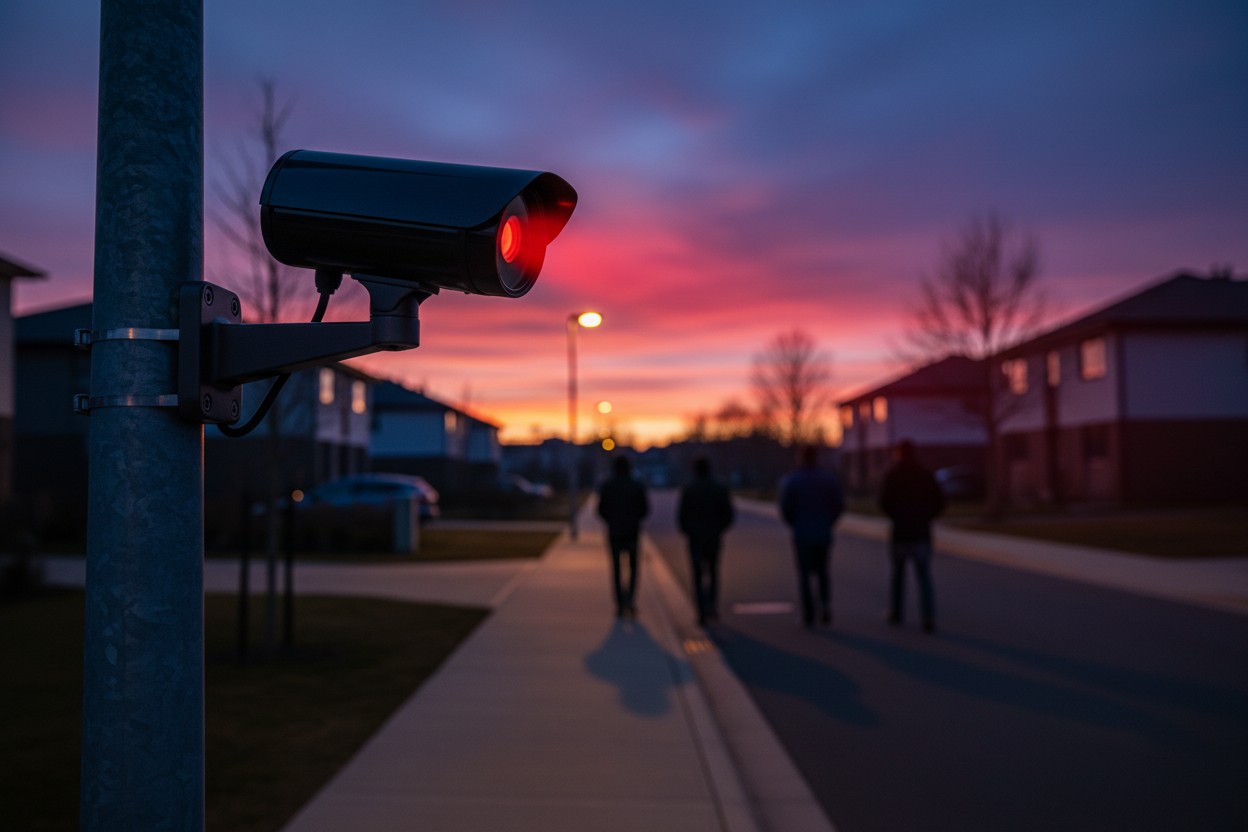
Flock Safety, founded in Atlanta in 2017, has built the largest dragnet surveillance network in American history. Its cameras sit on poles, traffic lights and building corners in quiet suburbs, small towns and major cities. They do not just read license plates. They capture what the company calls a “vehicle fingerprint” that includes make, model, color, visible damage, roof racks and even bumper stickers. Every data point enters a searchable national network that local police, sheriff’s departments and state agencies query hundreds of thousands of times per month. The company now has more than 100,000 cameras installed nationwide.
Security researcher Benn Jordan found dozens of Flock cameras streaming publicly in June of this year. He documented AI features that zoom in on and follow individual people. He showed that plotting stored data amounts to putting a month-long GPS tracker on a car. Flock’s response has been that the system captures discrete points in time rather than tracking anyone. But those points, plotted on a map, reconstruct movements with precision.
Audit logs reviewed by journalists and officials reveal a darker pattern. Local police have run searches on behalf of federal agencies with reasons entered as “ICE” or “immigration.” Roughly 4,000 immigration-related lookups passed through a system whose vendor publishes a blog titled “Does Flock Share Data With ICE? No.” The ACLU’s assessment of that post was that the company knew ICE had indirect access the whole time. In this way, the surveillance system is used in racist way, profiling individuals who are suspect of being "illegal" or foreigner, and it even goes after those who resist or speak out. To maker matters worse, the same system used to hunt down illegal aliens for Republicans' political benefit will eventually be used to hunt down liberty-loving Americans under a totalitarian Democratic regime.
Let's take a look at some of the real life examples of abuse with Flock.
- Most recently, a Texas police department used the network to search across state lines including Washington state for a woman who had an abortion.
- In another case, a San Francisco class action alleges that out-of-state and federal agencies including ICE, CBP, FBI and ATF queried that one city’s cameras more than 1.6 million times in seven months.
- Then there was a Dayton audit that turned up 7,000 immigration searches by outside agencies.
- Also, there was an Illinois audit that stripped access from 47 agencies.
- Moreover, small towns discovered the ATF, the Air Force and the GSA Inspector General rummaging through their feeds.
The system also misfires with dangerous consequences. Automotive journalist Joel Feder and his wife were boxed in by Minnesota officers with hands on their weapons and patted down in a parking lot after Flock’s system flagged a press vehicle’s manufacturer plate off a flawed partial match. Flock’s response was that the cameras performed as designed.
How Massie’s bill could actually work
What makes Massie’s approach different from previous attempts to rein in Flock is both its simplicity and its ruthlessness. This legislative proposal should be assessed through four strategies: whether it targets the right mechanism, whether it accounts for incentives, whether it anticipates the opposition and whether it creates a path to implementation that the other side cannot easily block.
First, the mechanism. Massie is not trying to ban cameras outright or require warrants for their use. He is cutting off the money. Flock’s business model runs on local government contracts. Cities sign up, pay roughly $50 per household per year and get cameras that federal agencies then access without paying. By threatening federal grant money that flows to those same cities, Massie creates a direct financial disincentive. A city that takes Flock cameras eventually risks losing far more than it pays for the system. This targets the customer base rather than the vendor, which is harder for the company to fight because it cannot sue its own clients.
Second, incentives. Local politicians and police chiefs adopt Flock cameras for reasons that include genuine crime-solving, but they also implement them for grant money and the appearance of action. Massie’s bill flips that. Suddenly the calculus shifts from “get free cameras with federal money” to “lose federal money because of free cameras.” The company’s claim that it helps solve 700,000 crimes a year becomes irrelevant if the cost of participation is measured in millions of dollars of lost federal aid.
Third, the opposition. The coalition against Flock is already unusual. The left objects to ICE access to local cameras. The right objects to warrantless dragnet tracking of every driver. The Associated Press has noted that this is one of the few issues on which a divided country has found common ground. The Rutherford Institute’s John and Natasha Whitehead wrote that the danger is not the camera but the AI layer that turns a photograph of a car into the building blocks of a suspect society, an “electronic concentration camp” assembled one pole at a time. Massie’s bill appeals to both sides because it does not pick a cultural fight. It picks a fight against a federal government with too much power.
Fourth, implementation. This is where the bill may stall. Federal grant streams are numerous and overlapping. The bill must specify which grants are cut, how “surveilling law-abiding citizens” is defined and whether any Flock deployment triggers the penalty or only warrantless dragnet use. House leadership must give it floor time. Previous attempts from Perry, Burchett and the Massie-Boebert team have not advanced. Perry’s amendment died in committee. Neither the Burchett bill nor the Massie-Boebert bill has moved. The text is expected in the coming weeks. Until then, this is one issue that should rally all Americans, regardless of political beliefs, to fight against big government, big tech, and mass surveillance.
Sources include:





Please contact us for more information.


