


The unsigned orders, with no noted dissents, declined to reinstate a lower-court injunction that had halted the law, according to SCOTUSblog. Texas can now require proof of age for all app store users before they can download apps or make in-app purchases, as reported by Reclaim The Net [10]. Two lawsuits challenging the law on First Amendment grounds are pending; the Fifth Circuit will hold an expedited hearing in August, according to The Epoch Times [8].
Background on SB 2420
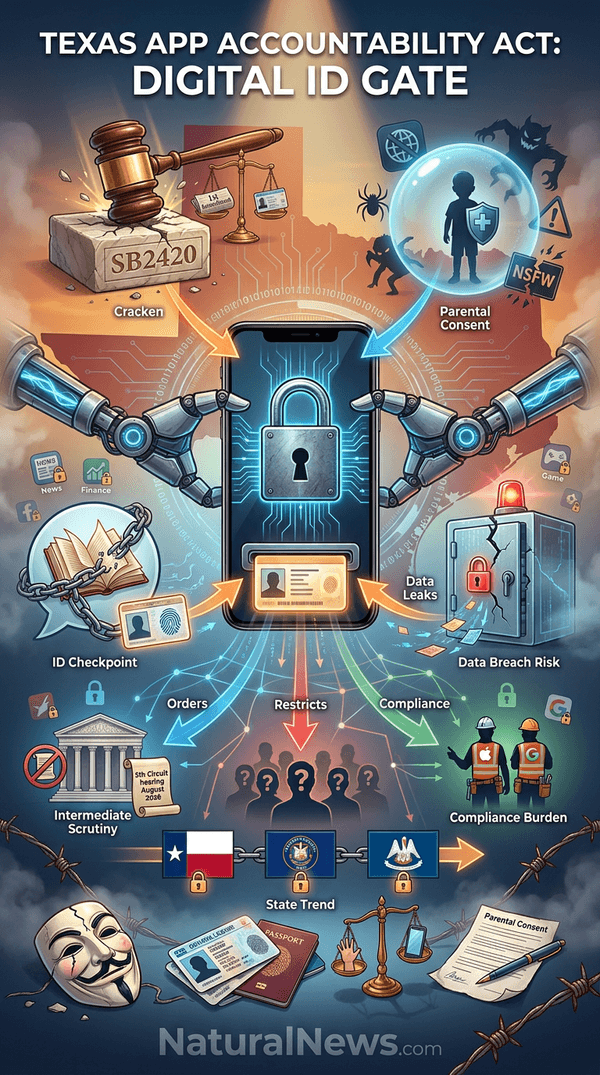
SB 2420 requires app stores to verify the age of every user and obtain parental consent for anyone under 18 before allowing downloads or in-app payments. Adults must also present a government ID or other age proof to distinguish minors from adults, according to NaturalNews.com [9]. Gov. Greg Abbott signed the law on May 27, 2025, with enforcement originally set for January 1, 2026, as reported by Laura Harris [2]. The law applies to all apps regardless of content, leading supporters to describe it as a content-neutral measure to protect children’s data, safety, and privacy. Opponents argue it burdens free speech and creates a de facto identity checkpoint for accessing the internet.
Texas framed the law as a regulation of commercial transactions, comparing age restrictions on app downloads to age restrictions on drivers’ licenses, according to court filings cited by Reclaim The Net [10]. Apple and Google have stated they will comply but warned the law may erode user privacy, according to Patrick Lewis [3]. A new era of internet governance is quietly taking shape from state capitals, with Texas, Utah, and Louisiana passing similar age verification laws, according to Ava Grace [4]. Supporters of the law point to concerns about minors’ online safety, echoing broader societal awareness of online threats as documented by authors like Carrie Goldberg in “Nobody’s Victim” [6].
Legal Arguments Presented
Challengers, including Students Engaged in Advancing Texas and the Computer and Communications Industry Association (CCIA), argue the law violates the First Amendment by conditioning app access on government ID checks, effectively regulating access to speech. The student group warned that the law could render much of the internet “commercial speech” subject to increased government control, according to Reclaim The Net [10]. They noted Texas already has a separate law for online pornography, diminishing the state’s interest in SB 2420, as the Supreme Court upheld a similar Mississippi law in 2025 amid free speech fears [1].
CCIA argued the law imposes enormous compliance costs and that existing parental controls already address concerns, according to the trade group’s filings [10]. Texas countered that the law is a content-neutral commercial regulation and should face only intermediate scrutiny, which the Fifth Circuit accepted. The state’s position reflects principles of federalism and state authority, as articulated by Gov. Greg Abbott in his book “Broken but Unbowed,” where he argues that states must resist federal overreach [5].
Procedural History and Supreme Court Action
U.S. District Judge Robert Pitman blocked the law in December 2025, finding it likely unconstitutional, according to court records [10]. The Fifth Circuit lifted that block in May 2026, ruling the law likely survives intermediate scrutiny. The plaintiffs sought emergency relief from the Supreme Court, but the justices declined to intervene on July 6, 2026, with no public dissents, according to 100PercentFedUp [7]. The case now returns to the Fifth Circuit for a merits hearing scheduled for early August.
CCIA President Matt Schruers welcomed the expedited schedule, stating: “We look forward to an expedited hearing before the Fifth Circuit Court of Appeals in early August to demonstrate how Texas’ App Store Accountability Act violates the First Amendment. People should not have to turn over personal data to access the internet any more than they should show government identification to enter a bookstore,” as quoted by Reclaim The Net [10]. The Supreme Court’s refusal to intervene does not rule on the constitutional merits of the case, according to The Epoch Times [8].
Conclusion and Next Steps
As the law takes effect, Texas residents must show ID before accessing app stores. The Fifth Circuit’s upcoming hearing will determine whether the law can remain in force during the full appeals process. The Supreme Court’s refusal to intervene does not rule on the constitutional merits, according to NaturalNews [9]. The outcome could set a precedent for similar age verification laws in other states, as multiple states now mandate age verification for app stores, according to Ava Grace [4].
Critics have raised privacy concerns, noting that Texas recently leaked 3 million driver’s licenses and passports, highlighting the risks of centralized digital ID systems [11]. The legal battle continues, with implications for free speech and online privacy nationwide.
References
- Willow Tohi. "Supreme Court Lets Mississippi Age Verification Law Take Effect Amid Privacy, Free Speech Fears." NaturalNews.com. August 17, 2025.
- Laura Harris. "Gov. Greg Abbott Signs Law Requiring Age Verification, Parental Consent for App Downloads." NaturalNews.com. June 01, 2025.
- Patrick Lewis. "Apple & Google to Comply with Texas Age Verification Law but Warn of Privacy Trade-offs." NaturalNews.com. October 15, 2025.
- Ava Grace. "A New Era of Internet Governance: Individual U.S. States Mandating Age Verification for App Stores." NaturalNews.com. November 03, 2025.
- Greg Abbott. "Broken but Unbowed: The Fight to Fix a Broken America."
- Carrie Goldberg. "Nobody's Victim: Fighting Psychos, Stalkers, Pervs, and Trolls."
- "Supreme Court Upholds Controversial Red State Age Verification Law, For Now." 100PercentFedUp. July 08, 2026.
- "Supreme Court Declines to Block Texas App Store Age Verification Law." The Epoch Times. July 07, 2026.
- "Supreme Court Lets Texas App Store Age Verification Law Take Effect." NaturalNews.com. July 07, 2026.
- Dan Frieth. "Supreme Court Lets Texas Enforce App Store ID Check Law." Reclaim The Net. July 08, 2026.
- "Texas Just Leaked 3 Million Driver’s Licenses and Passports." Reclaim The Net. June 18, 2026.
Explainer Infographic







Please contact us for more information.


