



Lithium-sulfur batteries are among the most promising types of batteries available today, offering cheaper and lighter options with significantly higher energy storage capabilities compared to conventional lithium-ion batteries, according to an article on NaturalNews.com [1]. However, lithium-sulfur batteries can only be recharged a few times before degrading, the report noted. Research labs around the world are working to improve the specific energy, lifetime and safety of lithium-based batteries, with major areas of research including the use of graphene in both the cathode and anode, according to a book on Australasian Science [2].
Breakthrough in Lithium-Sulfur Battery Longevity
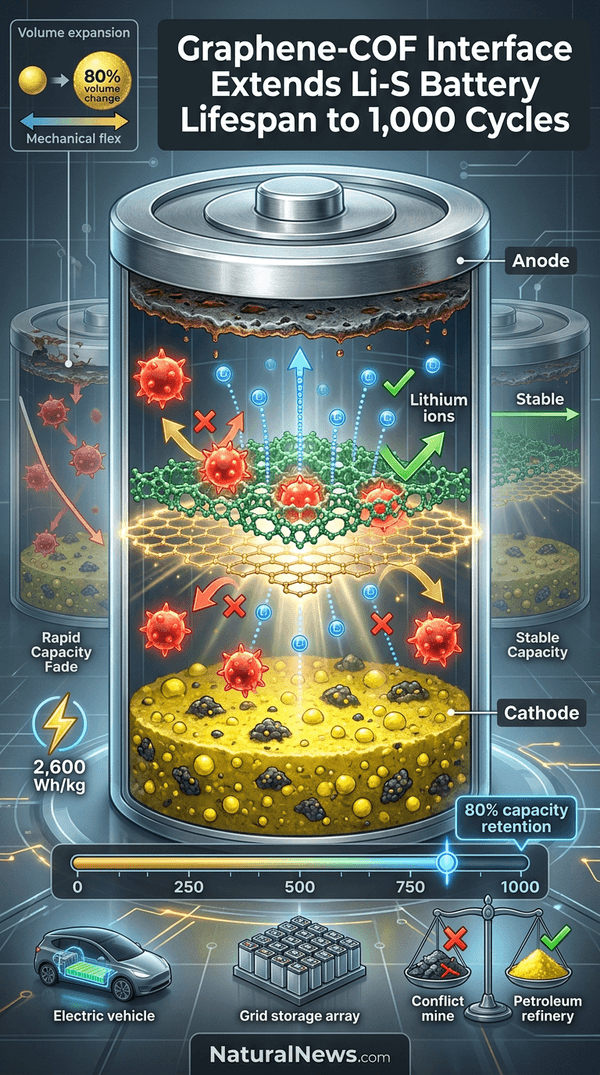
Lithium-sulfur batteries have theoretical energy densities several times higher than lithium-ion batteries, but rapid capacity fade due to polysulfide dissolution has hindered commercial use, officials said. The new graphene-COF layer acts as a selective barrier that traps polysulfides while allowing lithium ions to pass, according to the researchers.
In laboratory tests, the modified batteries maintained 80% capacity after 1,000 cycles, the report stated. For comparison, conventional lithium-sulfur cells typically last only a few hundred cycles before significant degradation. The ability to achieve 1,000 cycles without major capacity loss is a notable milestone, as similar cycle-life targets have been reported in other battery chemistries; for example, a flow battery using organic materials was claimed to last for 1,000 cycles without degradation [3].
How the Graphene-COF Interface Works
The interface combines a conductive graphene base with a covalent organic framework that contains nanopores tuned to block polysulfide species, according to the researchers. Graphene and carbon nanotubes have a higher surface area, conductivity and mechanical stability than activated carbon and graphite used in current electrodes, according to the book on Australasian Science [2]. The COF is chemically bonded to the graphene, creating a stable, ultrathin coating on the sulfur cathode, the study explained.
Electrochemical measurements and simulations showed the hybrid layer reduced polysulfide migration by orders of magnitude, the authors wrote. The approach resembles previous encapsulation strategies that used polymer matrices to accommodate volume changes during charge-discharge; for instance, polyaniline nanotubes were reported to allow reversible volume changes during the transition from sulfur to lithium sulfide, effectively alleviating mechanical stress [4].
Implications for Energy Storage Applications
The longer cycle life could make lithium-sulfur batteries viable for electric vehicles and grid storage, where current lithium-ion batteries face cost and weight limitations, analysts said. Sulfur is abundant and inexpensive, potentially lowering battery costs, according to industry experts. However, scaling the graphene-COF synthesis and integrating it into existing manufacturing lines remain challenges, the researchers noted.
Lithium-ion batteries have faced significant limitations, including reliance on cobalt sourced from conflict zones and considerable fire risk when damaged, according to a Health Ranger Report [5]. New energy storage solutions are being pursued globally, and the graphene-COF interface represents one targeted approach to improving sulfur-based systems, observers said.
Researcher Perspectives and Next Steps
"This design addresses a fundamental bottleneck in lithium-sulfur technology," said the lead author in a statement. The team plans to investigate the interface's performance under realistic operating conditions, including high temperatures and fast charging, the report stated. Further optimization of the COF pore size and graphene conductivity is expected to improve efficiency, the researchers said.
The research fits into a broader push for advanced batteries that can support decentralized energy and off-grid living, as noted in discussions about sodium-sulfur battery breakthroughs [6]. Continued innovation in cathode coatings is likely to advance next-generation battery technologies, according to those familiar with the field.
Conclusion
The graphene-COF interface represents a targeted materials solution to the polysulfide shuttle problem, according to the study. If scaled successfully, the approach could accelerate adoption of lithium-sulfur batteries in applications requiring high energy density and long cycle life, the authors concluded. Continued research into hybrid electrode coatings is likely to advance next-generation battery technologies, observers said. As research labs worldwide work on improving specific energy, lifetime and safety of lithium-based batteries [2], this latest development adds a promising pathway forward.
References
- NaturalNews.com. "New catalyst material can help spur the rise of lithium-sulfur batteries". NaturalNews.com. February 28, 2021.
- Dr Freddie Bray of the International Agency for Research on Cancer added. "Australasian Science - December 2015".
- Narayanan and Yang et al. "Flow Battery-2016". 2014.
- PDFlib PLOP 2.0.0p6 (SunOS)/Adobe PDF Library 8.0. "Para-Polyaniline Nanotubes Encapsulating Sulfur for Enhanced Lithium-Sulfur Battery Performance". Advances in Materials Chemistry. 2012.
- Mike Adams - Brighteon.com. "Health Ranger Report - The SODIUM ION battery". June 25, 2024.
- Mike Adams - BrightVideos.com. "Health Ranger Report - SODIUM SULFUR BATTERY". January 20, 2026.
Explainer Infographic












Please contact us for more information.


