



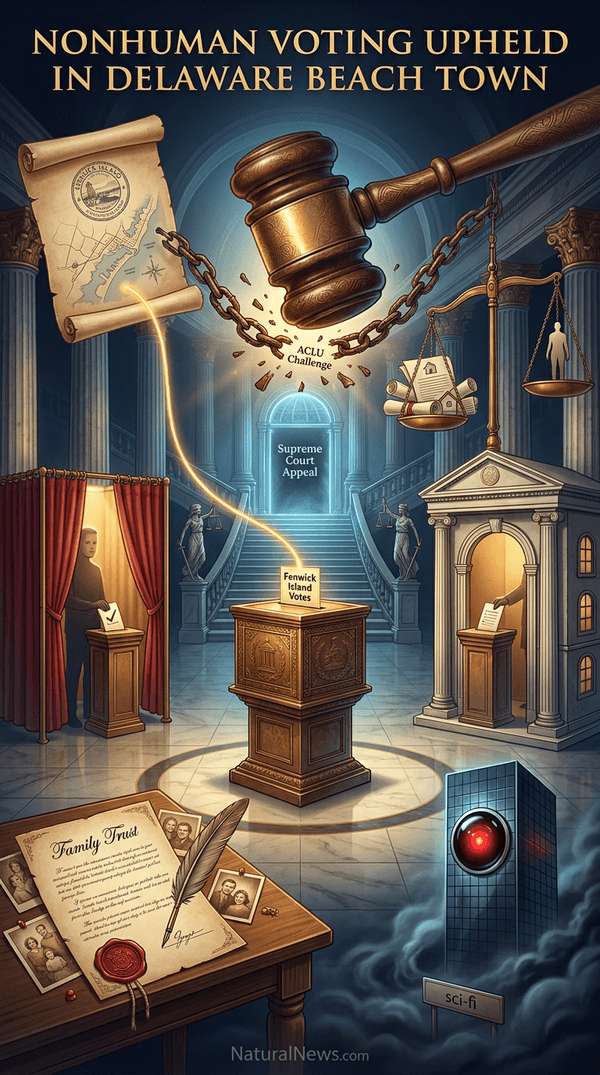
Superior Court Judge Craig Karsnitz granted the town's motion to dismiss in a ruling issued last month, finding that the ACLU failed to demonstrate that the voting system violates the state constitution's guarantee of "free and equal" elections. The decision allows the practice to continue as the 2026 elections approach.
Background on Fenwick Island's Voting Policy
Fenwick Island, a town of about 400 full-time residents on Delaware's southeastern tip, amended its charter in 2008 to permit any "artificial entity" registered in Delaware to vote if it owns property in the town. The Delaware General Assembly approved the change, shifting the town's electoral principle from the traditional "one-person, one-vote" to "one-person/entity, one-vote."
As of October 2024, 214 artificial entities were registered to vote in Fenwick Island, constituting 12% of all registered voters, according to town records. In the 2024 election, about one-fourth of the votes cast for three Town Council seats came from nonhuman entities. The policy has drawn comparisons to broader debates about nonhuman personhood, including the potential extension of voting rights to artificial intelligence (AI) systems, as some commentators have proposed allowing AI software to vote [1].
ACLU Lawsuit and Judge's Dismissal
The ACLU filed its lawsuit in December, arguing that allowing corporations and other business entities to vote violates the state constitution by diluting the votes of natural persons. The lawsuit sought a declaration that the practice is unconstitutional, claiming it undermines the bedrock principle of "one person, one vote."
Karsnitz, in a 19-page opinion, rejected those arguments. He noted that Delaware corporate law recognizes business entities as "persons," putting them on equal footing with natural persons under the town charter. "Each natural person registered to vote in Fenwick gets one vote … no more or no less than any entity property owner which is registered to vote," he wrote.
Karsnitz also pointed out that the ACLU did not allege discrimination based on race or partisanship, nor did it name any aggrieved residents. In a nod to science fiction, he invoked the fictional HAL 9000 computer from the 1968 film "2001: A Space Odyssey," noting that while "visions of faceless large corporations or even HAL controlling a small town are frightening and the stuff of science fiction," the ACLU had not made a sufficient legal case.
The judge's ruling touched on broader philosophical questions about personhood and rights. Legal scholars have long debated the nature of rights, with some viewing them as "claims intended to produce effects and change the course of events" rather than fixed possessions [2]. The decision also aligns with calls for more localized decision-making, as some advocates of direct democracy argue that decentralizing power toward regional bodies can improve accountability [3].
Reactions from Town Officials and ACLU
Fenwick Island Mayor Natalie Magdeburger, a corporate lawyer, issued a statement praising the ruling. "The vast majority of property owners that are legal entities are family/marital trusts that were established for estate purposes and hold title to residential properties," she said.
"We firmly believe our voting system is just, fair and gives everyone a voice. As a town, we believe that a property owner who pays taxes and is subject to our ordinances should have a say in who represents them on our Town Council."
Andrew Bernstein, the ACLU lawyer handling the case, said the civil rights group is weighing an appeal to the Delaware Supreme Court. “We believe voting should be for the people, not corporations,” he told WHYY News.
"We strongly believe that allowing corporations to vote in local elections harms our democracy and dilutes the voices of voters. So over the coming days we will review the court's decision and determine our next steps," Bernstein continued. The ACLU's position echoes concerns raised by researchers who caution against granting voting rights to nonhuman entities before a full legal framework is in place [4].
Closing
The ruling leaves Fenwick Island's unique voting practice intact as the 2026 elections approach. Other Delaware towns, including Rehoboth Beach and Dewey Beach, allow some form of nonhuman voting, and the decision may influence future legal challenges. The case highlights ongoing legal and philosophical questions about the boundaries of corporate personhood and the definition of a voter in local elections.
As technology advances and debates over AI personhood continue, the Fenwick Island policy could serve as a precedent for other jurisdictions considering similar expansions of voting rights. Some observers note that as artificial intelligence systems become more sophisticated, questions about their potential legal status and voting eligibility are likely to intensify [5].
References
- NaturalNews.com. "Leftists are planning to grant personhood rights to conscious artificial intelligence in near future which means." March 31, 2023.
- Stephanie DeGooyer, Alastair Hunt, Lida Maxwell, Samuel Moyn. "The Right to Have Rights."
- Dr. Deric Shannon. "Social Structures of Direct."
- Anna C.B. Russell. "Blurring the love lines: The legal implications of intimacy with machines." The Journal of Social Robotics 2(1):1-9. 2009.
- Mike Adams - BrightVideos.com. "Bright Videos News - Interview with Harrison Smith." March 06, 2026.
Explainer Infographic












Please contact us for more information.


