


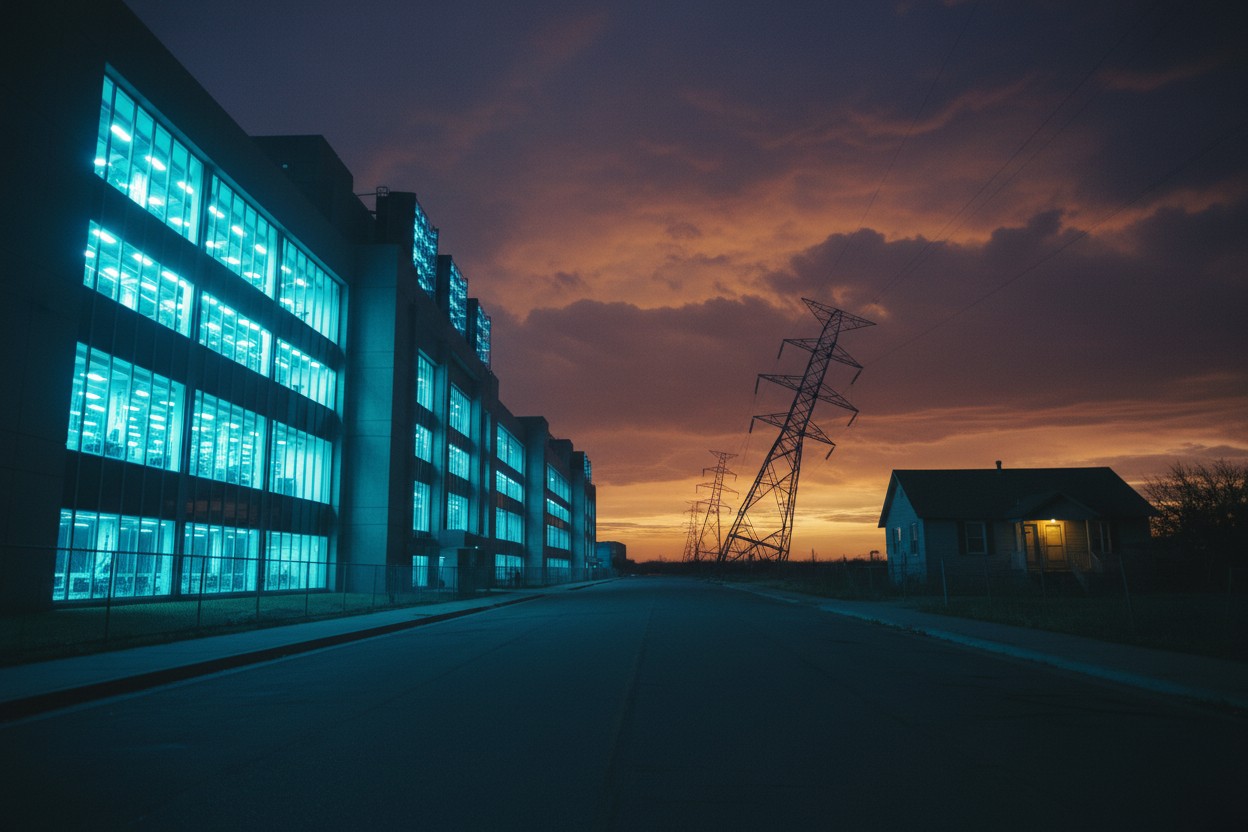
The Looming Blackouts Nobody Is Talking About
I have been warning for years that America’s power grid is teetering on the edge, and now the evidence is undeniable. PJM Interconnection, the grid operator serving 67 million people across 13 states and Washington, D.C., is heading for a catastrophic failure to meet its own operational requirements by June 2027. Goldman Sachs projects that spare generation capacity on the grid will plummet to just 14% by 2027, far below the 20% safety margin needed to prevent rolling blackouts. [1] That is not a distant threat -- it is a countdown. And it means peak demand days will almost certainly result in power loss for residential customers.
PJM’s own capacity auction has already failed to meet reliability standards, and winter storms have repeatedly exposed the system’s fragility. During Winter Storm Fern in January 2026, the grid lost 16% of its generation capacity, forcing emergency conservation pleas. [2] I saw the same pattern in Texas before the 2021 freeze, when the Electric Reliability Council of Texas nearly collapsed under similar stress. The difference is that PJM’s crisis is structural, not weather-driven: surging demand from data centers, electric vehicles, and electrification mandates is overwhelming an aging infrastructure. In May 2025, I reported that PJM warned extreme heat could trigger rolling blackouts with demand reaching 166 gigawatts. [3] This is not speculation; it is the grid operator’s own admission.
Here’s the hard truth: the eastern power grid will fail to meet its own operational standards by June 2027, creating a "perfect storm" for blackouts potentially impacting millions of residents across 13 U.S. states. The system is already running on borrowed time, and government price fixing on wholesale electricity costs just made the problem even worse.
How Government Price Caps Guarantee Electricity Shortages
The federal government’s solution to rising electricity costs is to impose price caps (at the wholesale auction level), but this only guarantees shortages. By capping wholesale electricity prices below the free-market cost of new generation, the government disincentivizes investment in power plants while encouraging consumption. It is the same logic as price controls on bread that create empty shelves – capping electricity prices ensures blackouts during peak demand.
Making matters worse, Biden-era EPA regulations forced the closure of dozens of coal and natural gas plants, removing reliable dispatchable power from the grid. [4] Now the Trump administration is scrambling to repeal those policies, but the damage is already done.
The government’s fixation on renewable mandates has created a system that cannot meet real-time demand on peak days. Wind and solar are intermittent, and battery storage is far too expensive to fill the gaps. As I discussed with David Tice, the vulnerabilities in our power grid are compounded by policies that prioritize political goals over reliability. [5] The result is a textbook case of government intervention making a problem worse: price caps that starve the market of new capacity, renewable subsidies that cannibalize baseload power, and a federal bureaucracy that cannot move fast enough to approve new natural gas plants.
Meanwhile, PJM’s own market monitor admits the grid lacks capacity for data centers, let alone residential homes. [6] The government is not going to save you – they are the ones creating the crisis.
Why Your Home Will Be Sacrificed for Data Centers
The explosive growth of artificial intelligence and cloud computing has made data centers the priority customer for America’s strained grid. According to recent reports, 94% of new electricity demand comes from data centers, many tied to national security and AI programs. [1] When supply falls short, grid operators will protect the big contracts and cut residential power first.
I have seen this pattern before: in Texas, the grid failed on the coldest day, leaving millions without heat while some industrial customers were shielded. Now the eastern grid faces the same reckoning on the hottest days.
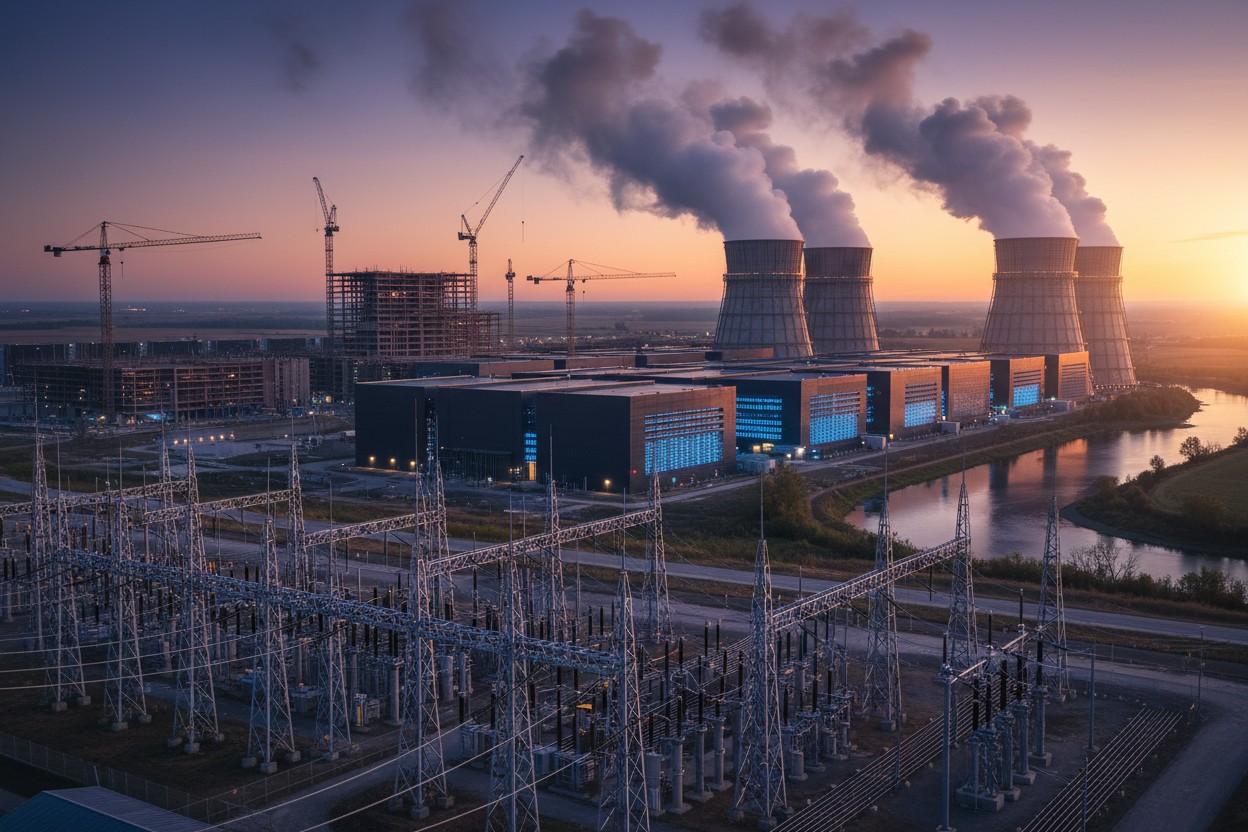
Tech giants like Microsoft, Google, and Meta are building massive data centers on former farmland, further straining local grids. [7] In Northern Virginia, PSEG is trying to condemn private properties to build a 500,000-volt transmission line just to keep data centers running. The company’s court filings admitted that without that line, the region could face blackouts or voltage collapse by summer 2027. [8] Meanwhile, homes and small businesses will be the first to be cut off when reserves run dry. The government and utilities will claim they must “prioritize critical infrastructure” – meaning AI servers over your refrigerator. As one analyst noted, the United States is building data centers it cannot power, and the homes will be sacrificed. [9] Do not expect any mercy from the grid operators or the AI tech industry.
Your Only Option: Go Off-Grid Before It’s Too Late
A grid-tied solar system is useless when the grid goes down. You need an off-grid setup with batteries, a transfer switch, and possibly a diesel generator. I am building my own off-grid system because I do not trust any grid – and neither should you. Even a small solar generator can keep your refrigerator, lights, and communications running during blackouts. The book “Be your own power company” by David J. Morris provides detailed guidance on designing small-scale solar and wind systems that can make you energy independent. [10] Start with the basics: a few solar panels, a charge controller, and a lithium iron phosphate battery bank. These components are available today, and prices are falling.
Diesel generators are reliable but require fuel and maintenance. Stock up on oil, filters, and spare parts now – shortages are coming. As I discussed in my interview about the documentary “Grid Down Power Up,” the four major threats to the grid – physical attacks, cyberattacks, EMPs, and geomagnetic disturbances – all have the same outcome: prolonged blackouts. [11] Protecting against those threats starts with decentralizing your energy supply. Lithium iron phosphate batteries are your best bet for now, but sodium-ion may be even better next year. [12] Do not wait for perfect technology. Start with what you can afford and expand over time. The goal is to keep essential circuits running so you are not sitting in the dark while data centers stay lit.
You Have One Year – Act Now or Sit in the Dark
June 2027 is the deadline to be prepared. PJM’s capacity shortfall begins then, and the risk of widespread blackouts skyrockets. If you are one of 67 million Americans who live on the Eastern grid, you now have twelve months to prepare – move to a location with reliable backup power, install your own solar and battery system, or hoard diesel fuel and other supplies. Waiting for better battery technology or government action is a gamble with your family’s safety. Do not count on the grid saving you – it is already at its limit. [13]
This is not just about convenience; it is about liberty and self-reliance. The government and corporate utilities have demonstrated that they will prioritize their own projects over your well-being. As I have long said, centralized systems are fragile and prone to control. The only way to protect yourself is to take control of your own energy production. Start today: assess your power needs, research solar and battery options, and build a plan. You have one year to prepare. Use it wisely, or you will be left in the dark.
Note: I'm covering more off-grid solar technology with upcoming interviews on my Decentralize TV show, available for free at Decentralize.TV
References
- Goldman Sachs warns US power grid nearing collapse as AI and EVs overwhelm aging infrastructure - NaturalNews.com, June 06, 2025. Author: NaturalNews.com.
- Eastern US grid pushed to the brink as Winter Storm Fern exposes critical weaknesses - NaturalNews.com, January 28, 2026. Author: NaturalNews.com.
- Brighteon Broadcast News - WAR ZONE - Mike Adams - Brighteon.com, May 12, 2025. Author: Mike Adams.
- Trump aims to dismantle flawed climate policy to protect grid reliability and save taxpayers trillions - NaturalNews.com, July 24, 2025. Author: Willow Tohi.
- Mike Adams interview with David Tice - July 18 2025. Author: Mike Adams.
- Back to basics: How natural gas is saving America’s grid from collapse amid AI boom - NaturalNews.com, February 14, 2025. Author: Willow Tohi.
- Data Centers Are Destroying Farmland - The New American, May 26, 2026. Author: The New American.
- Brighteon Broadcast News - CITIZEN SABOTAGE Threats - Mike Adams - Brighteon.com, August 20, 2025. Author: Mike Adams.
- Mike Adams interview with Andy Schectman - October 22 2025. Author: Mike Adams.
- Be your own power company selling and generating electricity from home and small-scale systems photovoltaics wind power. Author: Morris David J.
- Mike Adams interview with David Tice - March 6 2024. Author: Mike Adams.
- Health Ranger Report - EPA Endangerment - Mike Adams - BrightVideos.com, February 11, 2026. Author: Mike Adams.
- The Grid Will Hold – Maybe – But the Bill Will Rise - Watts Up With That, January 27, 2026. Author: Terry L. Headley.
- Massive Power System Failures. Author: M Kathleen Stewart.
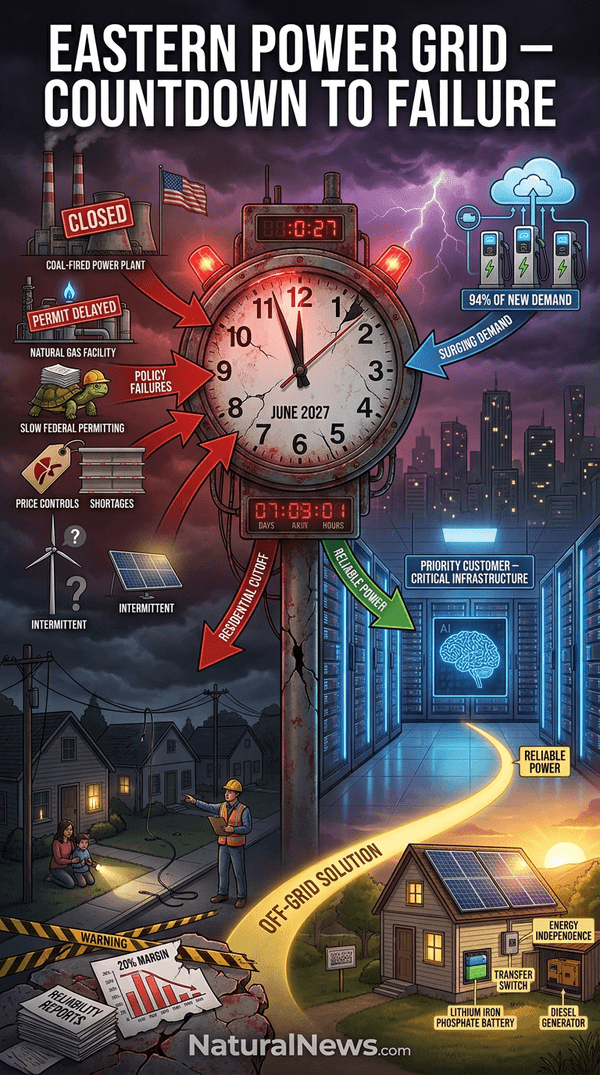
Explainer Infographic
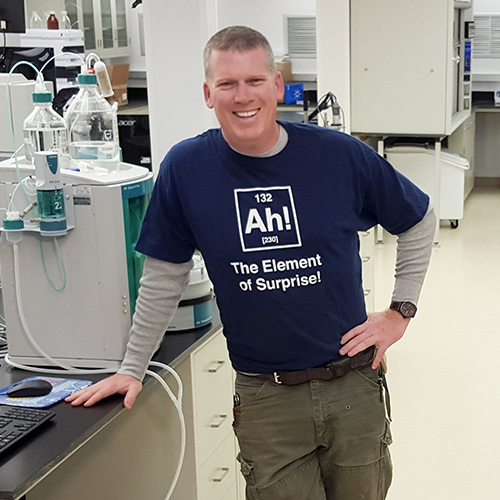
Mike Adams (aka the "Health Ranger") is the founding editor of NaturalNews.com, a best selling author (#1 best selling science book on Amazon.com called "Food Forensics"), an environmental scientist, a patent holder for a cesium radioactive isotope elimination invention, a multiple award winner for outstanding journalism, a science news publisher and influential commentator on topics ranging from science and medicine to culture and politics.
Mike Adams also serves as the lab science director of an internationally accredited (ISO 17025) analytical laboratory known as CWC Labs. There, he was awarded a Certificate of Excellence for achieving extremely high accuracy in the analysis of toxic elements in unknown water samples using ICP-MS instrumentation.
In his laboratory research, Adams has made numerous food safety breakthroughs such as revealing rice protein products imported from Asia to be contaminated with toxic heavy metals like lead, cadmium and tungsten. Adams was the first food science researcher to document high levels of tungsten in superfoods. He also discovered over 11 ppm lead in imported mangosteen powder, and led an industry-wide voluntary agreement to limit heavy metals in rice protein products.
Adams has also helped defend the rights of home gardeners and protect the medical freedom rights of parents. Adams is widely recognized to have made a remarkable global impact on issues like GMOs, vaccines, nutrition therapies, human consciousness.





Please contact us for more information.


