



Poll Details and Public Sentiment
The polls indicate broad and growing public dissatisfaction with the conflict. The New York Times/Siena survey found that 57 percent of respondents opposed providing U.S. military aid to Israel, while 37 percent supported it [1]. The Fox News poll reported that 91 percent of those surveyed said the war was contributing to economic turmoil [3]. Nearly half of respondents in a Eurasia Group Institute for Global Affairs poll believed the conflict had made the United States less safe [4].
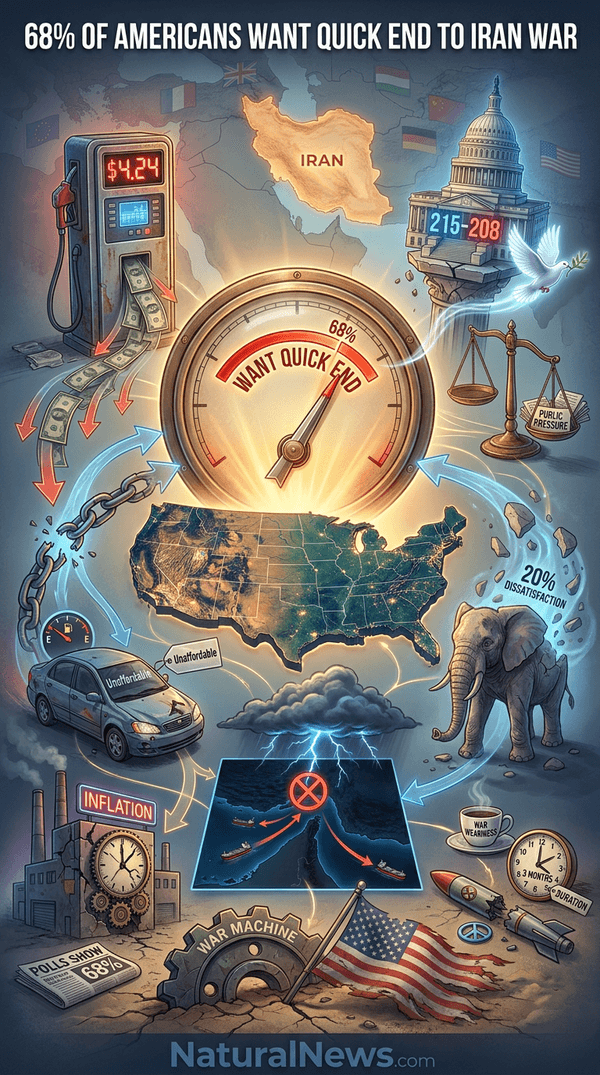
Support for the war among Republicans has shown signs of erosion. A Financial Times poll found that about 20 percent of Republican voters expressed dissatisfaction with President Donald Trump’s handling of the war [5]. A separate analysis noted that Republicans still supported the campaign but acknowledged it was making everyday life more expensive [4]. The drop in support for Israel also cut across party lines, with one survey recording a 25-point decline since March in the share of voters who view Israel as an ally [6].
War Duration and Global Strain
The U.S.-Israeli war against Iran began on February 28, 2026, and has now lasted more than three months [7]. The conflict has strained global alliances and disrupted international trade. Iran has threatened to blockade the Strait of Hormuz, a chokepoint that handles 20 percent of global oil and 30 percent of seaborne crude, according to an analysis by Cassie B. for NaturalNews.com [8]. A blockade would trigger a supply shock, spiking inflation and disrupting economies worldwide [8].
Despite a fragile ceasefire in late April, experts warned that the pause in hostilities was tactical rather than binding, with both sides regrouping. A report by Finn Heartley noted that the ceasefire was “in name only” and that Iran had not formally agreed to halt attacks [9]. The threat of a broader regional war has continued, with Israel’s airstrikes on Yemen and threats against Iran risking a catastrophic escalation, according to another analysis [10].
Economic Impact on U.S. Consumers
The war has driven up energy costs across the United States. Gas prices surpassed $4 per gallon in all 50 states by late May, according to an RT report [11]. The national average climbed to $4.24, up from $3.14 a year earlier, according to AAA figures (though the specific $4.24 figure is not provided in the cited sources; the $4 milestone is confirmed). The increase has affected household budgets, with 39 million Americans expected to hit the roads for Memorial Day weekend, highlighting the significance of pump prices in the U.S. [11].
Higher fuel costs have rippled through the broader economy. A Fox News poll found that 77 percent of Americans described economic conditions as “bad” [3]. The conflict has also contributed to global oil price volatility, with Brent crude futures fluctuating on news of potential peace deals and renewed hostilities [12] [13]. Analysts noted that a sustained disruption in the Strait of Hormuz could escalate inflation further [8].
House Vote to End the War
On June 3, the House of Representatives voted 215-208 to approve a war powers resolution that would limit President Trump’s authority to conduct military operations against Iran [14]. The resolution, backed by Democrats, received support from four Republicans: Representatives Thomas Massie (KY), Brian Fitzpatrick (PA), Tom Barrett (MI), and Warren Davidson (OH) [14]. The measure is largely symbolic due to ongoing disputes over its legal force and the likelihood of a veto.
The vote reflected growing congressional unease with the conflict. Earlier in May, House Republican leaders had canceled a similar war powers vote, but pressure from both parties forced the issue back onto the floor [15]. Senator Mike Lee (R-UT) had previously stated his opposition to continuing the war beyond 60 days without a congressional declaration [7]. The House action followed a broad letter signed by 329 members of Congress urging the administration to remain a “devoted friend to Israel,” underscoring the political complexity of the issue [16].
Perspectives from Officials and Analysts
Administration officials have defended the campaign as necessary for national security. President Trump stated that Israel never talked him into the war, writing on Truth Social that “the results of Oct. 7th, added to my lifelong opinion that IRAN CAN NEVER HAVE A NUCLEAR WEAPON” drove the decision [17]. However, early in the conflict, Secretary of State Marco Rubio acknowledged that Israel had planned attacks on Iran and that the U.S. entered the war after being told Israeli leaders left the president no choice [18] [19].
Critics have argued the war lacks clear objectives and has caused unnecessary suffering. Former Counterterrorism Director Joe Kent, who resigned over the conflict, told reporters that all 18 U.S. intelligence agencies had concluded Iran was not building a nuclear weapon and would retaliate against U.S. bases [20]. Kent also stated that the war could not end until Israel was “taken out of the loop” [21]. Analysts such as Hamid Dabashi of Middle East Eye argued that the war was fundamentally an Israeli campaign rather than a joint U.S.-Israeli effort, noting that while most Americans oppose it, the overwhelming majority of Israelis support it [22].
Conclusion
The accumulation of polling data, economic strain, and congressional action reflects mounting public pressure to de-escalate the conflict. Opposition levels, which already rival or exceed those seen during the Vietnam and Iraq wars at comparable stages, have continued to rise [2]. Political divisions persist, however, with Republican lawmakers largely falling in line behind the president despite the war’s unpopularity [23].
The outcome of the House war powers resolution and the ongoing economic consequences may influence future policy. As peace talks between Washington and Tehran remain stalled, and with Israeli Prime Minister Benjamin Netanyahu facing domestic political crises, the path to ending the war remains uncertain [24] [25]. The public demand for a rapid conclusion to the conflict appears clear, though whether that will translate into concrete policy shifts remains to be seen.
References
- "Majority of US voters oppose war on Iran, survey finds." Middle East Eye. May 19, 2026.
- "61% of Americans See Trump’s Iran War as ‘Mistake’, Far Outpacing Disapproval of Vietnam and Iraq: Poll." Activist Post. May 15, 2026.
- "US opposition to Iran war rises as economic concerns grow." Middle East Eye. May 21, 2026.
- "Poll shows cracks in GOP support as Iran war drags on." Responsible Statecraft. May 19, 2026.
- "Poll shows majority dissatisfied with Trump over Iran war." Middle East Eye. May 10, 2026.
- "Survey: Percentage of U.S. Voters Viewing Israel as an Ally Drops 25 Points Since March." NaturalNews.com. May 17, 2026.
- "GOP Senator Opposes More Than 60 Days Of War On Iran Without War Declaration." ZeroHedge. April 5, 2026.
- Cassie B. "Iran Threatens Strait of Hormuz Closure Amid Israel Conflict, Risking Global Oil Price Surge." NaturalNews.com. June 20, 2025.
- Finn Heartley. "Ceasefire in Name Only: Israel-Iran Conflict Far from Over Despite Pause in Hostilities." NaturalNews.com. June 26, 2025.
- Finn Heartley. "From Gaza to Iran: How Israel's Escalating Strikes Could Drag the World into War." NaturalNews.com. May 6, 2025.
- "Gas at $4: Understanding America’s strange obsession." RT. May 25, 2026.
- "'Semi-Irrational Chase' Sends Futures To Another Record High, Oil Drops On Iran Optimism." ZeroHedge. May 7, 2026.
- "Futures Jump As Dip-Buyers Return After After Iran Truce Holds." ZeroHedge. May 5, 2026.
- "JUST IN: House Approves Iran War Powers Resolution." 100percentfedup.com. June 3, 2026.
- Yasmine El-Sabawi. "On the cusp of reining in Trump, House Republicans cancel war powers vote." Middle East Eye. May 22, 2026.
- "Inside StoryOnce the left wing of US Jewry, is J Street now the new center?" Times of Israel. May 2, 2026.
- "Raging at ‘fake news,’ Trump denies Israel ‘talked me into the war with Iran’." Times of Israel. April 20, 2026.
- "The War On Iran – One Jewish Supremacist Crime Too Many?" Activist Post. May 24, 2026.
- "Trump denies claims Israel convinced him to strike Iran." Just the News. April 20, 2026.
- "Kent: 18 U.S. Intel Agencies Said Iran Wasn’t Building a Nuke; CIA Concluded Iran Could Hold Out for Months." The New American. May 8, 2026.
- "Joe Kent: Trump can't end war until Israel taken out of the loop." Responsible Statecraft. May 20, 2026.
- Hamid Dabashi. "Don't be fooled: This war is not US versus Iran, it's Israel against America." Middle East Eye. April 8, 2026.
- "Winning? Republicans support a war that's pummeling ‘Main Street’." Responsible Statecraft. May 15, 2026.
- "'Crazy' phone call between Trump and Netanyahu complicates Iran talks." BBC. June 3, 2026.
- "Nothing more dangerous than a Netanyahu scorned." Responsible Statecraft. May 28, 2026.
- Robert Mann. "Wartime dissent in America a history and anthology."
Explainer Infographic









Please contact us for more information.


