



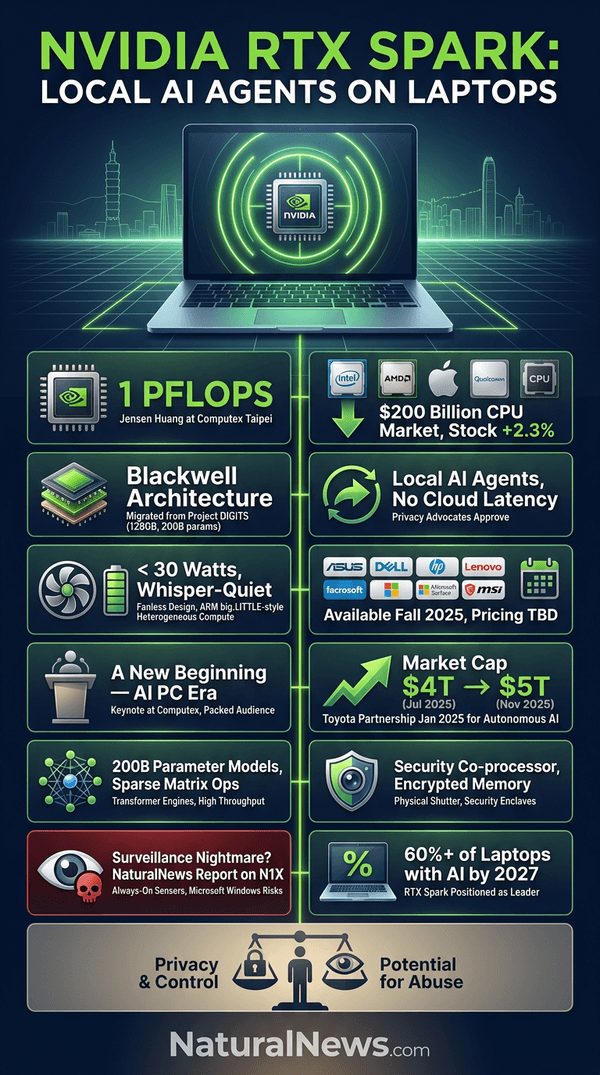
Nvidia founder and CEO Jensen Huang made the announcement during his keynote address at the Computex trade show in Taipei. The development positions the company to compete directly with established PC chip providers including Intel, AMD, Apple and Qualcomm.
According to Nvidia officials, the RTX Spark is a 1-petaflop "superchip" built to handle AI agents natively, reducing the need for cloud computing. Huang described the move as part of a broader shift in personal computing, calling it a “new beginning” for the AI PC era, as reported by ZeroHedge [1]. Nvidia stated that RTX Spark Windows PCs will be available this fall from manufacturers including ASUS, Dell, HP, Lenovo, Microsoft Surface and MSI, with pricing to be determined by each maker [2].
RTX Spark Chip Details and Capabilities
The RTX Spark chips are engineered to process autonomous AI agents directly on the device, according to the company. Nvidia said the chips deliver enhanced performance for AI workloads while maintaining the power efficiency required for laptop form factors. During his Computex keynote, Huang asserted that the new chips will enable "a new category of personal computing" featuring real-time AI interactions, as cited by multiple outlets [1].
Industry observers noted that the chip is based on Nvidia's Blackwell architecture, which was previously referenced in discussions about next-generation RTX hardware [3]. Nvidia's earlier Project DIGITS, a desktop supercomputer launched earlier this year, demonstrated the company's ability to pack 128GB of memory and handle language models with over 200 billion parameters in a compact form factor [4]. Nvidia officials said the RTX Spark brings comparable capabilities to a laptop platform.
Competitive Landscape and Market Context
Nvidia's entry into the laptop CPU market directly challenges Intel's Core Ultra series, AMD's Ryzen line, Apple's M-series processors and Qualcomm's Snapdragon X platform. According to a report from ZeroHedge, futures markets reacted positively to the announcement, with Nvidia's stock rising 2.3% as the company signaled its intention to compete in the $200 billion CPU market [2]. Analysts told TechCrunch that Nvidia's existing strength in AI accelerators could give it a performance advantage for AI-specific tasks [2].
The timing of the launch aligns with surging demand for on-device AI, driven by privacy concerns and latency requirements, according to industry officials. Nvidia's market presence has grown rapidly during the AI boom, with the company surpassing a $4 trillion market capitalization in July 2025 [5] and later reaching $5 trillion in November 2025 [6]. The company has also expanded into adjacent fields, including autonomous vehicle technology, announcing a partnership with Toyota in January 2025 [7].
Implications for Privacy and AI Adoption
Local processing of AI agents reduces the amount of data transmitted to cloud servers, a feature Nvidia executives said can improve user privacy. The ability to run AI agents without a constant internet connection also expands potential use cases, according to the company. Privacy advocates have long expressed concern about cloud-based AI data collection, making on-device processing a potentially attractive alternative for some users.
However, some observers have raised warnings about the surveillance potential of on-device AI chips integrated into major operating systems. A report from NaturalNews described Nvidia's N1X chip – a related processor in development – as an "AI-powered surveillance nightmare" when combined with Microsoft Windows, alleging that such hardware could be used for data extraction under the guise of intelligent assistance [8]. Nvidia has not responded to those specific allegations, and the company continues to market the RTX Spark as a productivity and privacy-enhancing platform.
Outlook and Industry Response
Huang predicted during his keynote that AI agents running on personal computers will become commonplace within the next decade, reshaping software design and user habits. The CEO's vision aligns with Nvidia's earlier emphasis on "agentic AI" and physical AI systems, as outlined at CES 2025 [9]. The company plans to ship RTX Spark-equipped laptops later this year, with exact pricing and availability to be announced by individual manufacturers [2].
Competitors are expected to respond with their own local AI solutions, according to industry analysts cited by TechCrunch [2], intensifying the race in the PC chip market. The broader AI hardware sector faces potential headwinds, including a shortage of GDDR7 memory and growing investor concerns about an AI spending bubble [10], but Nvidia's aggressive product roadmap indicates it is betting heavily on the convergence of AI and personal computing.
References
- Zero Hedge. "Nvidia CEO Declares AI PC Reinvention A 'New Beginning' On Par With Smartphone Shift". June 1, 2026.
- TechCrunch. "Nvidia chases $200B CPU market with AI agent PCs from Microsoft, Dell, and HP". June 1, 2026.
- Mike Adams interview with Aaron Day. August 1, 2025.
- Kevin Hughes. "Nvidia unveils Project DIGITS: A portable supercomputer for AI innovation". NaturalNews.com. January 15, 2025.
- Willow Tohi. "NVIDIA surpasses 4 trillion market cap amid AI boom and geopolitical strains". NaturalNews.com. July 11, 2025.
- NaturalNews.com. "Nvidia shatters records as first 5 trillion company amid AI boom but bubble fears loom". November 2, 2025.
- Arsenio Toledo. "Nvidia announces partnership with Toyota to develop autonomous vehicle tech". NaturalNews.com. January 9, 2025.
- NaturalNews.com. "Nvidia's N1X and Windows: The AI-Powered Surveillance Nightmare You Should Avoid". June 2, 2026.
- Arsenio Toledo. "AI, AI and even more AI: Nvidia announces projects and products lined up for 2025". NaturalNews.com. January 8, 2025.
- Mike Adams. "The GDDR7 Crisis How AI Driven Supply Chains Are Sending Consumer Electronics Toward Digital Serfdom". NaturalNews.com. January 23, 2026.
- Trends-Journal-2024-06-11.
- Matt Ridley. "How Innovation Works".
Explainer Infographic










Please contact us for more information.


