


I'm Calling It: The AI Investment Bubble Is Real
As someone who has built AI systems from the ground up -- spending years curating knowledge bases and training models on a network of 48 GPU-powered workstations -- I have a unique vantage point on this market frenzy. I use AI every day to create free knowledge tools for the public (like BrightLearn.ai), so I understand the technology's genuine potential. But what I am seeing in the financial markets is not a reflection of real progress. To me, it looks like a speculative mania fueled by cheap debt and fanciful revenue projections.
Hedge fund legend Michael Burry, who famously shorted the housing bubble before the 2008 crash, is now placing a massive bet against AI. According to a recent report, Burry has stated, "This bubble looks an awful lot like the dot-com bubble" [1].
I have to agree. The charts are textbook parabolic, and as Lance Roberts notes, the semiconductor index "closed Friday at $509.77 after touching a fresh intraday high of $511.68 -- a gain of roughly 244% from the April 2025 low" [2]. That is not healthy growth; it could be the final blow-off top of a speculative cycle.
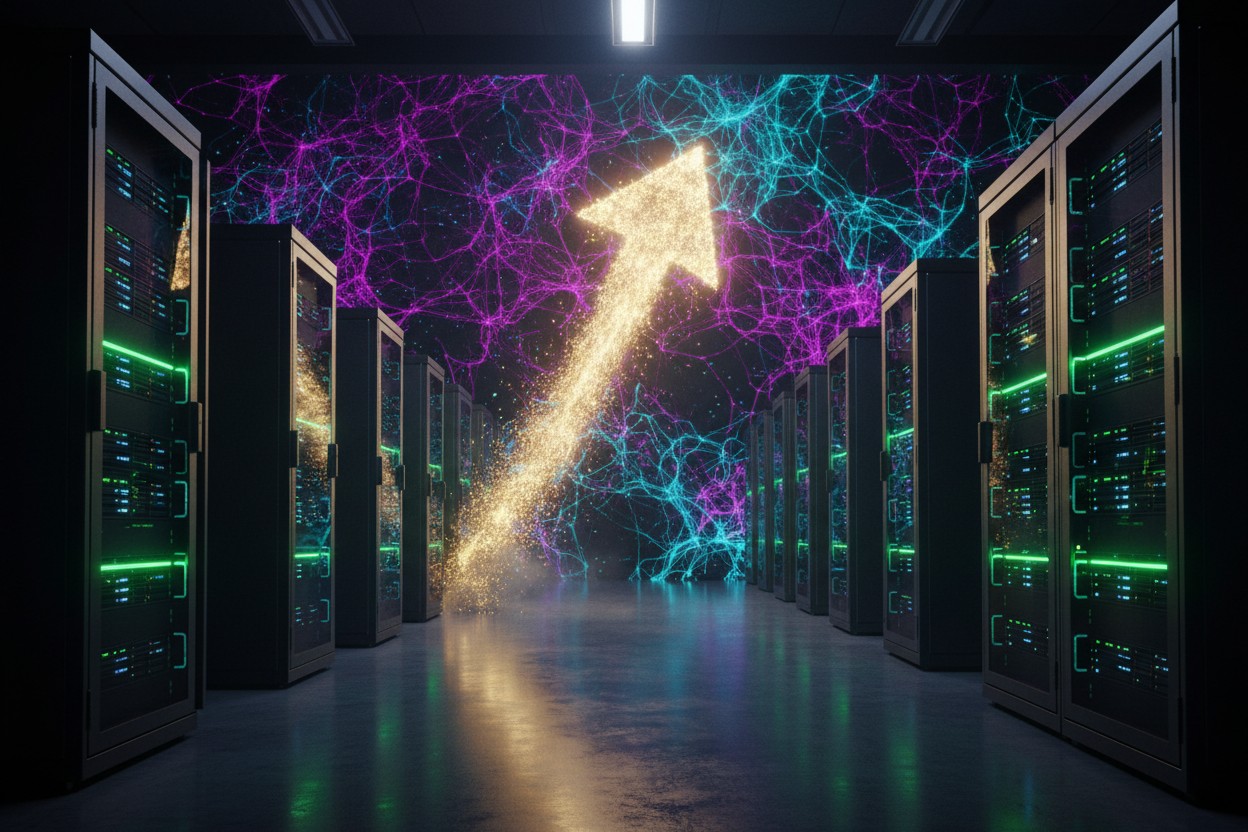
The thesis of this article is simple: a crash is coming. Not a crash of AI capability -- the technology itself is real -- but a crash of the investment bubble built on fake demand, broken promises, and an infrastructure pipe dream that cannot physically be built on the promised timeline.
Token Maxing: The Fake Demand for AI Inference
One of the dirtiest secrets in the AI industry is that much of the reported demand for inference -- the actual use of AI models after training -- is manufactured. I have seen reports of entire teams at large tech companies running pointless batches of tokens just to improve their standing on public leaderboards. This is 'token maxing,' and it creates artificial demand for Nvidia GPUs that has nothing to do with solving real-world problems. When you actually talk to developers who ship products, they measure tasks completed, not tokens burned. The disconnect between vanity metrics and genuine utility is staggering.
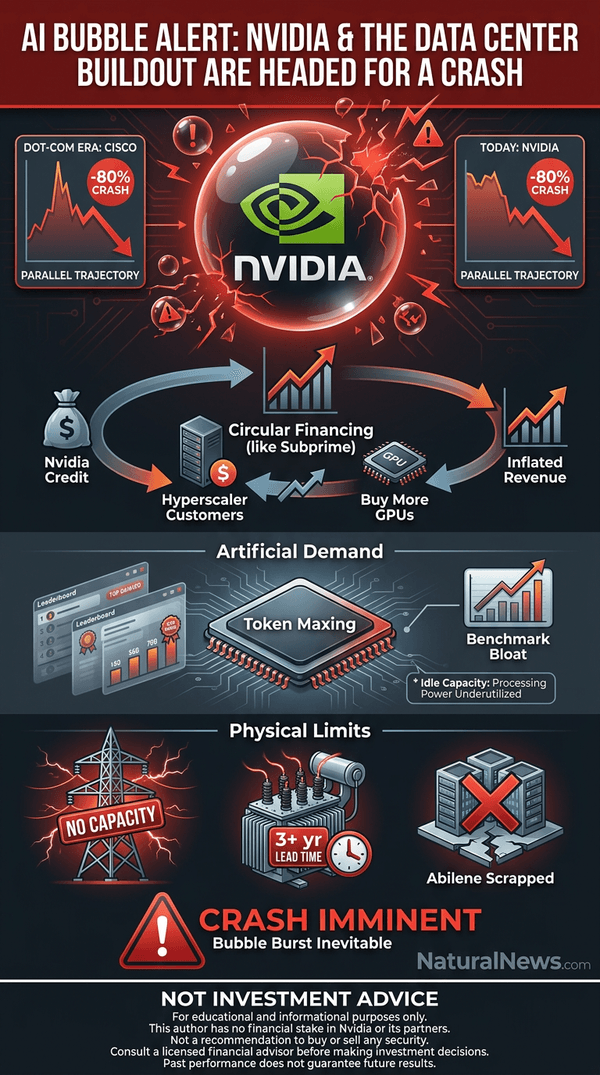
Meanwhile, Meta just borrowed $30 billion to fund its AI ambitions -- a move that signals even cash-rich giants cannot afford the race from revenue alone [3]. That debt is being used to buy GPUs that will likely sit idle a large portion of the time. As one analyst put it, "AI data centers are popping up all over America," but the valuations have "far outpaced the actual profits" [4]. This is not high-demand infrastructure for the future; it is an ego-driven buildout where companies are spending money they do not have on chips they can't keep fully occupied because the market demand simply doesn't exist. The circular financing loop -- where Nvidia lends money to customers who then buy more Nvidia chips -- has eerie parallels to the subprime mortgage machine.
Nvidia's Broken Promises and Customer Betrayal
I know from bitter personal experience that Nvidia's hardware is not the flawless miracle the stock price suggests. When I purchased the company's $4,699 'Personal AI Supercomputer' -- the DGX Spark -- I encountered a debilitating networking bug that made distributed computing impossible. I also had a warranty claim on a Blackwell card that Nvidia flat-out failed to honor. As I reported in detail, "I bought NVIDIA's $4,699 'Personal AI Supercomputer'... and then lost all optimism for NVIDIA" [5]. The hardware is good, but the company's support and honesty have evaporated as it chases data center profits and bails on its core consumer business.
Nvidia's management has also mastered the art of vaporware announcements. CEO Jensen Huang recently projected a data center AI market opportunity worth $1 trillion by 2027, causing sharp volatility as reality set in [6]. But when you look at the actual delivery timelines, many products come late or fail to meet specs. To me, it looks like Nvidia has abandoned its consumer and prosumer base entirely. The company is now focused on selling million-dollar racks to hyperscalers, and in doing so, it has created a single point of failure for the entire AI economy. If those hyperscalers start canceling orders -- and they are -- Nvidia's house of cards could tumble.
Michael Burry's Financial House of Cards
Burry understands that the AI bubble is not about technology; it is about a financial engineering scheme that resembles the 2008 crisis. The circular financing is real: Nvidia extends credit to customers who then use that credit to buy more Nvidia hardware, inflating both revenue and valuations. A recent report showed that Blue Owl Capital failed to secure third-party funding for a $4 billion data center, with one analyst bluntly stating, "We saw it. We passed." [7] When the private credit markets start saying no, the entire leverage structure begins to crack.
Then there is the staggering math behind the end customers. HSBC analysis reveals that OpenAI alone will require an additional $207 billion in funding by 2030 just to stay solvent [8]. The projected cost of cloud compute rentals is expected to reach $792 billion by 2030 -- numbers that are simply not achievable without printing trillions of dollars and involving government contracts or bail-outs. This is not an investment thesis; it is a death spiral.
As one market veteran warned, "Talk of bubbles in tech or AI... obscures the mother of all bubbles in U.S. markets" [9]. The comparison to Cisco in 2000 is apt: the company was a dominant player in a transformative technology, but its stock fell by more than 80% when the internet infrastructure buildout proved overdone. Nvidia is Cisco 2.0, says Burry.
Physical Limits: Transformers, Turbines, and Power
Even if the financial engineering held up, the laws of physics would stop this buildout cold. The U.S. power grid has zero spare capacity on the Eastern interconnection. AI data centers require massive amounts of electricity -- a single facility can consume as much power as a small city. Transformer lead times are stretching past three years, and gas turbines are backordered for half a decade or more. Utilities are spending billions on infrastructure, but as they race to build, the risks are enormous: "several factors are working against utilities as they seek to manage risk," leaving ratepayers possibly on the hook for stranded assets [10].
I have been warning about this physical bottleneck for months. In my article on the compute crunch, I explained that "the explosive demand for artificial intelligence is colliding with the immutable laws of physics and supply chains, creating a structural famine in silicon, memory, and power" [11]. The parallel to the dot-com era is uncanny: then, companies laid millions of miles of fiber optic cable that was never lit. Today, they are pouring concrete for data centers that will never be fully powered. Oracle and OpenAI just scrapped a major expansion in Abilene, Texas [12]. The signs of overbuild are everywhere, yet the market continues to pretend there is no limit.
The Crash Will Come – So Get Ready
History repeats because human nature does not change. The dot-com bubble burst when investors realized Pets.com would never replace grocery stores. The subprime bubble burst when homeowners could not pay their adjustable-rate mortgages because they mostly had no jobs or income. This AI bubble will burst when the market realizes that the trillion-dollar data center buildout is generating negative returns and that Nvidia's exponential revenue growth is impossible to sustain. When the selloff comes, it will be violent because so many leveraged players -- both corporations and retail investors -- are crammed into the same trade.
But I am not just warning about the crash; I am preparing for it. When the panic hits and the hyperscalers go bankrupt, I plan to buy server racks, GPUs, and networking gear for pennies on the dollar. I will use that salvage hardware to expand my decentralized AI infrastructure -- the kind that serves humanity with free knowledge, not enriches Wall Street gamblers.
As I see it, real AI is about helping people live healthier, freer lives. It is not about pumping a stock to $5 trillion while the founders cash out. So let the bubble pop. I will be ready to build something that actually helps humanity on the other side.
References
- Burry's New 'Big Short' on AI. - Daily Reckoning. November 4, 2025.
- Parabolic Semiconductor Rally Is Pricing In 2028 Already. - Zero Hedge. Lance Roberts. May 11, 2026.
- The $30 Billion Bet: Meta's Debt-Fueled AI Gamble. - NaturalNews.com. Ava Grace. November 4, 2025.
- What's Really Going on Inside AI Data Centers? - 100PercentFedUp. Chris Hurt. March 10, 2026.
- I Bought NVIDIA's $4,699 'Personal AI Supercomputer' … and Then Lost All Optimism For NVIDIA. - NaturalNews.com. Mike Adams. May 3, 2026.
- Nvidia Shares Experience Volatility Following CEO's Projection of $1 Trillion Revenue by 2027. - NaturalNews.com. Edison Reed. March 18, 2026.
- We Saw It. We Passed': Blue Owl Fails To Secure Third Party Funding For $4 Billion Data Center. - Zero Hedge. February 20, 2026.
- HSBC: OpenAI Requires Additional $207B by 2030 to Remain Solvent. - NaturalNews.com. Ava Grace. November 30, 2025.
- Trends-Journal-2024-12-10.
- Utilities are spending billions on the data center boom. What are the risks? - Utility Dive. March 6, 2026.
- The Compute Crunch: How AI's Unstoppable Demand is Creating a Hardware Famine for Years to Come. - NaturalNews.com. Mike Adams. February 18, 2026.
- Oracle, OpenAI Scrap Texas Data Center Expansion Plan, AI Stocks Decline. - NaturalNews.com. Chase Codewell. March 11, 2026.
- AI Bubble Fears Spark Sell-Off as Tech Giants Face Investor Backlash. - NaturalNews.com. Kevin Hughes. February 10, 2026.
- Trends-Journal-2024-07-02.
Explainer Infographic
Editorial Cartoon
Mike Adams (aka the "Health Ranger") is the founding editor of NaturalNews.com, a best selling author (#1 best selling science book on Amazon.com called "Food Forensics"), an environmental scientist, a patent holder for a cesium radioactive isotope elimination invention, a multiple award winner for outstanding journalism, a science news publisher and influential commentator on topics ranging from science and medicine to culture and politics.
Mike Adams also serves as the lab science director of an internationally accredited (ISO 17025) analytical laboratory known as CWC Labs. There, he was awarded a Certificate of Excellence for achieving extremely high accuracy in the analysis of toxic elements in unknown water samples using ICP-MS instrumentation.
In his laboratory research, Adams has made numerous food safety breakthroughs such as revealing rice protein products imported from Asia to be contaminated with toxic heavy metals like lead, cadmium and tungsten. Adams was the first food science researcher to document high levels of tungsten in superfoods. He also discovered over 11 ppm lead in imported mangosteen powder, and led an industry-wide voluntary agreement to limit heavy metals in rice protein products.
Adams has also helped defend the rights of home gardeners and protect the medical freedom rights of parents. Adams is widely recognized to have made a remarkable global impact on issues like GMOs, vaccines, nutrition therapies, human consciousness.










Please contact us for more information.


