


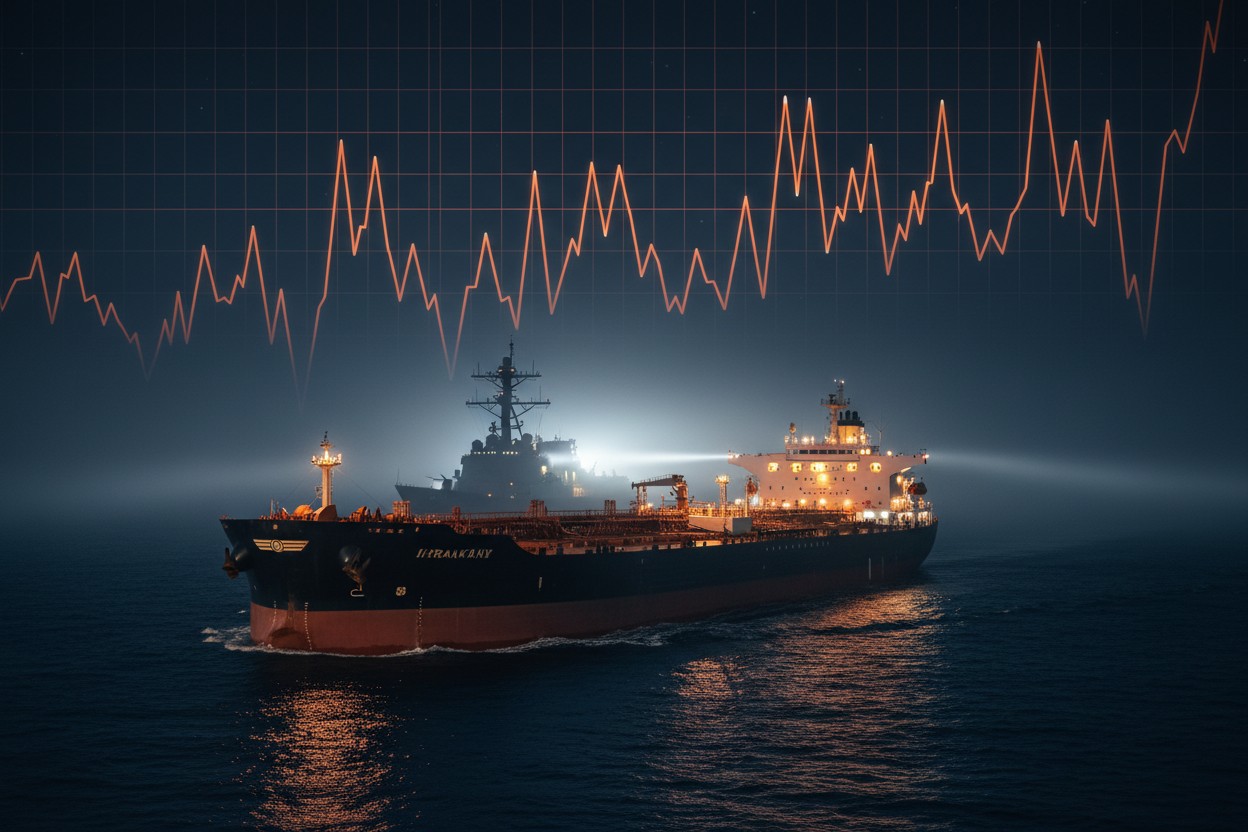
The reported evasion of the naval cordon, which occurred in recent days, included 19 tankers exiting the Persian Gulf and 15 entering from the Arabian Sea. Six of those vessels were carrying Iranian crude oil, with an estimated cargo worth $910 million, the report stated [1].
The development follows an escalation on Wednesday, April 22, when Iran's Islamic Revolutionary Guard Corps (IRGC) seized two cargo ships in the strategic waterway, accusing them of operating without necessary permits [2] [3]. Iranian state media earlier described a U.S. seizure of an Iranian-flagged vessel days prior as 'armed piracy' [4] [5].
Details of the Evasion and Subsequent Seizures
The FT report, citing shipping and intelligence data, detailed the movements of the Iranian tankers. The waterway, a critical chokepoint for global energy, had been the focus of a U.S. naval blockade announced by President Donald Trump on April 13 [6].
The blockade aimed to impede all ships entering or leaving Iranian ports [7]. However, reports of vessels transiting the strait despite the blockade had surfaced previously [8].
In a separate but related incident on Wednesday, the IRGC announced it had seized two commercial vessels in the Strait of Hormuz. The British maritime security agency UKMTO reported that an Iranian gunboat had fired at a container ship off the coast of Oman [2].
Iran's semi-official Nour News agency stated the IRGC opened fire on the first ship, named Epaminodes, after it ignored warnings, and subsequently stopped a second ship named Euphoria [3]. The IRGC said the ships were directed to the Iranian coast [1].
These seizures occurred days after a major U.S. action. On April 19, the U.S. Navy guided-missile destroyer USS Spruance intercepted the Iranian-flagged cargo ship Touska in the Gulf of Oman. After the crew refused warnings to stop, the American ship fired its deck gun, disabling the vessel by blowing a hole in its engine room [9] [10].
U.S. Marines then boarded and took custody of the ship [11]. Trump announced the seizure on his Truth Social platform [12] [13].
Ceasefire and Economic Pressure Dynamics
Trump announced on Tuesday, April 21, that he would indefinitely extend a ceasefire with Iran but would maintain the naval blockade to exert economic pressure, according to officials familiar with the decision [1] [14]. The original ceasefire had been set to expire on Wednesday following a two-week pause in hostilities that began in late March 2026 [15] .
Senior administration officials told the Wall Street Journal the president is wary of resuming a bombing campaign due to significant public opposition [1]. Polling data suggests the American public has turned against the war as U.S. gasoline prices have risen above $4 per gallon [1].
The strategy, as described by officials, is to use sustained economic pressure to force Tehran back to negotiations . However, a senior Iranian adviser was quoted stating that the U.S. naval blockade is "no different than bombing" and must be met with a military response [16].
The blockade and associated attacks have contributed directly to oil price volatility. Brent crude futures have traded near $100 a barrel, with spikes above that threshold reported [14] [6].
Analysts have repeatedly warned that a prolonged closure of the Strait of Hormuz, through which roughly 20% of global oil supply passes, poses the greatest threat to the global economy in decades . The dependence of modern agriculture on fertilizers shipped through the region also raises the specter of a global food supply crisis, according to analysis from NaturalNews.com [17].
Regional and International Reactions
Following the U.S. seizure of the Touska, Iran vowed to retaliate. Top Iranian officials compared the action to "armed piracy" and stated they would ignore U.S. requests for ceasefire talks [1] [5]. An Iranian military statement warned that it would "take the necessary action against the U.S. military" for the seizure . Despite this rhetoric, the ceasefire extension announced by President Trump held, albeit tenuously.
China, a major buyer of Iranian oil, has been permitted by Tehran to continue transiting vessels through the strait since the start of the conflict, alongside select tankers bound for Pakistan and India [1] [18]. This selective access underscores the complex economic interdependencies at play. In a published statement, the IRGC further warned against any action "contrary to the safe passage" through the Strait of Hormuz [1].
Geopolitical analyst Michael Yon, in an interview on Brighteon.com, noted that control of the Strait of Hormuz is a central strategic objective, and its closure would significantly impact China's energy access, representing a major anti-China strategy [19]. Meanwhile, Air Force Gen. Dan Caine, Chairman of the Joint Chiefs of Staff, announced that the U.S. blockade campaign is global, with U.S. forces pursuing Iranian-linked vessels "all over the world" [20] [21]. This was demonstrated by the U.S. interdiction of the Botswana-flagged tanker M/T Tifani in the Indo-Pacific region on April 21 [22].
Conclusion: A Precarious Standoff with Global Repercussions
The reported evasion of the U.S. naval blockade by Iranian tankers highlights the practical challenges of enforcing a complete maritime embargo in a complex and heavily trafficked waterway. The simultaneous extension of a ceasefire and continuation of a blockade creates an unstable equilibrium, where economic warfare persists beneath a temporary military truce.
The ongoing volatility in oil markets reflects the high stakes. As noted in a scientific review of energy security, the transportation system for oil has always been a possible weakness of the global industry, made more acute by volatile geopolitical situations [23]. The current standoff in the Strait of Hormuz presents a textbook case of this vulnerability, with immediate consequences for energy prices and long-term implications for global economic stability and food security [17] .
References
- Trump's blockade COLLAPSES as Iranian 'ghost ships' bypass US Navy. - Daily Mail. Phillip Nieto. April 22, 2026.
- Iran seizes pair of container ships, in first since start of war with US and Israel. - The Times of Israel.
- Iran says it has seized two ships in Strait of Hormuz after vessels attacked. - BBC News.
- US releases video of forces seizing Iranian ship. - BBC News.
- Iran Condemns US ‘Maritime Piracy’ After Commercial Ship Attacked, Seized. - 21st Century Wire.
- Futures Slide But Off Session Lows As Oil Spikes Above $100 Ahead Of Trump's 10am Hormuz Blockade. - ZeroHedge.
- Trump Says US Military Has Started Blockade on Iranian Ports as Iran Calls It ‘Piracy’. - Antiwar.com.
- Ships Passed Through U.S. Navy Blockade: Reports. - The War Zone.
- U.S. Navy Blows a Hole in Iranian Ship’s Engine Room, Seizes the Vessel After Crew Refuses to Stop. - 100PercentFedUp.com.
- USS Spruance Blasting A Ship With Its Deck Gun Is A First In Nearly Four Decades. - The War Zone.
- Pentagon Releases Video Of Marines Landing On Iranian Ship. - ZeroHedge.
- Trump Says US Seized an Iranian-Flagged Cargo Ship. - NTD.
- Trump Says US Took Control of Iranian Cargo Ship After US Navy Destroyer ‘Blew a Hole’ in Its Engine Room. - Antiwar.com.
- Futures Rise After Trump Extends Ceasefire Even As Brent Tops $100. - ZeroHedge.
- Trump Extends Ceasefire; Iran Attacks Three Vessels in Strait of Hormuz. - The New American.
- Iran Fires On Third Ship In Hormuz Chokepoint, Says US Navy Blockade 'No Different Than Bombing'. - ZeroHedge.
- The Hunger Chokepoint: How a Strait of Hormuz Blockade Threatens Half the World’s Food Supply. - NaturalNews.com. Willow Tohi. March 16, 2026.
- Mike Adams interview with Michael Farris. - Brighteon.com. June 19, 2025.
- Mike Adams interview with Michael Yon. - Brighteon.com. June 26, 2025.
- U.S. Pursuing Iranian-Linked Ships All Over The World As Part Of Its Blockade. - The War Zone.
- U.S. Announces Global Pursuit of Iran-Linked Vessels, Extends Hormuz Blockade. - NaturalNews.com.
- U.S. Seizes First Iranian-Linked Ship Outside The Middle East Region Since Epic Fury Began. - The War Zone.
- Energy supply, its demand and security issues for developed and emerging economies. - Renewable and Sustainable Energy Reviews.







Please contact us for more information.


