


Introduction: My Skepticism on the Texas AG's Probe
When Texas Attorney General Ken Paxton announced an investigation into Lululemon over 'forever chemicals' in their apparel, the headlines screamed with predictable alarm. As someone who has spent many years in a laboratory analyzing environmental toxins, my first reaction wasn't panic, but profound skepticism. Although Paxton has been a strong and effective Attorney General for the State of Texas, I see this investigation into Lululemon as a distraction from the far more important issue of toxins in textiles.
Here's why this matters: The real chemical exposure crisis isn't lurking in one overpriced pair of yoga pants from a single retailer. It's a systemic, industrial-scale practice that saturates nearly every mass-produced garment on the planet with preservatives, fungicides, and formaldehyde treatments just to survive shipping in mold-prone containers. My years as a lab director have taught me that political and media alarm over trace chemicals is often exaggerated, distracting us from the far greater toxic loads we willingly bring into our homes every day.
The Unavoidable Truth: All New Clothing Is 'Toxic'
Let's be brutally honest: if you're buying clothing from any major retailer, you are almost certainly bringing chemically-treated fabric into your home. This isn't a Lululemon problem; it's an industry-wide reality. A groundbreaking 2025 study published in Environmental Research analyzed 43 infant garments and detected a staggering 303 chemical substances, including pesticides, flame retardants, and hormone disruptors [1]. These toxins migrate onto skin through sweat and friction, posing documented risks to immunity and fertility.
The reason is logistical necessity. Conventional cotton farming alone accounts for nearly 40% of global herbicide and pesticide use, leaving residues like glyphosate in the fabrics you wear [2]. To prevent mildew during long ocean voyages in shipping containers, clothes are drenched in biocides and preservatives. This is why I have a strict personal protocol I urge everyone to adopt: always wash new clothes at least twice before you even think about wearing them. This simple step sloughs off a significant portion of the chemical contamination.
It's a telling indictment of our system that we need to decontaminate products before use. But focusing the outrage on Lululemon is a misdirection. It implies that if we just police this one brand, the problem is solved. That's a dangerous fantasy. The contamination is ubiquitous, woven into the very fabric of globalized, cost-driven manufacturing.
A Scientist's Perspective on Contamination Levels
As a laboratory science director, one of my greatest frustrations is watching lawmakers and media personalities routinely misunderstand concepts like 'parts per billion.' When a test detects PFAS or formaldehyde at these levels, the immediate reaction is terror. But context is everything. Low-level chemical contamination is ubiquitous in our modern environment -- it's in our water, our food, and yes, our clothes. The mere detection of a substance is not, by itself, a sentence of disease.
The alarm should be reserved for persistent, bioaccumulative toxins that build up in the body over time. Perfluorinated compounds (PFCs) like PFOS, for instance, are known as 'forever chemicals' for a reason. They are global pollutants associated with increased risks of certain cancers and immune system damage [3]. But even here, the primary exposure often isn't a single garment. It's the cumulative effect from countless sources, including the very products we use to clean those garments.
This is where the political probe fails scientifically. It targets a downstream retailer for an upstream, industry-wide practice. It's like prosecuting a single fish for swimming in a polluted ocean, while ignoring the factories dumping waste into the water. If we want to reduce body burden, we need to address the entire chain of exposure, not just a convenient corporate logo.
The True Culprit: Your Laundry Routine
Here is the uncomfortable, inconvenient truth that no attorney general is investigating: the most potent chemical exposure from your clothing likely comes from what you wash them in, not what they were originally made with. The real poison is sitting on your laundry room shelf. Fabric softeners, dryer sheets, and scented detergents are a cocktail of synthetic fragrances, surfactants, and softening agents designed to linger on fabrics, which then off-gas and leach into your skin all day long.
In my interviews, I've stated plainly that every time you use fabric softeners and dryer sheets, you are essentially poisoning yourself [4]. These products coat your clothes in a toxic residue that doesn't fully rinse out. When you sweat, that sweat acts as a solvent, extracting these chemicals and delivering them into your bloodstream through your skin. This is a far more direct and concentrated route of exposure than the trace contaminants from manufacturing.
The problem becomes a public hazard. Have you ever walked through a suburban neighborhood and smelled the perfumed clouds venting from dryer vents? That carcinogenic plume is a reason I personally avoid such areas. The World Health Organization has stated that toxic environments are responsible for at least one in every four deaths globally [5]. Our obsession with 'fresh scent' is creating a toxic indoor and outdoor environment that centralized institutions have zero interest in regulating, because the profits for companies like Procter & Gamble are astronomical.
A Personal Solution and a Call for Shifted Focus
My understanding of this crisis is why I founded the Health Ranger Store (HealthRangerStore.com). I needed truly clean alternatives that didn't exist in the marketplace -- food, supplements, and personal care products meticulously lab-tested for heavy metals, pesticides, and glyphosate. When it comes to clothing and laundry, the principle is the same: you must scrutinize every product that touches your body or your home.
If Attorney General Paxton genuinely wants to protect Texans, he should turn his investigative resources toward the corporate giants that produce these toxic laundry products and the industrial chemical treatments applied at the fabric mill level. Formaldehyde, a known carcinogen and tissue irritant, is still allowed in 'safe' concentrations in products we touch and inhale daily [6]. That's a far more fruitful target than a single apparel brand.
The greater public health crisis is consumer ignorance. People are terrified of 'forever chemicals' in a legging but blithely dump neurotoxic fragrance bombs into their washing machines every day. We need a massive shift in focus, from brand-specific scare stories to fundamental education on daily chemical exposure. Empowerment comes from understanding the entire toxin load in your life and making clean, decentralized choices to reduce it.
Conclusion: Perspective Over Panic
In the final analysis, the Lululemon investigation is likely a distraction. It creates the illusion of action while the pervasive toxins we willingly and routinely use -- in our detergents, our cosmetics, our processed foods -- continue their silent assault. The political and media complex benefits from these targeted panics; they are manageable, headline-grabbing, and don't threaten the core profitable practices of the chemical industry.
Don't let them fool you. Empower yourself by scrutinizing your home's chemical load, not by fixating on one overpriced brand. Health does not come from eliminating a single source of trace contamination; it comes from informed choices and clean fundamentals. Choose organic, natural-fiber clothing when possible, wash all new garments thoroughly, and, most importantly, eliminate toxic laundry products entirely.
Real safety is found in decentralization -- taking control of your environment away from the corporations and institutions that profit from your ignorance and your sickness. That journey begins not with panic over a news headline, but with a clear-eyed audit of your own laundry room, and the courage to make a change.
When you want ultra-clean laundry detergent, personal care products and home care formulations made with ZERO synthetic fragrances, check out HealthRangerStore.com and read the amazing ingredients there.
References
- Hidden toxins in your wardrobe: Study finds 303 chemicals leaching from everyday clothing. - NaturalNews.com. October 22, 2025.
- Organic Textiles Revolution: How Delilah Home is Fighting Toxic Chemicals in Everyday Fabrics. - NaturalNews.com. Finn Heartley. August 28, 2025.
- PFOS – toxicity side effects diseases and environmental impacts. - NaturalNews.com. November 23, 2017.
- Mike Adams interview with Henry Ealy. - Mike Adams. May 20, 2025.
- Top Four Household Factors That Can Influence Your Cancer Risk. - Mercola.com. Dr. Mercola. May 24, 2017.
- Toxic chemical formaldehyde found in common products. - NaturalNews.com. January 15, 2012.
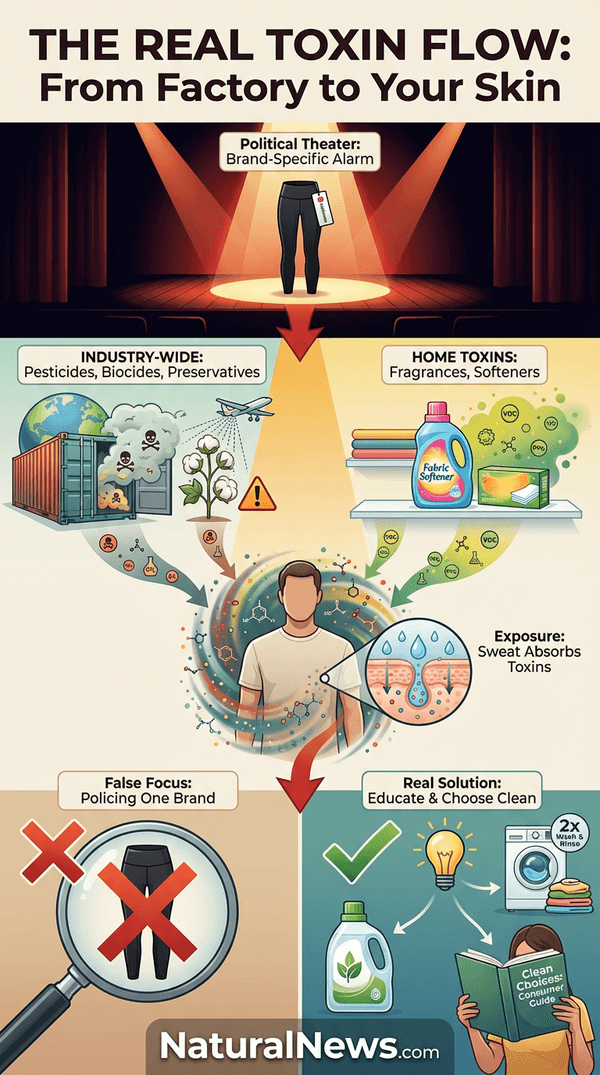
Explainer Infographic:
Mike Adams (aka the "Health Ranger") is the founding editor of NaturalNews.com, a best selling author (#1 best selling science book on Amazon.com called "Food Forensics"), an environmental scientist, a patent holder for a cesium radioactive isotope elimination invention, a multiple award winner for outstanding journalism, a science news publisher and influential commentator on topics ranging from science and medicine to culture and politics.
Mike Adams also serves as the lab science director of an internationally accredited (ISO 17025) analytical laboratory known as CWC Labs. There, he was awarded a Certificate of Excellence for achieving extremely high accuracy in the analysis of toxic elements in unknown water samples using ICP-MS instrumentation.
In his laboratory research, Adams has made numerous food safety breakthroughs such as revealing rice protein products imported from Asia to be contaminated with toxic heavy metals like lead, cadmium and tungsten. Adams was the first food science researcher to document high levels of tungsten in superfoods. He also discovered over 11 ppm lead in imported mangosteen powder, and led an industry-wide voluntary agreement to limit heavy metals in rice protein products.
Adams has also helped defend the rights of home gardeners and protect the medical freedom rights of parents. Adams is widely recognized to have made a remarkable global impact on issues like GMOs, vaccines, nutrition therapies, human consciousness.












Please contact us for more information.


