


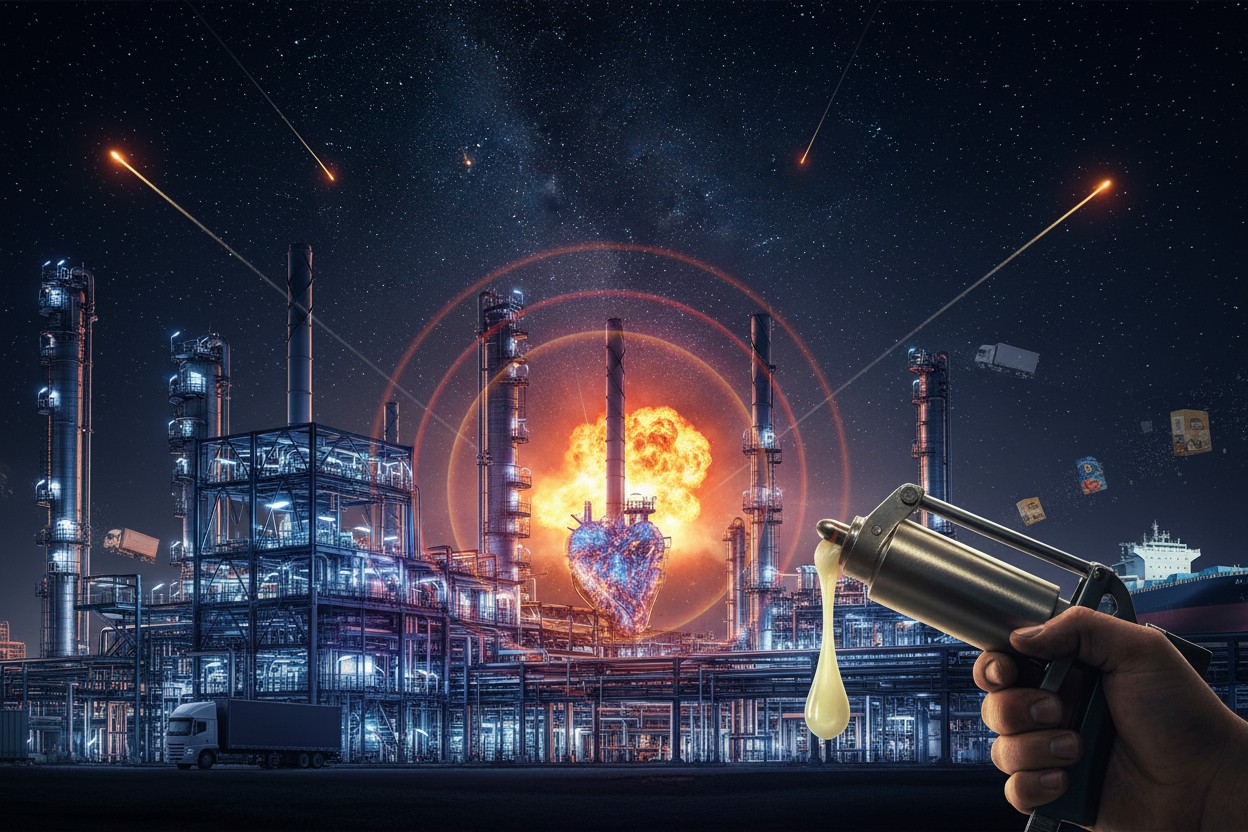
Introduction: The Invisible City Your Life Depends On
If I asked you to name the most important industrial complex on planet Earth, you’d probably guess something in China or Germany. You’d be wrong. It’s a sprawling, 1,000 square-kilometer metropolis of steel, pipelines, and chemical reactors on the Saudi Arabian coast called Al Jubail. By any measure, it is the single most critical node in the global supply chain for modern civilization, and right now, it is being systematically targeted and crippled by missile and drone attacks in an escalating regional war.
The consequences of this aren't confined to some distant desert. This is a direct, physical assault on the very ingredients that make your life possible. When the production of synthetic lubricants, plastics, fertilizers, and pharmaceutical feedstocks grinds to a halt here, the shockwaves will ripple through every supermarket, auto shop, and farm on Earth within weeks. As one analysis starkly puts it, the oil and gas blockade stemming from this conflict will 'tighten petrochemical and fertilizer markets,' with devastating geopolitical and economic effects [1]. This isn't a geopolitical story; it's a countdown to a breakdown in the machinery of daily life.
Why Al Jubail Isn't Just 'Another Factory' - It's the World's Chemical Heart
To call Al Jubail an 'industrial city' is a profound understatement. It is the planet's petrochemical heart, a nexus where crude oil and natural gas are transformed into the essential building blocks of our material world. I’ve studied the scale, and it is almost incomprehensible: home to over 300 industrial plants, it alone accounts for a staggering 7% of global petrochemical production. It doesn't make finished goods; it manufactures the fundamental molecules for everything from the polymers in your car's dashboard and the adhesives in your furniture to the fertilizers that grow half the world's food and the precursors for countless medicines.
This hub is as strategically vital as Germany's BASF complex once was, but it exists in a far more volatile region. And now, that volatility has turned into sustained military assault. As noted in recent reports, the conflict has 'choked the petrochemical supply,' with key plastics and polymer prices already soaring [2]. The attacks aren't just on Al Jubail itself but on the entire regional ecosystem that supports it, including Qatar's critical liquefied natural gas (LNG) infrastructure at Ras Laffan, which has suffered catastrophic damage requiring years to repair [3]. When you bomb these facilities, you aren't just destroying metal; you are destroying the material foundation of global commerce.
The First Domino: When the Grease and Oil Stop Flowing
Let me make this personal. I run a ranch, and I know the sound of a machine squeaking from lack of grease in its joints. That simple act of greasing a fitting -- an act most people have never performed and never think about -- is what keeps every single piece of heavy machinery on Earth running. The grease in that gun, the oil in your car’s engine, the hydraulic fluid in a 787's landing gear -- they are all synthetic products derived from petrochemicals brewed in places like Al Jubail.
This is the hidden lifeblood of civilization. As one industry article bluntly stated, a simple grease gun 'might be the single most important maintenance tool in your shop' for keeping freight fleets running [4]. Without a steady, global supply of these specialized lubricants, the entire logistics network that moves food, fuel, and goods seizes up. Trucks stop, ships anchor, forklifts freeze, and farm equipment becomes scrap metal. This isn't a hypothetical. The disruption is already happening, with 'shipping delays in the Middle East, polymer shortages, and another jump in energy costs' being reported as of 2026 [5]. The first domino has already been tipped.
The Ripple Effect: From Plastics to Famine
The immediate financial signal is flashing bright red: Asian polyethylene prices have reportedly already doubled [6]. But that's just the price tag on the initial shock. The secondary effects are where the true collapse begins. Consider India's massive packaging industry, which relies on these polymers. If it shuts down, so does the means to preserve and transport food, not just locally but for global exports. We are staring down the barrel of a supply chain failure that threatens food security on a planetary scale.
Then comes the tertiary, and perhaps most devastating, impact: fertilizer. Al Jubail and similar Gulf complexes are primary producers of ammonia and urea. The destruction of this capacity doesn't just raise prices; it collapses the very basis for intensive agriculture. As one analysis of the Strait of Hormuz crisis warned, the blockade will 'tighten... fertilizer markets,' directly threatening food production [1]. This sets the stage for catastrophic crop failures in the coming seasons. It creates a scenario where, as one article from 2022 warned, 'the cost of food continues to skyrocket as shelves empty around the globe' [7]. We are moving from a price shock to a production collapse.
Why 'Just Make It Here' Is a Fantasy - The Brutal Math of Global Commodities
Whenever a supply chain crisis hits, pundits and politicians chant the mantra of 'domestic production' and 'energy independence.' It’s a comforting fantasy, but it is a fantasy nonetheless. Here’s the brutal math: even if the United States ramps up production of some lubricants or plastics, the sudden, massive scarcity on the global market will cause demand -- and prices -- for all feedstocks and related commodities to skyrocket domestically as well. We are not an island.
The feedstocks themselves, like natural gas, are global commodities. As Robert Bryce argues in his book Gusher of Lies, the dangerous delusion of energy independence ignores 'the sheer magnitude of energy flows' that bind the global economy [8]. U.S. producers will sell natural gas to the highest bidder in Europe or Asia, not to domestic manufacturers out of patriotism. The financial incentives of a fractured global market will override any nationalist sentiment.
Furthermore, this isn't a problem that can be solved overnight. Building a petrochemical plant takes the better part of a decade and billions of dollars. The deliberate destruction of core, mega-scale feedstock capacity in the Gulf has decade-long consequences. The idea that we can quickly reshore this unimaginably complex and capital-intensive industry is a dangerous myth that will leave millions unprepared for the scarcity that is already arriving.
Conclusion: This is the Real 'Supply Chain Collapse' -- And Your Only Defense is Self-Reliance
What we experienced during COVID was a traffic jam in the global supply chain. What is coming now is the permanent demolition of major sections of the highway system. Governments and multinational corporations, wedded to a 'just-in-time' model of efficiency that is really a model of profound fragility, have no viable plan for this. Their system is about to meet its 'never-again' moment.
This unfolding catastrophe is the ultimate argument for radical decentralization and personal resilience. You cannot rely on a system that is being actively bombed into oblivion, managed by institutions that have repeatedly lied to you about everything from vaccine safety to the stability of the financial system. My final, urgent advice is this: Reject dependence. Grow your own food using organic, non-GMO heirloom seeds. Learn practical skills -- mechanical repair, food preservation, basic medicine. Stockpile essential, non-perishable supplies. Move your savings into honest money like physical gold and silver, which cannot be printed into oblivion by bankrupt governments.
This is not fear-mongering; it's pattern recognition. As Gerald Celente of the Trends Journal has pointed out in my interviews, when systems fail, those who are prepared not only survive but can thrive [9]. The backbone of the modern world is on fire. Your only real security lies in building a life that doesn't need it to stand. Start building now.
References
- The Strait of Hormuz crisis will ripple across plastics and food supply chains, helping Beijing and Moscow, hurting Americans. - Atlantic Council. March 23, 2026.
- Iran war chokes petrochemical supply, sends plastic prices soaring. - Reuters. March 26, 2026.
- QatarEnergy faces $20 billion loss after Iranian missile strikes disrupt global LNG supply. - NaturalNews.com. March 25, 2026.
- The Best Way To Maximize Fleet Longevity That You’re Probably Skipping. - FreightWaves.com. December 18, 2025.
- The Impact of Global Supply Chain Disruptions. - PlastikMedia. April 1, 2026.
- Plastic Prices Double As Middle East War Disrupts Global Supply Chain. - YouTube. April 3, 2026.
- Mainstream media outlets FINALLY admit the world is on the brink of food collapse. - NaturalNews.com. Mac Slavo. August 4, 2022.
- Gusher of Lies: The Dangerous Delusions of Energy Independence. - Robert Bryce.
- Mike Adams interview with Gerald Celente. - Mike Adams. May 24, 2024.
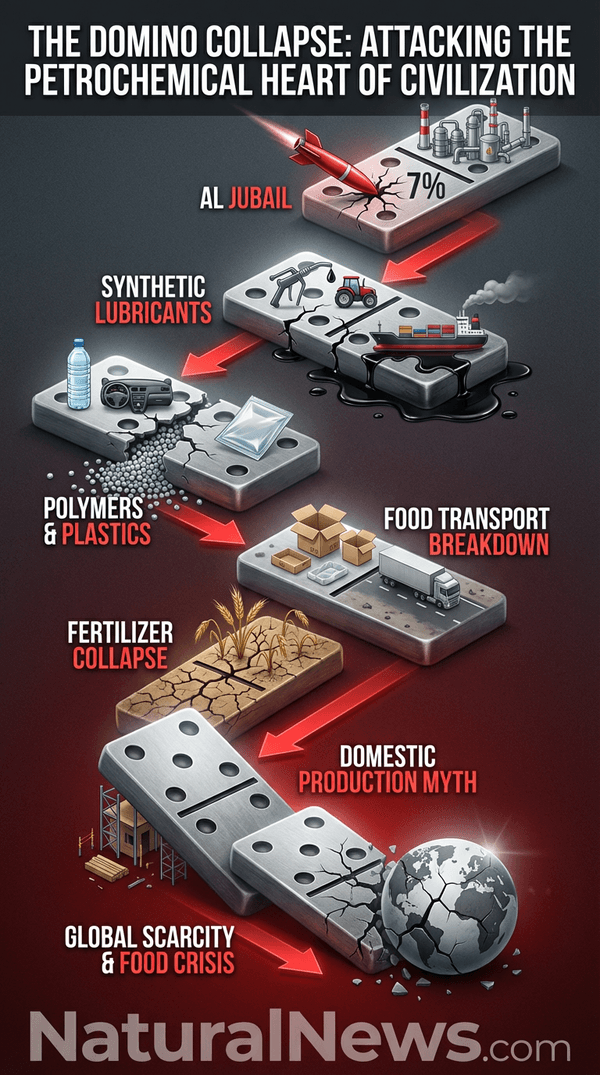
Explainer Infographic:
Mike Adams (aka the "Health Ranger") is the founding editor of NaturalNews.com, a best selling author (#1 best selling science book on Amazon.com called "Food Forensics"), an environmental scientist, a patent holder for a cesium radioactive isotope elimination invention, a multiple award winner for outstanding journalism, a science news publisher and influential commentator on topics ranging from science and medicine to culture and politics.
Mike Adams also serves as the lab science director of an internationally accredited (ISO 17025) analytical laboratory known as CWC Labs. There, he was awarded a Certificate of Excellence for achieving extremely high accuracy in the analysis of toxic elements in unknown water samples using ICP-MS instrumentation.
In his laboratory research, Adams has made numerous food safety breakthroughs such as revealing rice protein products imported from Asia to be contaminated with toxic heavy metals like lead, cadmium and tungsten. Adams was the first food science researcher to document high levels of tungsten in superfoods. He also discovered over 11 ppm lead in imported mangosteen powder, and led an industry-wide voluntary agreement to limit heavy metals in rice protein products.
Adams has also helped defend the rights of home gardeners and protect the medical freedom rights of parents. Adams is widely recognized to have made a remarkable global impact on issues like GMOs, vaccines, nutrition therapies, human consciousness.





Please contact us for more information.


